
Andrew Gardner still remembers his high school shop class on Long Island. He remembers the assignment from Mr. Kasten — build a wooden box — that resulted in Gardner receiving an F. Even as a teenager, the future seven-time world champion fish decoy carver refused to play by the rules. Instead of a box, Gardner carved a brown trout. Mr. Kasten, famed for his hard-nosed teaching, flunked Gardner for marching to his own drum.
Decades later, the black spot on Gardner’s high school report card is a distant memory, but it’s one whose butterfly effect is still rippling through the world of sportfishing today.
F is for fishing
Though Gardner, now 50, has called the west coast of Florida home for decades, memories of his childhood in New York are still vivid. He remembers Mr. Kasten’s shop class, sure. But he also remembers riding a train from Long Island into Queens to watch the Mets win the 1986 World Series. And he remembers taking the subway into Manhattan where his father, Charles Gardner, worked as an agent for outdoors and commercial artists. There, in the unlikeliest of neighborhoods for an outdoorsman, a legacy in sportfishing was born.
In the 1980s, the elder Gardner represented a slew of artists vying to make a name for themselves. The media landscape was different then, and outdoors writing was still a land of looming legends that might have considered this publication on bucket mouths lowbrow.
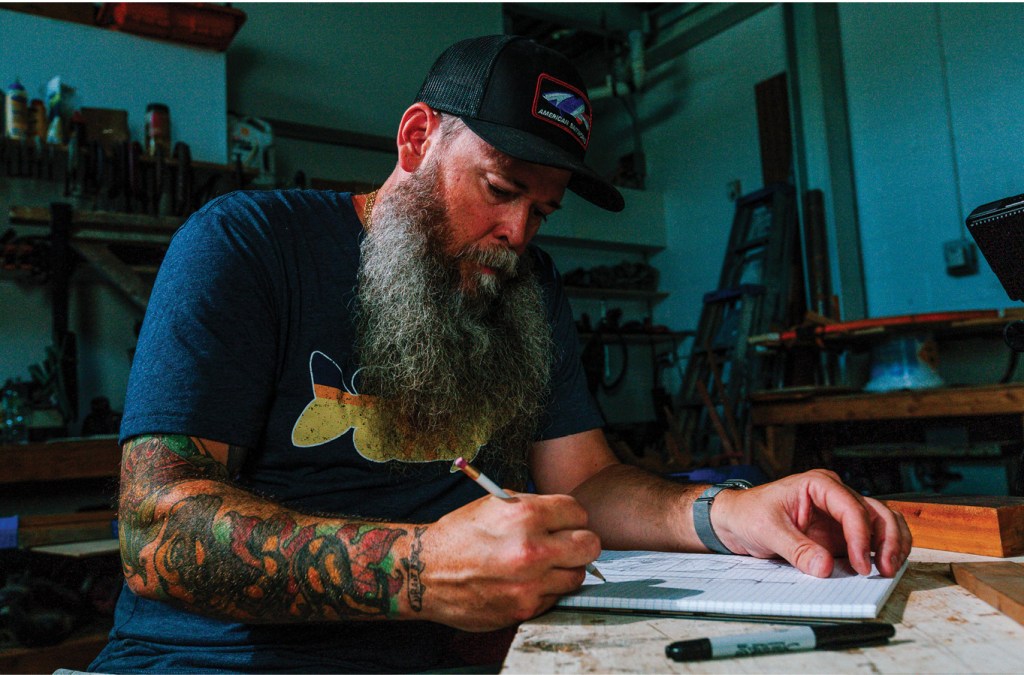
Editor’s note: See more photos from Gardner’s carving shop
Charles pitched the work of prolific outdoors artists for placement in publications like Field & Stream, Outdoor Life and Sports Afield. In between, he also deployed their brushes and pens for advertising jobs and children’s books. His Manhattan office contained a team of associates, fax machines, phone lines and printers — a fast-paced corporate playground built around business connections.
But back on Long Island, inside a woodshop not far from where Minor League Baseball’s Long Island Ducks now play, Charles sowed the slow-growing seeds of inspiration with his son. Sans internet and smartphones, the Gardners — master and apprentice — spent countless hours carving, sketching and sanding together. More often than not, their hands steadily transformed wood into wildlife. Trees transformed into life-size carvings of largemouth bass, brown trout and northern pike. Picture frames chronicled family forays onto lakes, ponds, bays and streams in pursuit of living inspiration for new paint schemes. Some of Charles’ masterpieces made their way onto Field & Stream covers or into other magazines as wood-borne tributes to the world outdoors.
By the time Andrew made it to Kasten’s shop class, he was already a published outdoors artist, too, having drawn pen-and-ink diagrams of Carolina and Texas rigs for Field & Stream at age 15. And he had little appetite for thinking inside his teacher’s box.
“Dad pulled a few strings that he really didn’t have to with some magazines,” says the younger Gardner. “So, I had my first artwork in a magazine when I was 15. They were just black-and-white drawings to show how setup was done. Back then, I didn’t take into consideration how amazing that was. I was just a kid, and art came easy to me, but in the years since, I have tried to find a copy of that first magazine, and I can’t find it … probably because they spelled my name wrong.”
Carving for championships
Andrew continued to stockpile magazine credits for a few hundred bucks a pop for several years. He served as an art director at a summer camp in upstate New York and dreamed of becoming an art teacher or a more accomplished outdoors artist. Ultimately, he fell into a career in retail management, working at grocery stores and home improvement chains.
By the early 2000s, New York’s flourishing outdoors art scene had fallen on leaner times. The digital revolution tanked the market for hand-drawn magazine art, and the Gardner family was making moves. Charles uprooted his career and became a field biologist for the Florida Fish and Wildlife Conservation Commission. Meanwhile, Andrew settled down near Weeki Wachee Springs about an hour north of Tampa.
Occasionally, Andrew would shuffle through a collection of his dad’s old art books, finding hidden treasures and techniques passed down from old masters. One such foray netted a weathered tome on woodcarving with a section devoted to fish decoys, an obscure genre of fishing tackle with roots in ancient history. In its pages, a spark was ignited.
The oldest known fish decoys predate the first Heddon lures by around 1,000 years. A millennium ago, indigenous North Americans used the hookless, carved fishing lures to attract predatory fish like pike to within spearing range. A great fishing decoy suspends in the water with delicately placed weights and makes graceful turns at the flick of a wrist. In theory, an angler could simply jig a fishing decoy through a hole in the ice and wait for a curious pike to cruise up.
Though some modern ice anglers still use fish decoys for their original purpose, the lures are largely the realm of artists today.
“I always loved functional art,” explains Andrew. “So, I started carving up some decoys. At first, they looked like crap. But I eventually found a competition in Michigan that said it was the world championship for fish decoys. I carved up four fish, packed them in my truck and drove 18 hours straight to get there.”
His eyes were opened in Michigan. Two of his fish won category awards at his first show. But Andrew says the stage was set for grander aspirations.
“I said, ‘Oh my God! This is awesome! And I took my ribbons and trophies and went home knowing I had to get better at it.”
At the time, Andrew was working 60-hour weeks at Lowe’s, cramming decoy carving into limited nights and weekends.
Any time off was devoted to the craft. Andrew dove deep into the history of fishing decoys, studying the works of Oscar W. Peterson, a prolific early 20th-century master who created more than 15,000 pieces of outdoors art — many of which are housed in the Smithsonian. Andrew made fast friends with Maurice Stiff, a surly Michigan woodcarver in his late 70s who traded thoughts, techniques and painting ideas with him. And Andrew chased an archnemesis, Harley Ragan, the modern-day Ric Flair of the fish decoy universe. Andrew worked his way toward his first world title, winning “Best Fish Decoy in the World” at the Great Lakes Fish Decoy Association (GLFDA) World Champion Fish Decoy and Carving Contest in 2010 before finally meeting Ragan.
“Harley has been carving a lot longer than me,” says Andrew. “When I saw his stuff, I knew I had to up my game because he was unbelievable.”
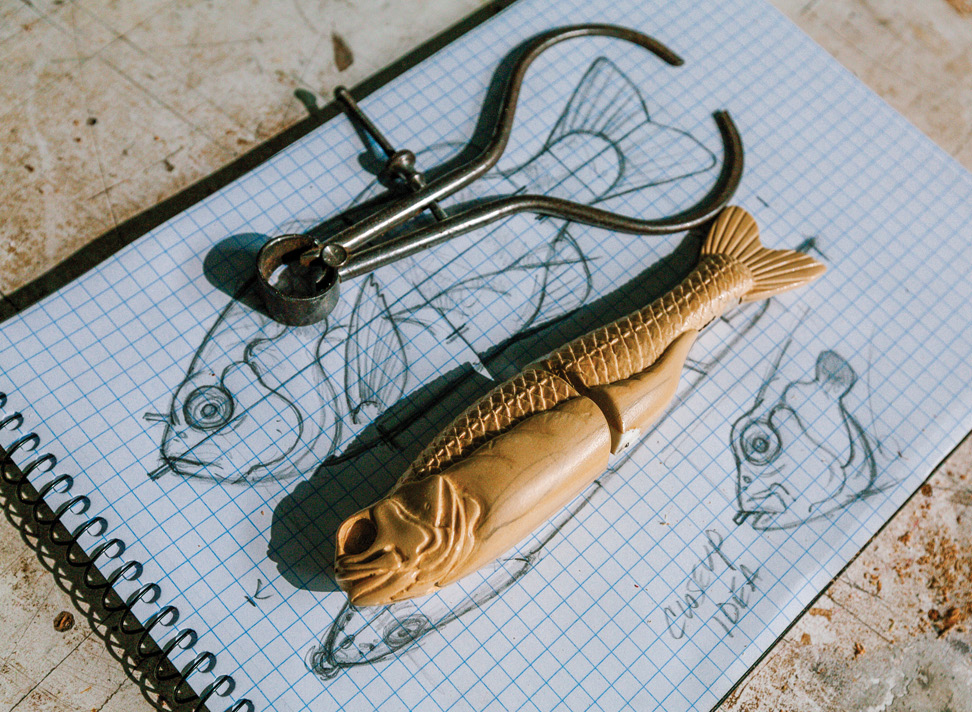
For a decade, Andrew and Ragan traded world championships like two heavyweights locked in a Saturday night feud. Ragan — the technical titan — excelled at decorative designs mimicking lifelike fish. Andrew used creativity to close the gap, at first leaning on folk art and mythical fish to wow judges while he worked toward Ragan’s level of realness.
“Carving and painting these things is easy compared to the swimming aspect,” Andrew says. “They all have to be weighted and balanced. They have to have proper fins that swim in a circle in just such a way. Those fins have to be a certain size, and the weights have to be cut and drilled into the bottom of the decoy. During competition, the decoys are placed in a 6-foot tank and put through their paces. If you do it right, all you do is jig it once and the decoy swims in almost a complete circle.”
Ragan, who already owned three world titles, took home the GLFDA’s top award in 2009, 2011 and 2012. Andrew chased him down in 2013, 2014, 2015 and 2018.
“Beating Harley in the finals for the first time was big,” Andrew adds. “It took me years to get there. I learned that if I couldn’t beat him with skill level, I had to be more creative than him. So, I would come up with really crazy ideas, like carving a crappie with a crawfish hanging out of its mouth or a frog that was a mating pair.”
Co-signing a legacy
By the mid-2010s, Andrew Gardner’s life had changed forever. And when a chance encounter with Mississippi-based American Baitworks launched him out of the retail world, fishing became a primary focus. After 20 years in a grocery store and 15 years at Lowe’s, Andrew got a chance from American Baitworks to live his version of the American Dream.
“They found me on Instagram,” says Andrew, whose account @meloshfishinglures is a great follow for anglers, artists and woodworkers. “They asked if I could help them set up a painting process to paint baits. I said I would be more interested in a full-time job, mainly so I could get my creations into more people’s hands.”
At American Baitworks, Andrew created colorways for Scum Frog and Snag Proof frogs, revamping the entire process for painting them. He transformed from retail manager to product designer. And he founded the Florida Fish Decoy Invitational to help grow the popularity of woodcarving among future generations.
After adding two more world championships in 2022 and 2023, Andrew decided to retire from regular competition. That year, both Stiff — Andrew’s decoy-carving running mate — and his father, Charles, passed away.
“2023 meant the most,” adds Andrew. “Dad passed away in May. Maurice left us in July, just before the world championship in September.”
For 2023, the GLFDA World Champion Fish Decoy and Carving Contest relocated to Cadillac, Mich. — Oscar Peterson’s hometown. Andrew says the continent’s greatest decoy carvers all showed up to compete in honor of the icon, more than 450 artists in total. The gathering represented nearly double the number of competitors that show up most years. And in the bedlam, a silver lining accompanied another championship for Andrew.
During competition, Andrew found out that his wildest dream was about to come true. The seven-time world champion was going to have his own line of fishing lures through American Baitworks.
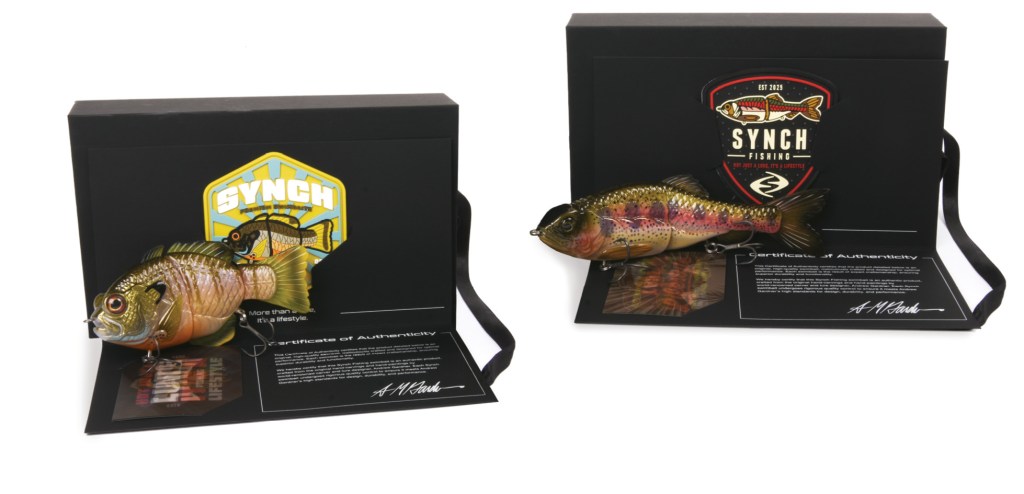
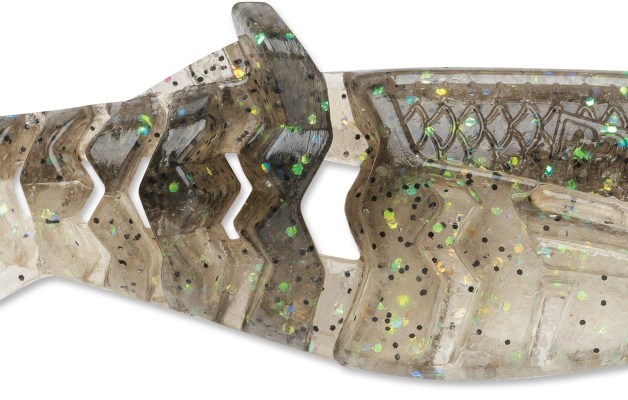
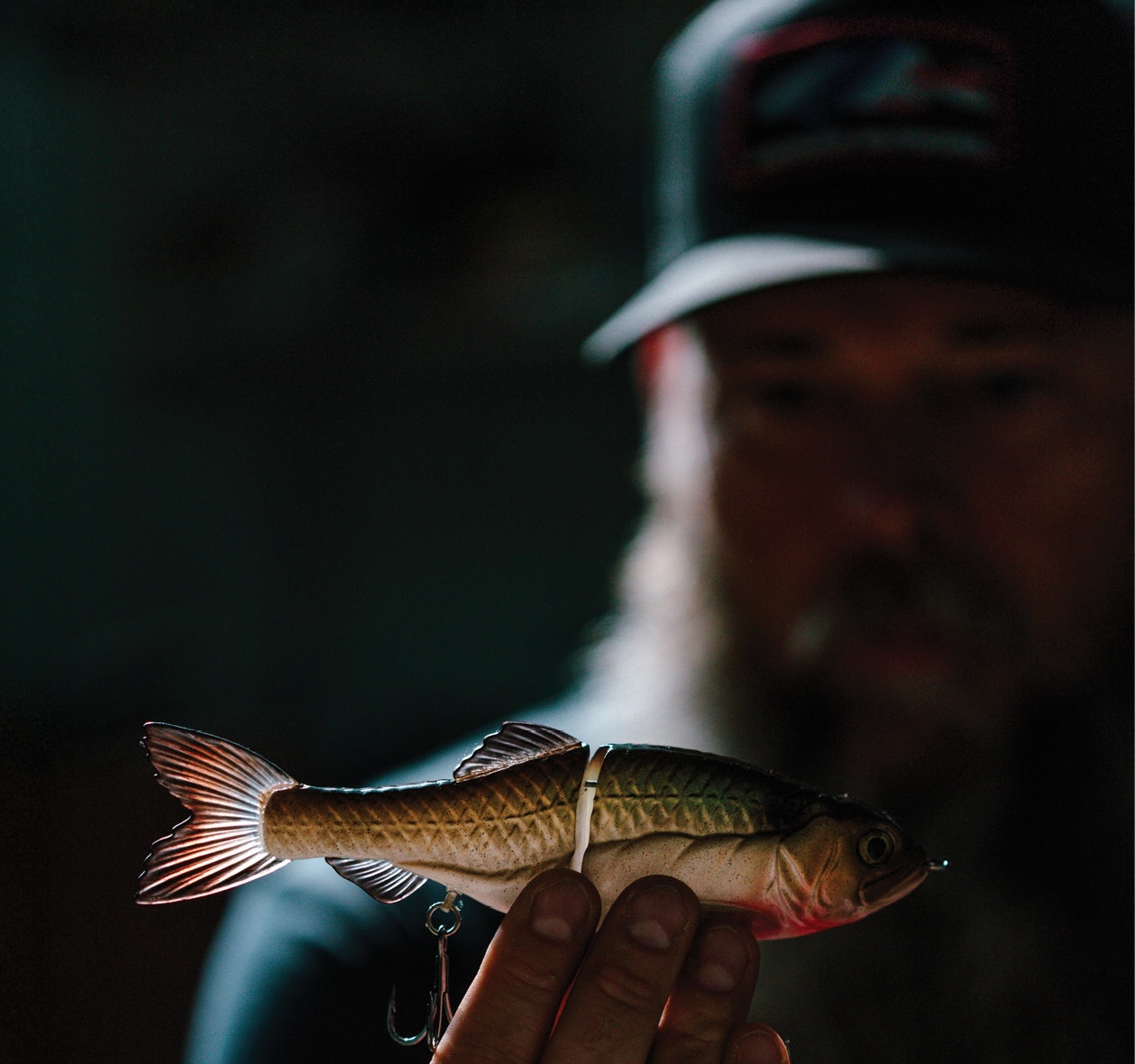
Synch Fishing launched in October 2025, just over two years from Andrew’s final world championship and more than three decades after Mr. Kasten gave him an F in shop class for crafting a fish instead of a box. The entire brand is built from Andrew’s woodcarvings. Its initial lineup features a swimbait and glidebait created straight from the master carver’s hands, using skills honed in his father’s workshop on Long Island and refined through years of competition against the best modern artists of an ancient craft.
After leaving Andrew’s shop, Synch’s wooden models are scanned in 3D and turned into working prototypes. Once complete, the lures are methodically colored and shipped with a certificate of authenticity before being placed on store shelves.
“Everything is coming to fruition for me,” Andrew says. “This was my dream. When people ask me what I do, I just tell them I am living my dream. I can’t ask for anything better in my life.”
Originally appeared in Bassmaster Magazine 2026.