As the emergence of artificial intelligence has thrust AI into the public consciousness, anglers are now facing opportunities to use the new technology on the water. In the past two years, consumer-facing AI has grown from the playground of ChatGPT-powered school papers into a fully-fledged leviathan. Search engine results, customer service chats, viral memes and even official videos from the White House are now being produced by AI.
So, too, are angling technologies that promise to solve the age-old riddles of where to find fish and how to catch them.
While AI may seem like a magic button to solve all of the riddles of humanity, the cost of that technology is increasingly coming with a price tag in electricity and freshwater. A recent study from the University of California-Riverside estimated that an AI chat session with around 20 queries requires a full bottle of freshwater to cool the computing hardware that powers the system. And generative AI features like photo and video creation require magnitudes more.
Our questions, memes and entertainment are now placing an increased load on water supplies. New data centers in nearly every region of the United States are making that demand a local problem.
“What goes unacknowledged, from a natural systems perspective, is that all water is local,” said Peter Colohan, director of partnerships and program innovation at the Lincoln Institute of Land Policy, in a recent Lincoln Institute article. The Lincoln Institute of Land Policy is a nonprofit research group focused on global land use. “It’s a small amount of water for a few queries, but it’s all being taken from one basin where that data center is located — that’s thousands of gallons of water being drawn from a place from people doing their AI queries all over the world. Wherever they choose to put a data center, it is like a giant soda straw sucking water out of that basin.”
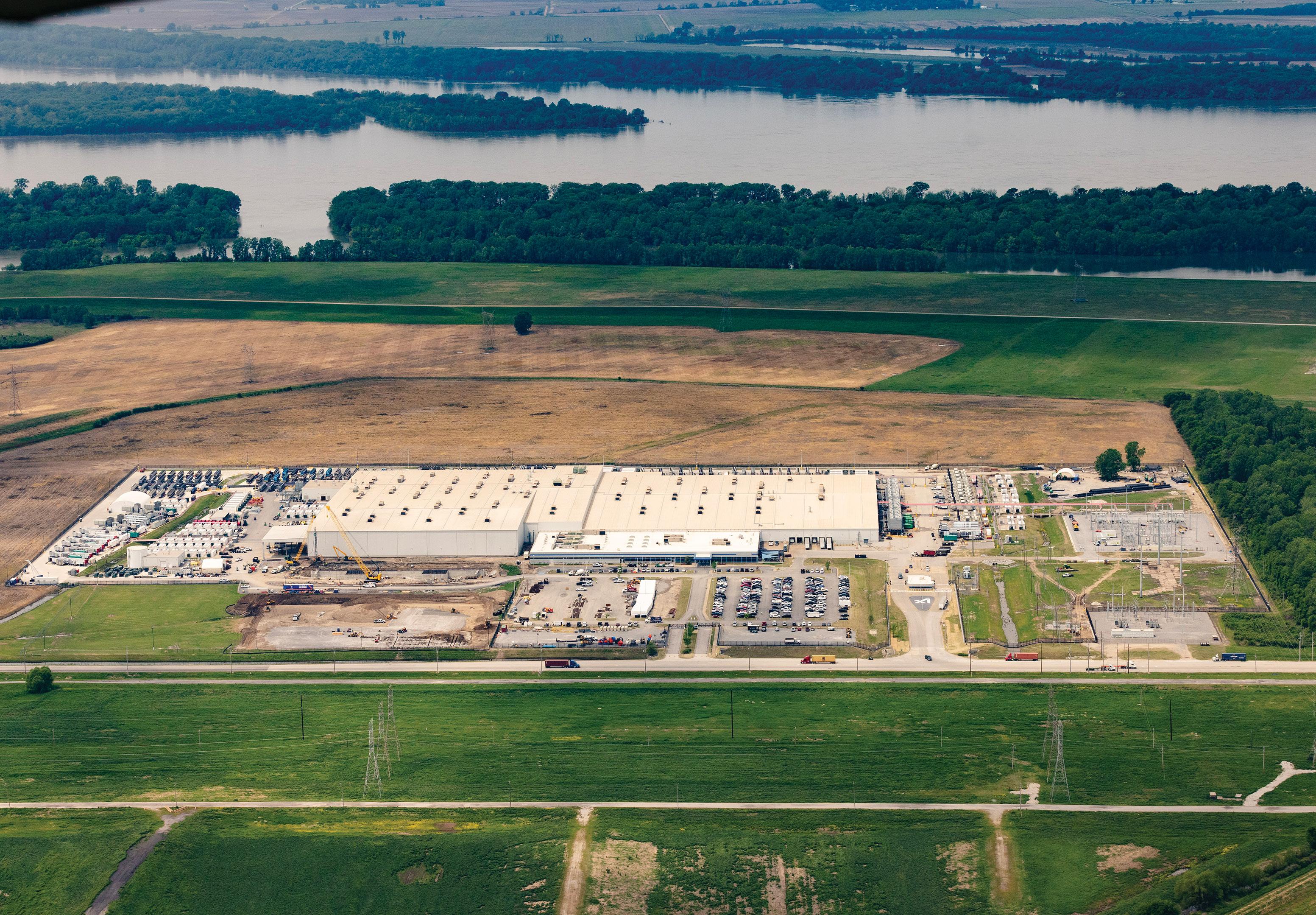
According to International Energy Agency data, a conventional data center can consume as much electricity as 10,000 to 25,000 households. And newer, AI-focused data centers and supercomputers — like xAI’s Colossus in Tennessee and another major facility in Mississippi and Meta’s Hyperion data center being constructed in Louisiana — could draw more power than 100,000 households, increasing utility bills in affected regions.
Data centers can also use billions of gallons of water per year for cooling. These centers house server stacks, which output incredible heat. Most centers use cost-effective, evaporating cooling methods to keep those servers from becoming overheated and damaged. While many data centers do use reclaimed or recycled water for parts of this process, the evaporative cooling means much of the water used to cool data centers simply dissipates into thin air. That means even data centers recycling their cooling water must also draw from freshwater sources like aquifers and watersheds.
Water use is forecast to increase, too. In 2023, Google reported using more than 6 billion gallons of water to cool its data centers, 31% of which was taken from freshwater withdrawals in watersheds with a medium or high water scarcity. In 2024, xAI updated its Memphis-area estimates to more than 5 million gallons of water per day for Colossus. And in early 2026, the Houston Advanced Research Center (HARC) released a white paper estimating that data centers in the Lone Star State use 25 billion gallons of water per year. HARC projected that by 2030 the annual total could rise to as much as 161 billion gallons. That’s about as much water as it would take to fill 244,000 Olympic swimming pools — enough pools to cover more than 100 square miles if they were continuously built end-to-end, side-by-side.
In many cases, AI data centers are popping up in economically depressed regions that may be unaware of the natural resources at stake. However, it’s now known that data centers don’t tend to create many long-lasting jobs. A data center requiring 1,500 construction workers, for instance, might employ only 50 full-time workers once operational.
Increasingly, communities are pushing back.
In a September 2025 Plan Commission meeting, residents of Caledonia, Wis., drew a line in the sand just 11 miles from the company headquarters of Minn Kota. During a public comment period, 40 of 49 commenters voiced their opposition to a Microsoft bid to rezone 244 acres of agricultural land for a data center near Lake Michigan. The move caused the world’s third-most valuable company to walk away days later.
Microsoft’s Caledonia project was part of a massive pushback on data centers in 2025, according to Data Center Watch. Between April and June of last year — the organization’s last reporting period — 20 data center proposals valued at $98 billion in 11 states were blocked or delayed by local opposition and state-level pushback.
“Couple this boom with climate change and long-term droughts in some regions, and you get a recipe for disaster from a fish’s viewpoint,” says B.A.S.S. Conservation Director Gene Gilliland. “Technological solutions to mitigate loss and public engagement on when and where data centers are located need to be included when discussing impacts [to] fish and fisheries.” While B.A.S.S. conservation partners like the American Sportfishing Association, Congressional Sportsmen’s Foundation and Theodore Roosevelt Conservation Partnership escalate monitoring of data center locations, bass anglers can also step up in their local communities. As was seen in Caledonia, small, organized conservation efforts do make a difference. And across the board, anglers can all be mindful of online habits that increase the burden placed on water supplies vital to the health of our sport.