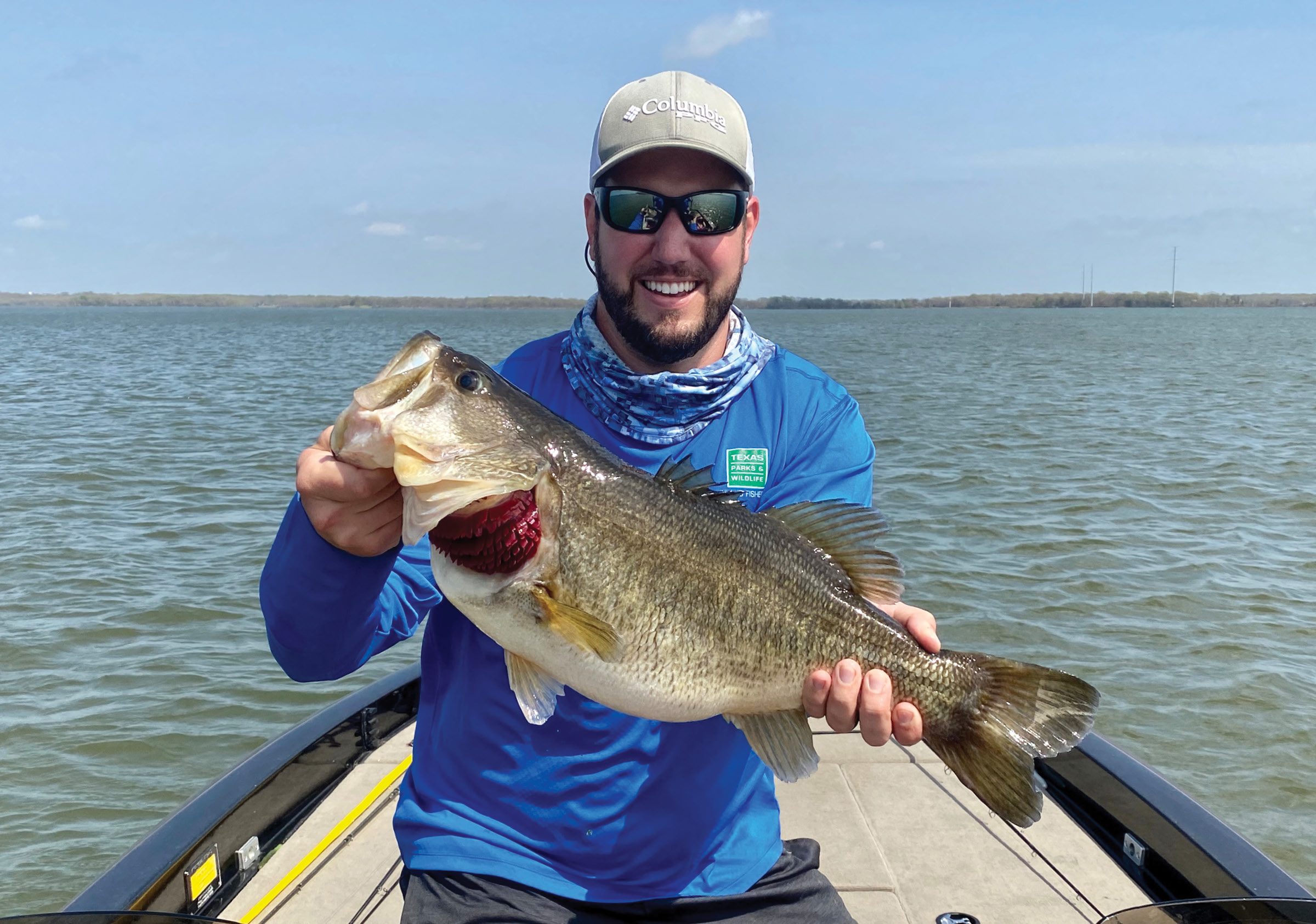

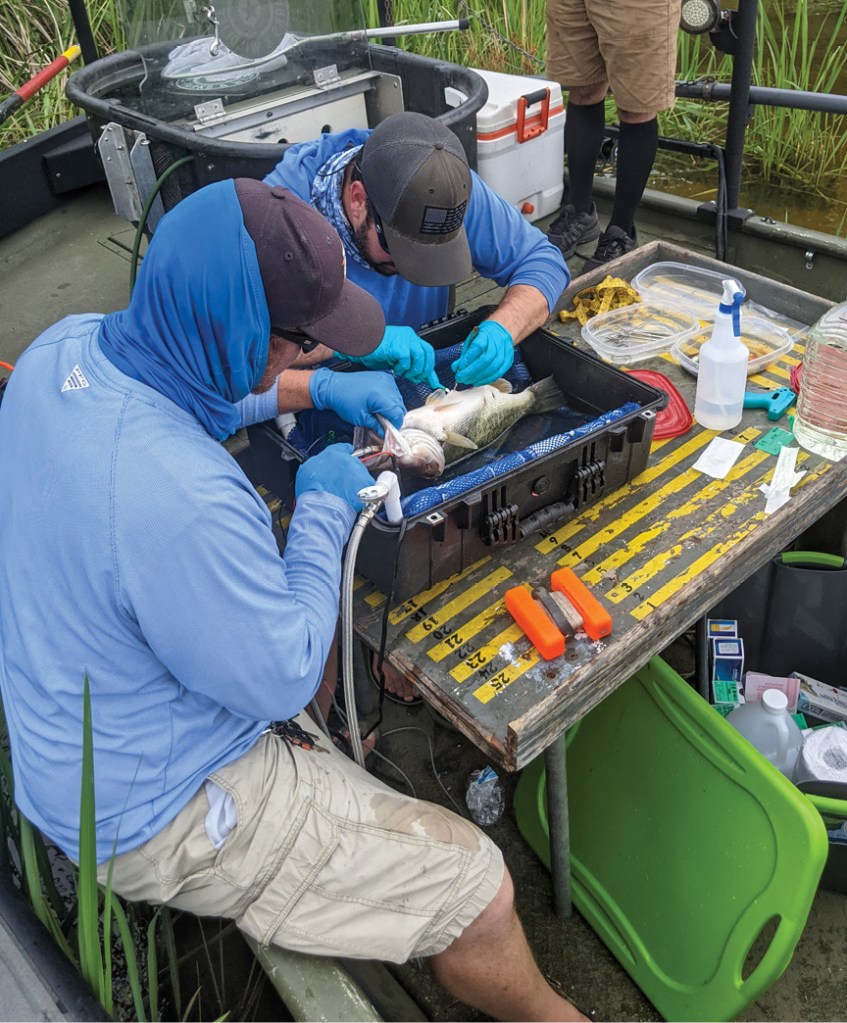
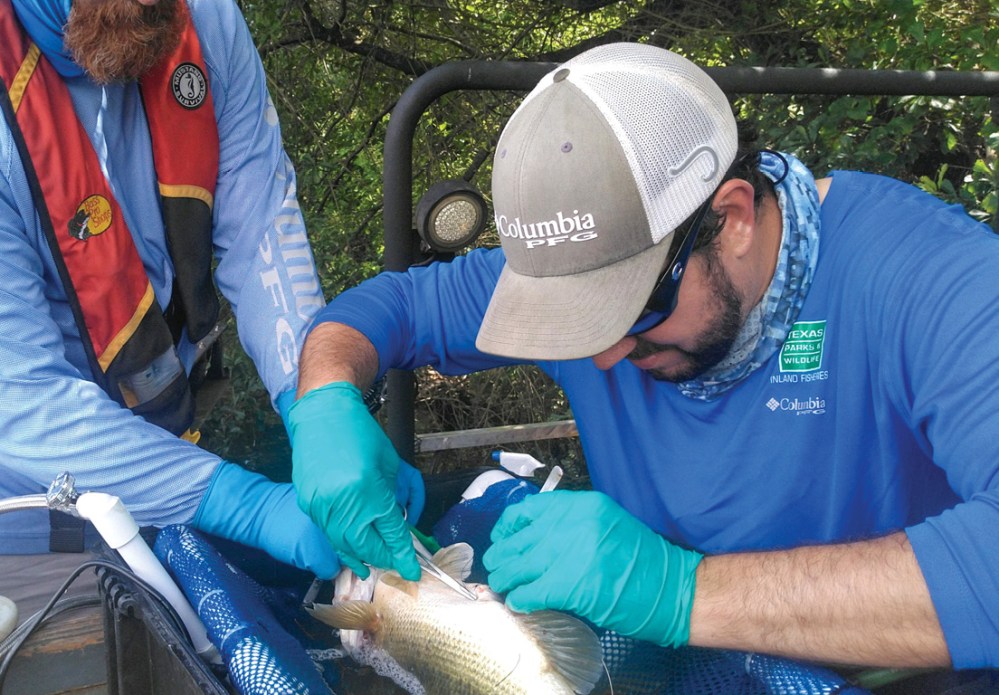
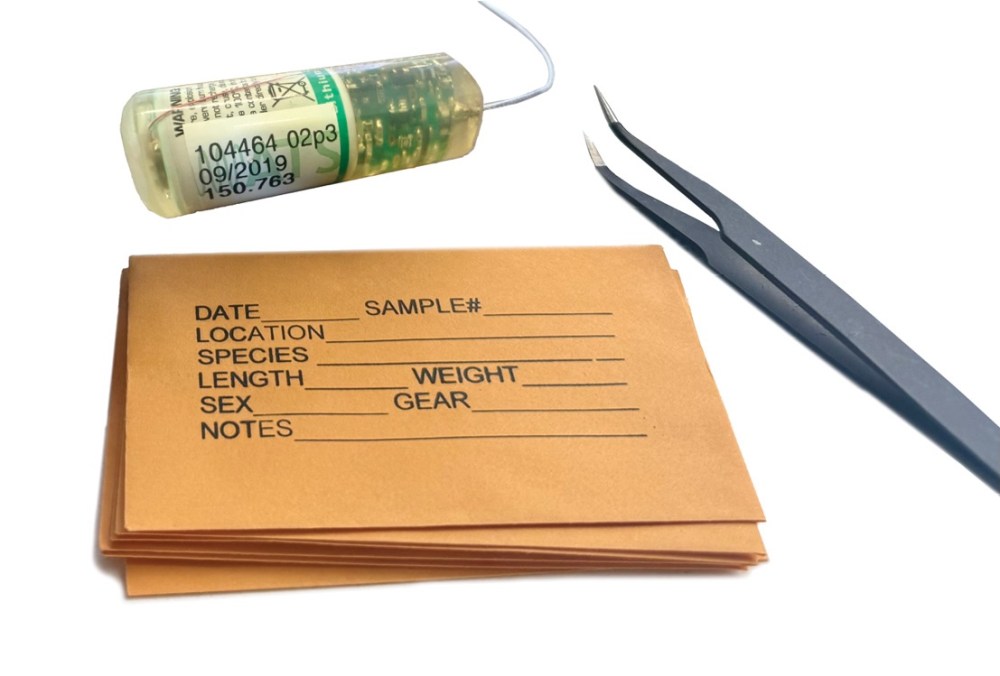
The surgery takes about five minutes. As soon as the fish clears the gunwale, the surgeons swap rods and reels for scalpels and stitches. As carefully and quickly as possible, they cradle the largemouth bass, place it under electro-anesthesia with a low-voltage current, pump oxygen-rich water over its gills and set to work implanting a telemetry device into its belly.
For the fish, the process must feel like an alien abduction. For fisheries biologists at the Texas Parks & Wildlife Department (TPWD), it’s a critical step toward research.
Within minutes, the fish is released back into one of the country’s most famous fisheries, Lake Fork. Repeated dozens of times over, the procedure helps create a data set for researchers with the state fish and wildlife agency to study. The goal? To better understand how fishing patterns affect fish movement within the east Texas reservoir.
In one line: Do fish change behavior because of anglers?
For two years, biologists have played the part of surgeons on one of the best bass lakes in America. And at the head of the operating room, a lifelong bass angler with a thirst for knowledge has been calling the shots.
“The whole project was based on angler concerns,” says fisheries biologist Jake Norman, the project lead. “We did it because anglers were telling us the fishing wasn’t as good as it should have been. We went out with the mindset of trying to look at these fish in crazy, heavily pressured systems and learn if they have adapted to avoid angling in general.”
Dock talk has likely never been more widespread in the world of bass fishing. Podcasts, blogs, websites, social media posts and magazines like this one keep a constant stream of information flowing toward anglers. Algorithms direct most of the digital flow to people most likely to consume it. And while anyone with enough willpower can make a post or a podcast, it’s still up to biologists to actually manage public fisheries and use science to cut through the chatter with irrefutable facts.
On Lake Fork, common theory around a perceived drop in the quality of bass fishing has been feeding dock talk for the past several years, and Norman is on a quest to draw a hard line between gossip and reality.
Four wheels and two degrees
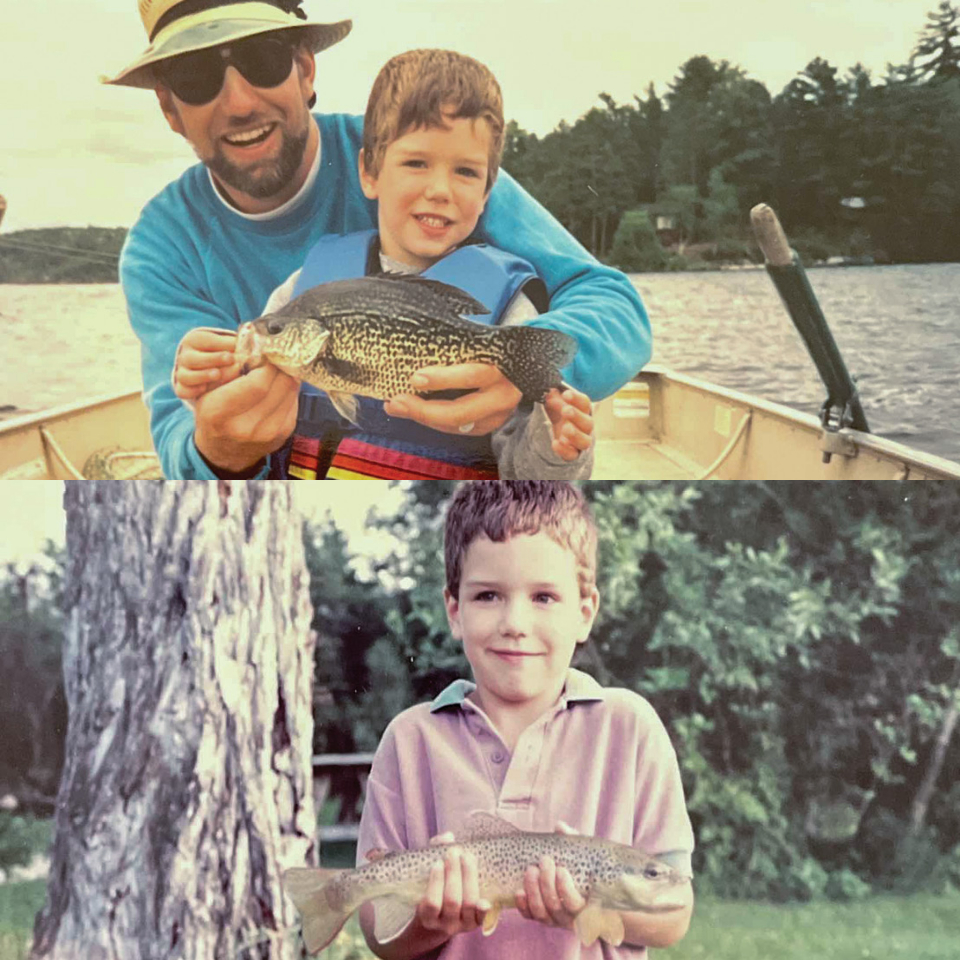
Norman grew up on the water. As a teenager, he chased bass around Lake of the Ozarks and Mark Twain Lake, within driving distance of his Grafton, Ill., hometown just north and over the Mississippi River from St. Louis. There, he fostered a true love of bass that extended beyond the adrenaline of a hook set or the thrill of boating a personal best.
Norman loved bass fishing. But he had his sights set on grander dreams. He wanted to move to Texas and find answers in the land of giants.
“Even in high school, I knew what I wanted to do,” says Norman, now age 40. “Before that, I was a little kid just fishing constantly. It became an obsession of mine. By age 6 or 8, I was out in the yard practicing with a fishing rod all of the time. By high school, I was telling the guidance counselor that I wanted to be a fish biologist, and they had no clue what I was talking about.”
At Jersey Community High School, counselors heard Norman’s rhythm but failed to understand his rhyme. They told him to consider joining the National Park Service as a park ranger. While an admirable pursuit, the young bass-head knew his mind craved a career that focused almost exclusively on one animal. He wanted to really delve into the biology of a bass, to try to understand the fish on an intimate, molecular level.
To chase his childhood dream, Norman needed to earn qualifications beyond a high school diploma. And it would take years of study to acquire them. Like most scientific fields, fisheries management is a career tightly tethered to academia. Without certain collegiate degrees, it can be difficult to even get a foot in the door.
First, Norman pursued a bachelor’s degree in fisheries and wildlife at the University of Missouri, just down the road in Columbia. Then, he attended Southern Illinois University to pursue a master’s degree in zoology, specializing in fisheries science and management. Though he didn’t technically graduate until May 2013, by the end of 2012, Norman was on the hunt for his first job in his dream field.
In a normal economy, that pursuit might have been easy. In 2012, competition was fierce.
The sailing wasn’t smooth. Fourteen years ago, Carly Rae Jepsen’s “Call Me Maybe” was topping the pop charts. Instagram had just 30 million users, compared to 3 billion today. At the time, the United States was still recovering from the Great Recession, filling the job market with hordes of fresh graduates.
“The market was pretty flooded back then,” Norman explains. “If you wanted to get in somewhere, you needed to be willing to relocate and do whatever else you could. So, job applications were literally a shotgun blast for me. I was applying for vacancies that I was quasi-qualified for, and Texas was one of them. My dad and friends had spent a week on Lake Fork fishing, so I knew the area a little bit. Obviously, I was familiar with Fork and its reputation. And I thought, ‘Good Lord. This would be a dream.’”
Norman’s application secured an interview with TPWD. Two weeks later, he was in a gold Toyota Camry packed to the gills for a 10-hour road trip to Tyler, Texas. The finish line promised a start in his dream field and a role as an assistant district biologist in an area that included Lake Fork.
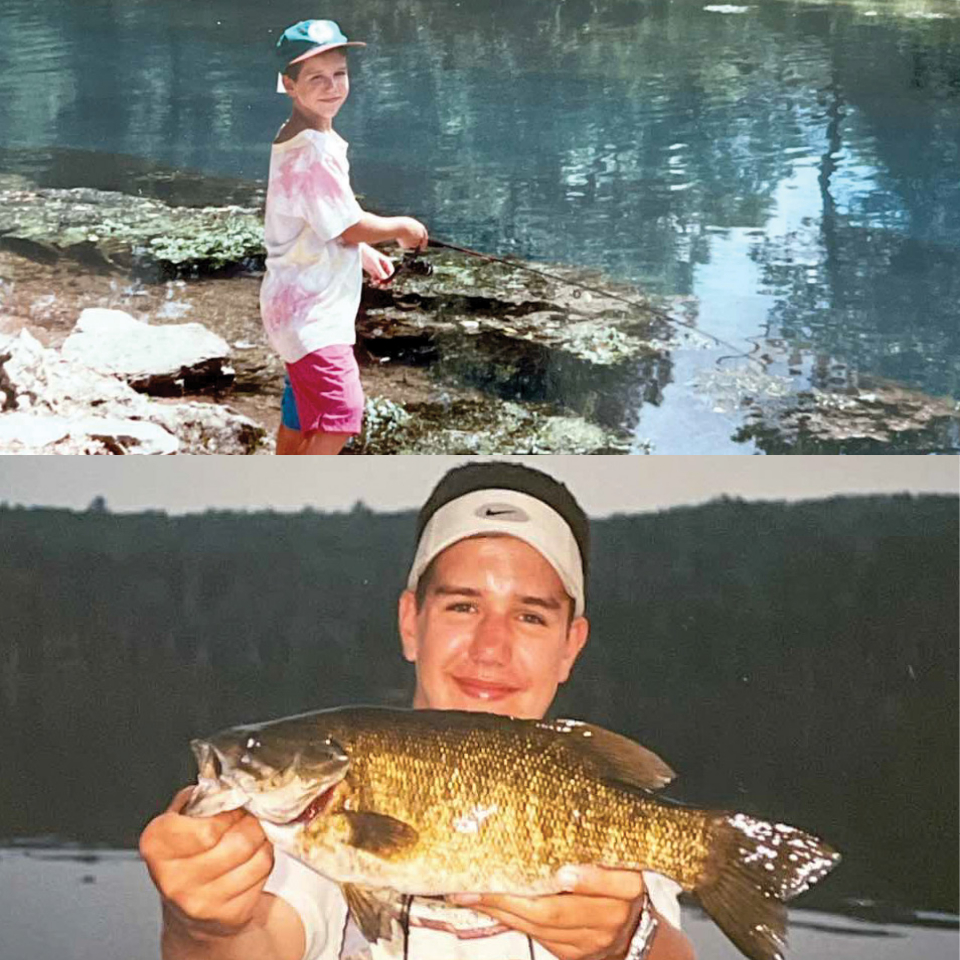
“I remember scrolling through my phone and seeing pictures of giant fish caught in Texas,” Norman says. “I couldn’t believe I was moving to one of the best places in the country for trophy bass, and not only was I going to get to fish in my free time, I was going to be working with them to know the lakes better and learn more about everything that makes them tick.”
On arrival, Norman immediately fell in love with his adopted home. Everything seemed like a bigger, grander version of the Ozark lakes he trained on as a young man.
Immediately, Norman rented an apartment. He started fishing, and he started helping TPWD in the field. On one of his first assignments, the Camry parked on the boat ramp gave away his outsider status.
“It didn’t take long for people to ask me if I was from around there,” he says with a laugh.
Texas, Norman learned, would take some time to adjust to the Midwestern scientist.
A day in the office
More than a decade after that first assignment, Norman has swapped his Camry for a GMC truck, and he has upgraded his title to District Supervisor Inland Fisheries Region 3. That region includes 14 counties full of waterways that all need monitoring, stocking, sampling and more management 365 days out of the year.
He’s happily married to a Texan that he met in the apartment complex where he lived on his very first assignment. And he’s the father of two children that proudly call the Lone Star State home. Norman also now oversees two other biologists and four technicians — the ones most recently putting in hours on Lake Fork.
On most days, the glamour of field work on the water is eclipsed by the reality of his position. He spends a ton of time on the phone, handling public inquiries from people like marina and campground owners, private property owners with lakeside residences and everyday anglers. He also spends a countless number of hours compiling and poring over fish-sampling data to put together new management plans for two dozen large bodies of water that all require updating every four years.
Occasionally, he still gets to participate in field work, where the tools of the trade shift from spreadsheets and conference calls back to fishing shirts and a tacklebox.
Outside of telemetry, his team is busy with other projects that include habitat restoration (“carpet bombing shorelines” with several thousand Christmas trees), vegetation management and property owner outreach.
“Most of the residents along the lakes really want the opposite of what we want as biologists and anglers,” explains Norman. He says it’s part of his job to help them find a middle ground with anglers.
“People that live on lakes here are usually pretty successful, pretty powerful people that in the big picture are accustomed to getting exactly what they want. So when they move to the lake, they may say that the vegetation is an eyesore or that their grandkids can’t swim or that they can’t get their boat out or that it attracts snakes and needs to go. We then have to say that it’s a public water body, that vegetation is critical. Vegetation is a golden ticket for lakes to have stable, quality bass populations.”
Norman says Lake Fork alone generates around $10 million in direct expenditures from anglers each year. That kind of economic weight means updating legislators on goings on around the lake, as well as policies that might impact fisheries management.
In the long term, all of that work goes to improve every angler’s day on the water in east Texas.
Telemetry tells the tale
Around Lake Fork, the results of the telemetry study are beginning to reshape the understanding of resident bass. The Lake Fork results, combined with results from a counterpart study on Toledo Bend led by recently retired biologist Todd Driscoll, have already been published once, with another paper slated to appear in the North American Journal of Fisheries Management later this year. The effort concluded that the east Texas bass are not nearly as migratory as dock talk chatter suggests.
For 24 months, Norman’s team looked for seasonal movements, habitat changes and baitfish migrations when conducting their research. They analyzed boat sounds. They scoured shallow waters and offshore no man’s land. They fished community holes and secret backwaters. They checked on telemetry transmitters every other week, meticulously documenting the movements of 37 individual bass.
When the data was finally analyzed, the biologists produced a manuscript with a conclusion based in science.
Unlike most blog posts, podcasts and social media videos, the conclusions rely on concrete evidence that’s collected using the scientific method. The data is reviewed by qualified experts from around the world and passes through multiple review cycles before publication in a journal. A typical scientific manuscript can take years to properly document and print all of the data.
The exhaustive process is one reason that scientific journals are still the gold standard for researchers, though Norman admits they’re not widely read by everyday anglers. To reach the masses, biologists still need to collaborate with media outlets of all forms.
Results of the recent study offer a glimpse at how bass respond to angler presence on a heavily pressured reservoir. Not surprisingly, they’re very aware. “About half of the fish we looked at reacted to boat noise before we ever put the trolling motor in the water,” Norman says.
The study also found that the average bass on Lake Fork only utilizes about 100 acres per year. It also found that bass move minimally between staging areas. The researchers did not find evidence of large-scale bass migrations between seasons. Though shad moved in and out of pockets and creeks, the bass feeding on them appear to simply be the resident population of the area — homebodies.
That conclusion may sound mundane, but for researchers it’s the kind of hard evidence that fuels their dreams. It’s the ultimate victory … the definitive answer to a question.
Today, Norman is no longer chasing his dream — he’s living it. The Illinois transplant has no plans to relocate away from east Texas, though his accent still sometimes raises eyebrows on the boat ramp.
Originally appeared in Bassmaster Magazine 2026.