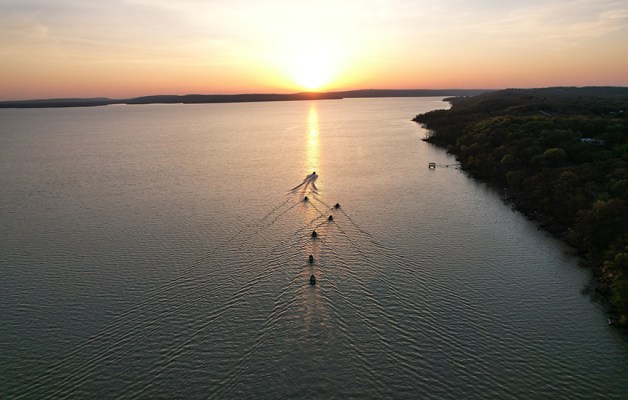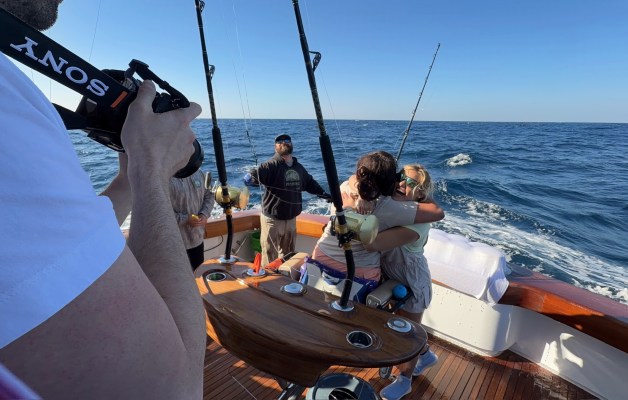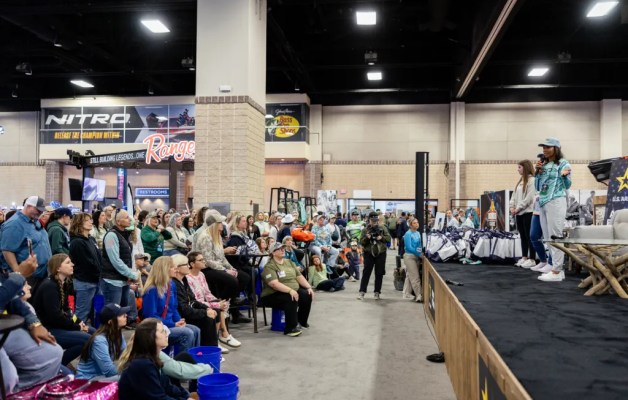
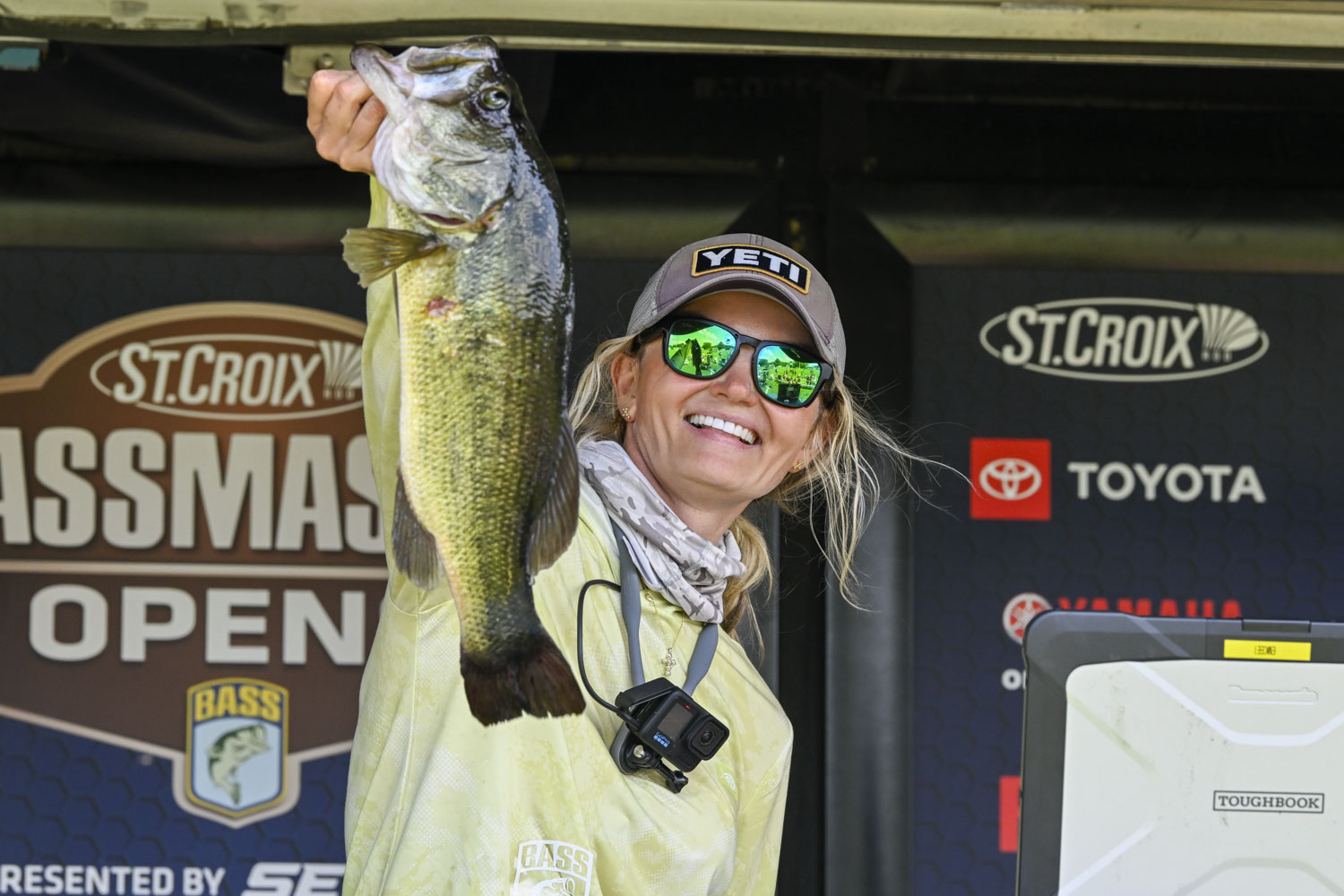
Not long into her first day as a Bassmaster Open’s angler, Kristine Fischer thought she had shaken off the morning jitters. She had made it through takeoff at Clarks Hill without a hitch, and two keeper bass were already in her livewell.
After firing up the outboard and moving to another spot, Fischer heard a strange noise coming from the back deck. It was the bass flopping around an empty livewell she knew she had filled up.
“I was like, what the heck?” the Nebraska native said. “I put water back in it, ran again and it was empty again.”
Upon further investigation, Fischer had forgotten to put the drain plug in her livewells, causing them to drain while she was running. Luckily, she noticed it before it was too late, just one of many lessons learned on the job.
After finishing 92nd in the Division 1 standings last season, the renowned kayak competitor will be fishing Division 2 of the 2026 Turtlebox Bassmaster Open presented by Battery Tender with the goal of finishing above 50th place in points and qualifying for the Nitro Boats Elite Qualifier Series presented by Bass Pro Shops in just her second season.
“I want to make the EQs. I would have a lot to improve,” she said. “I’m going to work my butt off to try to do it.”
Prior to the start of the 2025 season, the now 38-year-old had never fished a bass boat tournament as the captain, and while she knew it would take a little while to get used to her aluminum Ranger, she figured jumping in headfirst was the best way to challenge herself.
“I don’t do anything small. I jumped right in, and I knew that was going to be a challenge,” Fischer said. “The Opens is some of the best competition in the sport right now. For me, I love that. There is a larger percentage of people who are fishing for winning bass.”
There were plenty of nerves in preparation for her debut, but all of that melted away once she got on the water.
“When I got out there (at Clarks Hill), the nerves kind of melted away and I realized it was everything I wanted,” Fischer said. “Jumping into that kind of competition, it reignited that anxious wonder and excitement for a big tournament. I remember looking out and seeing all the rigs with Elite level competitors; I was overwhelmed and humbled to have the opportunity to fish.”
Unlike last year, the majority of the fisheries she’ll be tackling are ones she has found success on in her kayak career, and she’ll be riding in a brand new Ranger Z521. Sam Rayburn, Kentucky Lake and the Upper Mississippi River are all popular destinations for national kayak events. In fact, Kentucky Lake was where Fischer notched her first career victory.
“I’d love to cut a check this year,” Fischer said. “There were a couple of those tournaments last year where I was on the right fish and had the right bites to do a lot better. I knew I could have been up there, and I needed that confidence.”
As far as angling goes, Fischer is plenty confident in her abilities. She won her first Lady Bass Anglers Association event at Lake Seminole, for instance. But the challenges were all about getting used to the boat, how to drive it and how to fix it if and when the time came. It wasn’t until the third Open of the year in late July at the Upper Chesapeake Bay where she felt like she was in a good rhythm.
Many of the things experienced bass boat anglers take for granted are things Fischer stressed over constantly. Last year was the first year the Opens anglers were not accompanied by a co-angler, which meant Fischer would be launching, docking and parking all by herself.
“The biggest thing that intimidates most women, and new boaters, is backing the boat down and learning how to dock it,” Fischer said. “When it comes to docking the boat, that took awhile. I still can’t parallel it like a lot of people can. The most important thing I’ve learned is not doing it on the big motor and getting on the trolling motor. If you’re uncomfortable, use the trolling motor.”
What else did Fischer learn? Let’s break it down.
The fishing mechanics
Bass fishing is all about angles and positioning. Fischer’s Hobie was more or less an extension of herself. She knew exactly how she wanted it to move, what it would do in current and how she needed to be angled in order to make the perfect cast.
Fischer is still building that confidence in the bass boat.
“I’m still trying to get better. In order to get comfortable and fluid with boat positioning, which is the most important thing when fishing competitively. It takes years,” she explained. “From the first tournament to the last, it is a night-and-day difference. But, I really think it is going to take me a couple years to feel like that boat is an extension of me.”
Casting angles are much different when standing on the front deck of a boat as opposed to sitting or standing on a kayak. Using the trolling motor to swing around docks and cover, or back up out of a precarious position took a lot of getting used to. She quickly learned she isn’t nearly as stealthy in her Ranger as with her 360 Drive in the Hobie.
“When I’m fishing shallow, and I get close to something and need to flip around and go in reverse, I’m blowing that area out immediately,” she said. “I learned how much commotion the trolling motor is, and if you have it at a really high speed, it takes a lot more to slow it down and change direction than in a kayak.”
One of the biggest curves has come when utilizing forward-facing sonar. Her kayak has a separate, hand-controlled mechanism for controlling the transducer, so panning with the trolling motor was a much different feel.
“It was a very difficult adjustment for me,” she said. “I was so used to essentially being able to Spot-Lock and then pan the transducer independently. When you factor in wind and current, and the boat is moving while you are trying to fish a brushpile, that is difficult. The wind was my worst nightmare. My boat drafted a lot higher than the fiberglass boats.”
There’s no real way to figure all of this out other than spending a lot of time on the water, Fischer acknowledged.
“You can’t teach it. I can’t read a book about it,” she said. “You have to be the person to do it so you can feel what’s going on and know how the boat is reacting.”
Timing and organization
The Clarks Hill event encapsulates the struggles of moving from one vessel to another. Fischer used a kayak approach to practice, focusing her time in the furthest reaches of the lake both her warm-up days. In kayak tournaments, anglers can launch from any public launch approved by the tournament director, but in the boat world, all competitors launch from the same location.
Not only did it take much longer for Fischer to reach her starting area than she realized, it also became an issue on the way back. She was four minutes late to check-in and incurred a steep late penalty.
“I launched up there in practice, and I never made the run from takeoff. It didn’t even register that it would be a good idea,” she said. “In kayak tournaments I try to run up rivers and find little sloughs and stuff. I tried to apply that in the Opens, but I think I leaned too heavily into it.”
By this time in her career, Fischer has her kayak organization and system down to a science. All she needed to score a bass successfully in the Kayak Series was a Ketch measuring board and her phone. In the boat, a functioning livewell, cull tags and fish care were all new worries, and it took some time to find a system that worked for her.
“I struggled finding my cull tags, and I didn’t really practice that ahead of time,” Fischer said. “Learning the system that worked for me was a huge challenge. You don’t really think about that until you are in it.”
Preparing for anything
From the big motor, to trolling motors and everything in between, bass boats are a far different beast than a kayak. In its simplest form, kayak fishing involves dragging a kayak to the edge of a fishery and pushing off.
Of course, today’s advanced kayak rigs have small motor capabilities, but everything about a bass boat is more daunting than a piece of plastic.
“There is so much more that can go wrong on the boat,” she said. “There are definitely things that can go wrong in a kayak, but you are dealing with a whole different animal in the boat.”
The number one thing Fischer recommends to anyone is to have the right tools on hand before you need them, including fuse kits and extra props to name a few. At the second event at the Tombigbee Waterway, Fischer was having issues with her trolling motor prop and didn’t have the tools she needed to fix it.
“I spent some time in the service yard this past year,” she said. “They were my guardian angels. I was trying to learn all of this on the fly. I really want to know what is going on in the boat, and I don’t want to be the person who can’t fix my own stuff. I spent a lot of time there picking everyone’s brain.”
Fischer was also reminded that it is important to be prepared for any off-the-water incidents too.
“I had four or five transom savers break on me on the highway,” she said. “That’s the big thing people don’t always talk about. I can change a flat tire, but there’s so many things that can happen. Outside of Arkansas, the lug nuts were completely sheared off my back tire.”
Running and gunning
Running the boat no doubt had its trials, starting with how Fischer stored her gear.
“That was one of the little things. Properly moving gear around so the boat is level and operates the best. That was hard for me because I use my boat as a storage unit and am able to pull stuff here and there.”
Fischer asked around for advice about how to know if the boat is trimmed correctly, and on the water experience is crucial to knowing the boat is running correctly.
“The answer I got a lot was, ‘You’ll feel when the boat is in its happy place.’ So, I got out there, broke it in, and started playing with the trim tabs and the jackplate.” she said. “I would run up and down the lake and play with it and see how the boat reacted. After doing that for a couple of hours, you can pick up when the boat wasn’t running smoothly and when it was most efficient.”
Running rougher water was a daunting idea, and fortunately some of her competitors were able to walk her through.
“Safety was my number one thing going out there. It might not have been 15 years ago, but I asked so many questions and listened to what the guys had to say and went out and did it,” she said. “If you are trimmed too far down you risk spearing a wave, but you don’t want to be trimmed up too high either. You want to be coasting on top of the waves, and you kind of want to take them at a diagonal.”
Even though the Upper Chesapeake Bay got nasty a couple times, so much so that her depth finder fell in her lap, the Tombigbee Waterway was the most intimidating place to run for Fischer.
“In the area I was fishing in, there were just random stumps, which is terrifying. I had one really close call,” Fischer said. “That was also the first time I had gone through a lock, and there were 60 of us in there. Going out of that lock into a very narrow river with floating debris and boat wakes from every direction, that was 100% the most intimidating situation I’ve ever been in.”