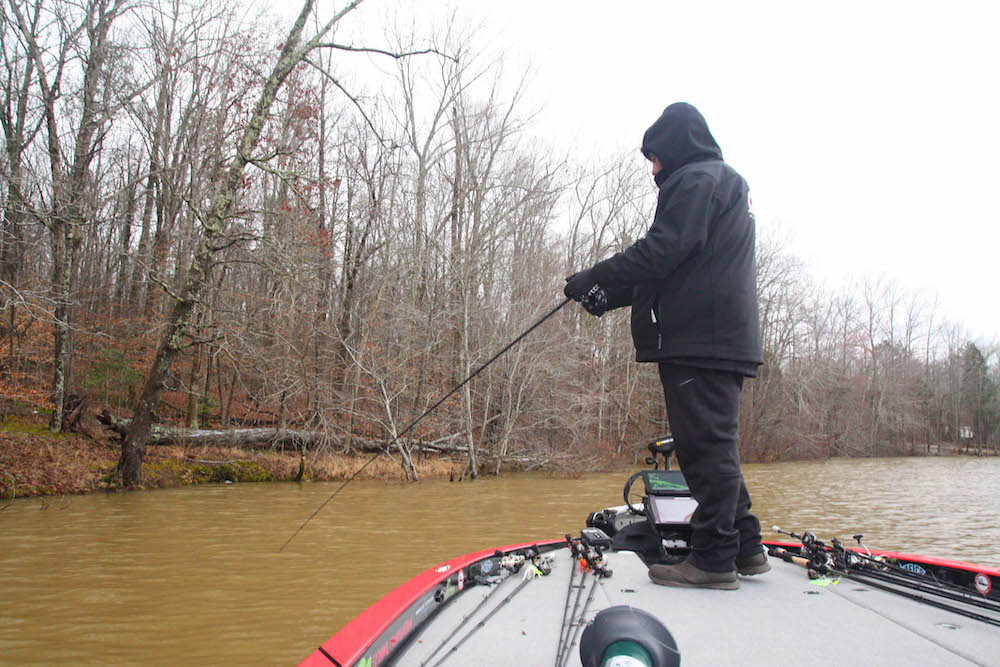
6:30 a.m. It’s 48 degrees and cloudy with a north wind when Talley and I arrive at Lake G’s deserted boat ramp. The small flatland reservoir is high and muddy after snowmelt followed by two days of rain. “The weather here has been crazy,” Talley says as he preps the Caymas for launching. “They had ice and snow two weeks ago, followed by monsoon rains and tornado warnings. Now there’s a massive cold front moving through and the air temp is supposed to start dropping like a rock. Hopefully, the bass are up shallow; power fishing shallow water is my strength. ”
SEVEN HOURS LEFT
6:40 a.m. We launch the Caymas. Near the ramp, at its lower end, Lake G is murky, 48 degrees and at least 2 feet high — the courtesy dock is completely submerged, shoreline trees and bushes are flooded, and leaves and sticks are floating everywhere. “Fast-rising water can move bass up into newly flooded cover, which works for me,” Talley says. “Those big storms can also put them on edge until they acclimate to the changing conditions, and that’s when you get a lot of short strikes. It might take until midday for them to get fired up, provided the front hasn’t passed completely through by then. I’ll start fishing shallow with moving baits and work my way deeper and slower if I have to. I’m just excited to finally be doing a ‘Day On The Lake,’ because I’ve been following this series for years!”
6:54 a.m. Talley rockets to the headwaters of Lake G. Here, the water is 52 degrees and extremely muddy. He moves into a shallow cove and makes his first casts of the day to flooded bushes with a 1/2-ounce chartreuse Angler Assets spinnerbait. “Muddy water doesn’t bother me one bit as long as it’s not real cold.”
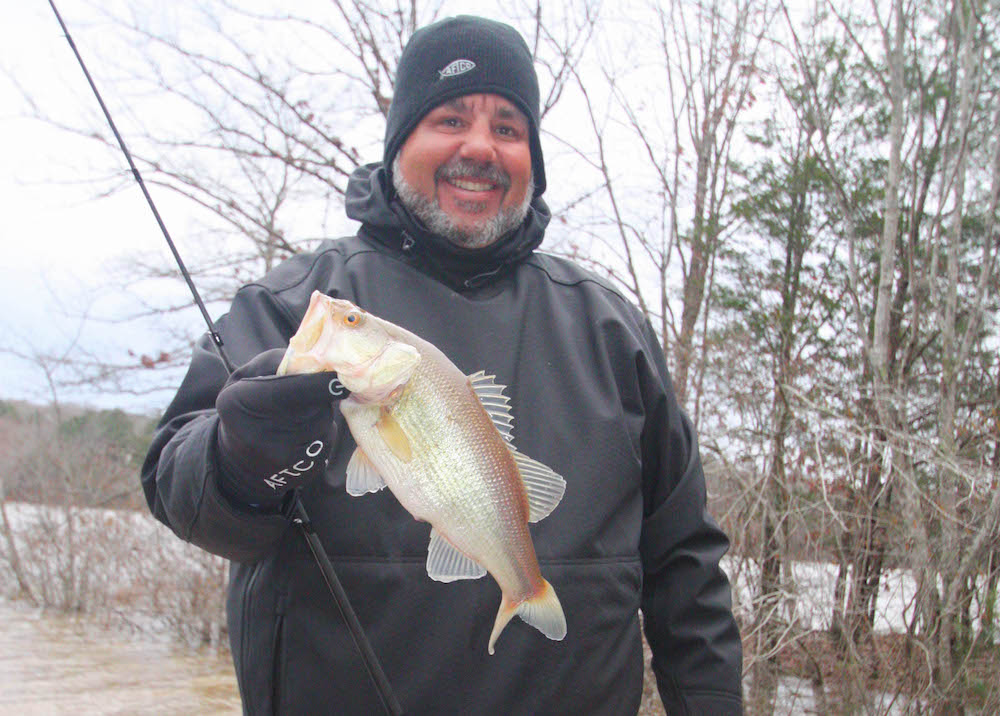
6:56 a.m. Talley promptly bags his first keeper largemouth of the day, 1 pound, 4 ounces, on the spinnerbait. “This fish was in a little patch of open water between flooded brush. He’s not big, but he jumped all over it!”
7:03 a.m. Talley moves to a nearby culvert where muddy water is pouring into the lake. An angler fishing the dirty inflow from shore catches a keeper channel cat. “When do we eat?” Talley asks him jokingly as he hurries past the culvert. “I want to move away from this spot; I don’t like to fish areas where there’s a been lot of shore fishing activity. The bass tend to get beat up around them, and there’s often a lot of old fishing line in the water that you invariably get tangled up in.”
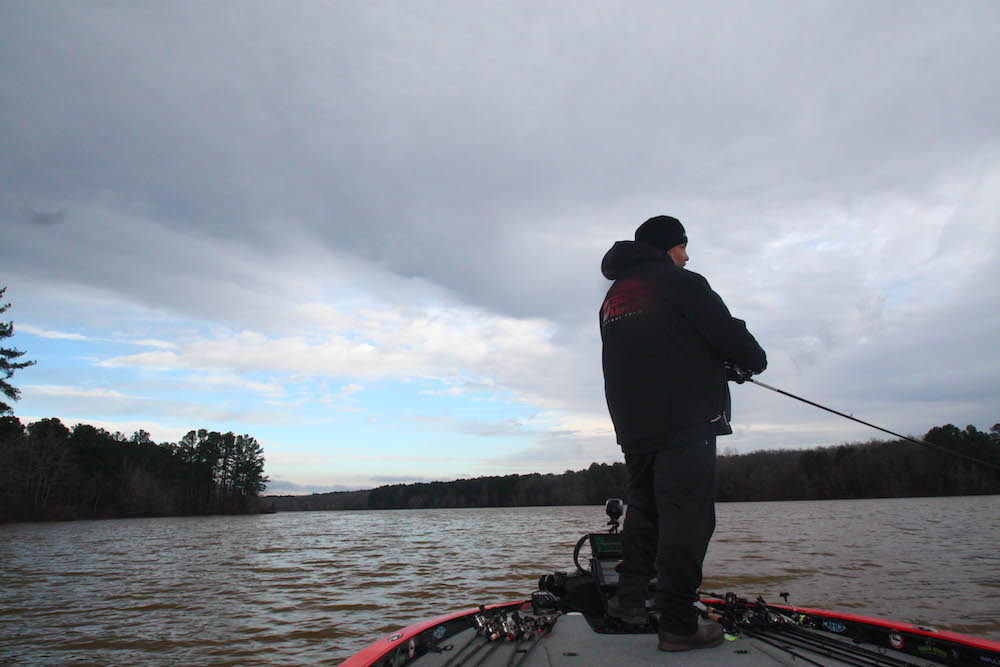
7:08 a.m. Talley zips down the bank to a pocket (shoreline indentation) and resumes making short, accurate pitch-casts to flooded brush with the spinnerbait. “Muddy pockets — sounds like an old Delta blues singer, but that’s where I expect bass to be in this high water.”
7:14 a.m. Talley moves to another pocket and slow rolls the spinnerbait past an isolated stickup. “Isolated cover is usually money, no matter when or where you’re fishing. It’s too early to tell whether the fish are being slow to bite or whether they just aren’t up in this flooded stuff.”
7:22 a.m. Talley has worked completely around the pocket with the spinnerbait. “I haven’t seen any baitfish dimpling the surface yet, which is pretty typical right after a big storm. Hopefully, they’ll get more active as the day progresses.”
7:31 a.m. Talley is fishing his way steadily along the flooded shoreline. “When I get to a tournament lake and start my practice day, I try to get a feel for what’s going on by covering water and making lots of casts with a moving bait, rather than by fishing slow with a worm or jig.”
7:34 a.m. Talley switches to a 1/2-ounce red and black Thunder Cricket bladed jig with a green pumpkin Rage Minnow trailer, both by Strike King. He pitches the vibrating lure to flooded brush. “I’ve got tons of confidence in this bait. It’s worked great for me in Elite events.”
7:39 a.m. Talley switches Thunder Cricket colors to chartreuse and white with a white trailer. “These brighter colors are more visible in this dirty water.”
7:46 a.m. Talley slows down to pitch a Strike King Rage Bug creature (California 420 color) to a flooded laydown.
6 HOURS LEFT
7:50 a.m. Talley’s trolling motor is kicking up mud in a flooded cove. He runs the Thunder Cricket past a stand of cattails. The wind is now blowing 15 mph out of the north and the air temp is plummeting.
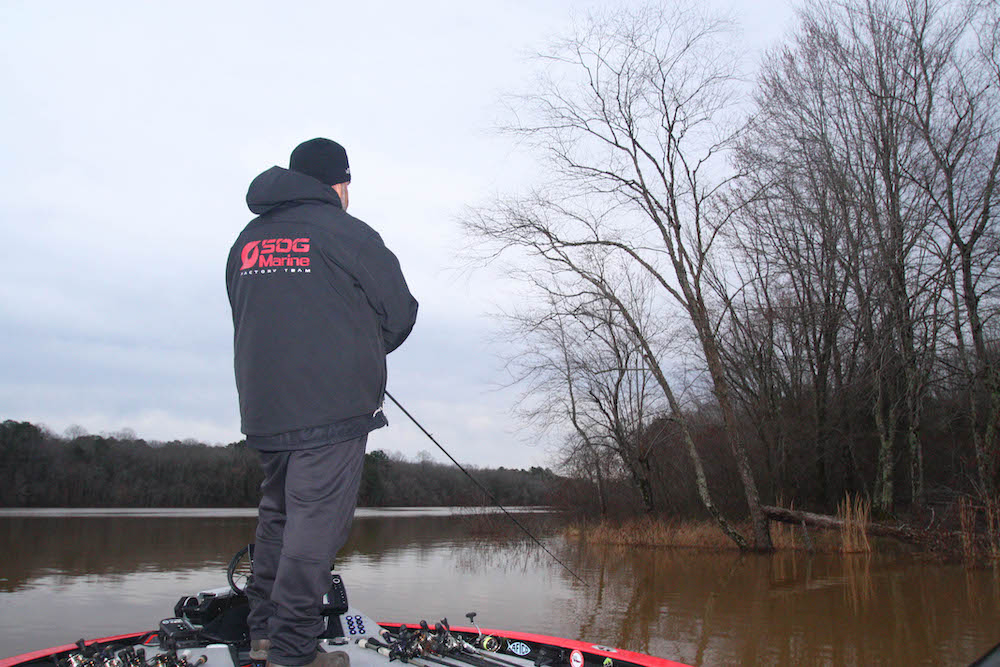
8:36 a.m. Talley runs back to the pocket where he caught his first keeper and tries a Strike King 1.5 squarebill crankbait in the DB craw pattern.
8:42 a.m. The water has gotten noticeably dirtier as muddy runoff gushes through the nearby culvert. Talley cranks the slackwater edge of the flow with the 1.5.
5 HOURS LEFT
8:50 a.m. Talley moves straight across the lake to grind the Thunder Cricket across a shallow flat. A few baitfish can be seen flipping on the surface. “Maybe everything’s waking up!”
8:59 a.m. Still fishing the flat. “At least this spot is out of that cold north wind. Usually the wind helps the bite, but during early spring cold fronts, bass will sometimes try to avoid it.”
9:26 a.m. After completing a thorough pounding of the flat, Talley has made a bone-chilling run to the back of another fork of Lake G. He’s now throwing a Strike King 1.5 in Rayburn red. “This is a classic dirty-water craw color.”
9:35 a.m. Cranking his way slowly downlake, Talley encounters a series of docks, which he dissects with the Thunder Cricket and red squarebill.
9:44 a.m. Talley idles into the extreme upper end of Lake G’s eastern fork, where an inflowing river is dumping more muddy water into the system. He dredges the Thunder Cricket near the dirty inflow.
4 HOURS LEFT
9:50 a.m. Talley makes a dozen casts to a big laydown tree with the spinnerbait but hauls water. “I can’t believe there wasn’t a fish there!”
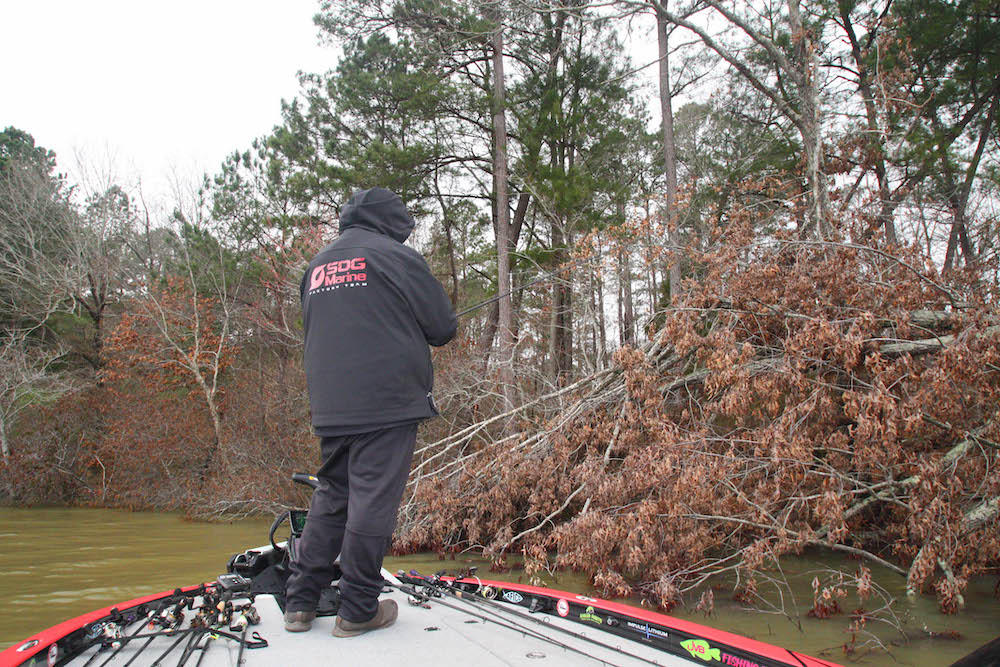
10:09 a.m. The crankbait is picking up leaves and sticks on every cast. “This inflowing trash limits what you can throw. A bladed jig or spinnerbait will run cleaner than a treble-hooked lure.”
10:17 a.m. Talley moves to a deeper sloping bank and tries a smoky shad Rage Swimmer on a 3/16-ounce jighead. “I saw some fish suspended off this bank on my Garmin LiveScope.” No takers, however.
10:28 a.m. Talley tries a 1/2-ounce finesse jig, brand unknown, with a matching Zoom Salty Chunk trailer on the sloping bank. What’s his take on the day so far? “It started off pretty well with two quick keepers, but it’s been slow ever since. That’s typical of early March; they tend to bite in spurts. It’s now a matter of figuring out whether my locations or presentations need changing. I’ve started expanding my lure offerings, but that hasn’t paid off yet. My next move will be to run back downlake where the water is colder but clearer.”
10:37 a.m. The Tank has run a quarter-mile downlake to a channel bank lined with rocks and docks. He cranks the DB craw squarebill unsuccessfully here.
10:45 a.m. Talley gets a short strike on the craw squarebill 10 feet off the channel bank.
3 HOURS LEFT
10:50 a.m. Talley cranks the shallow point at the end of the channel bank and dredges up a wad of leaves.
11:08 a.m. Talley runs another half-mile uplake and cranks a main-lake point with the craw squarebill. The water here is stained, not muddy.
11:17 a.m. Talley tries a pro blue Strike King KVD 300 floater/diver jerkbait on the point. “This style jerkbait doesn’t suspend; it dives when you twitch it, then slowly rises. I’m seeing baitfish suspended high in the water column on my electronics, so hopefully this will trigger a bite.”
11:29 a.m. Talley moves into a short creek arm to try the jerkbait.
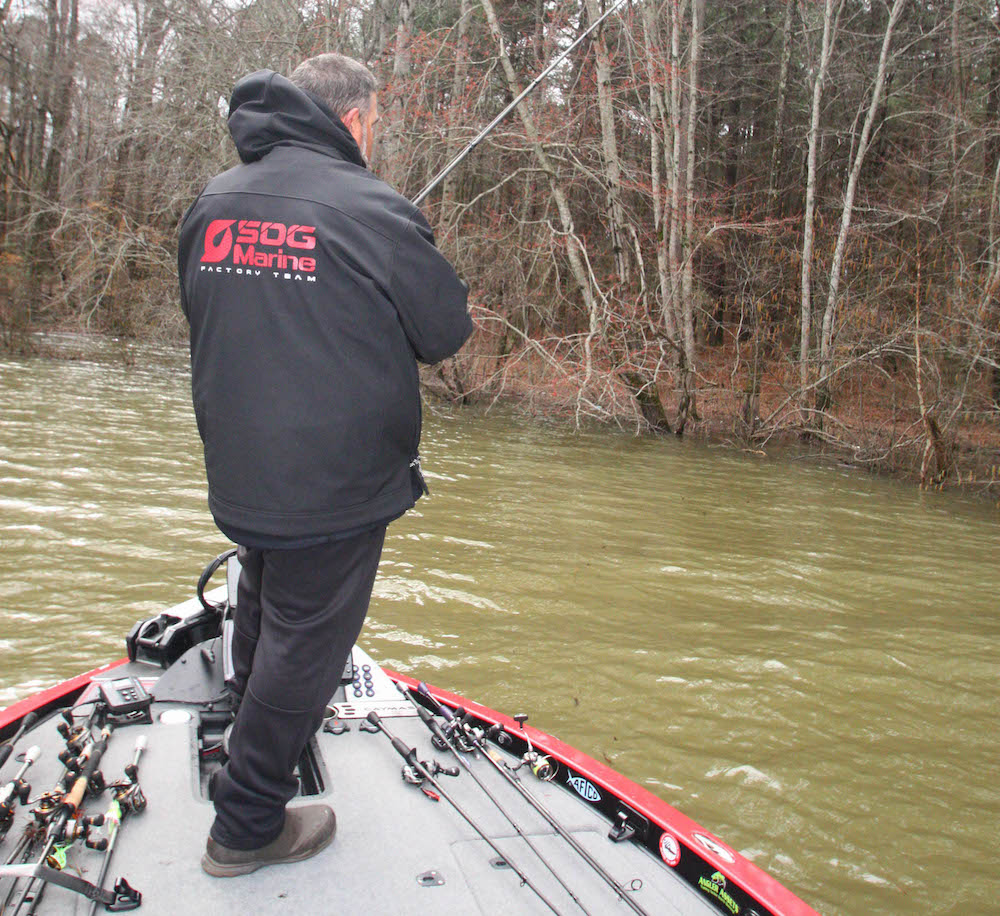
11:37 a.m. Talley fishes the spinnerbait around nearby flooded shoreline rocks. Still no takers. “Yo, I read that Bassmaster article you wrote about bass liking rock cover in March. Fake news!”
2 HOURS LEFT
11:50 a.m. Talley runs the spinnerbait past two boathouses in the creek arm, then lifts his trolling motor. “I’m just not feeling the love down here. Let’s run back uplake.”
12:11 p.m. Talley races halfway back to his starting point and hits a snaggy bank with the Thunder Cricket.
12:18 p.m. Still hitting flooded cover with the bladed jig. “The water is 53 degrees up here now. They should be snapping at it!”
12:33 p.m. Talley flips the creature to a pile of tree branches in front of a duck blind, causing two buzzards to beat a hasty retreat. “I don’t even want to know what they were eating inside that duck blind!”
1 HOUR LEFT
12:50 p.m. Talley casts a 1/2-ounce Rayburn red Strike King Red Eyed Shad lipless crankbait to the middle of a shallow pocket, using both a horizontal and yo-yo retrieve. “They’ll sometimes suspend in the middle of these pockets before they move in to spawn.” Sometimes, maybe, but not today!
1:16 p.m. He’s moved to another pocket with the lipless crank. Still no luck. “It’s bad enough when they short-strike you, but I can’t even get ’em to sniff it today!”
1:32 p.m. Talley is running out of time. He races downlake a half-mile to hit some laydowns with the Thunder Cricket.


THE DAY IN PERSPECTIVE
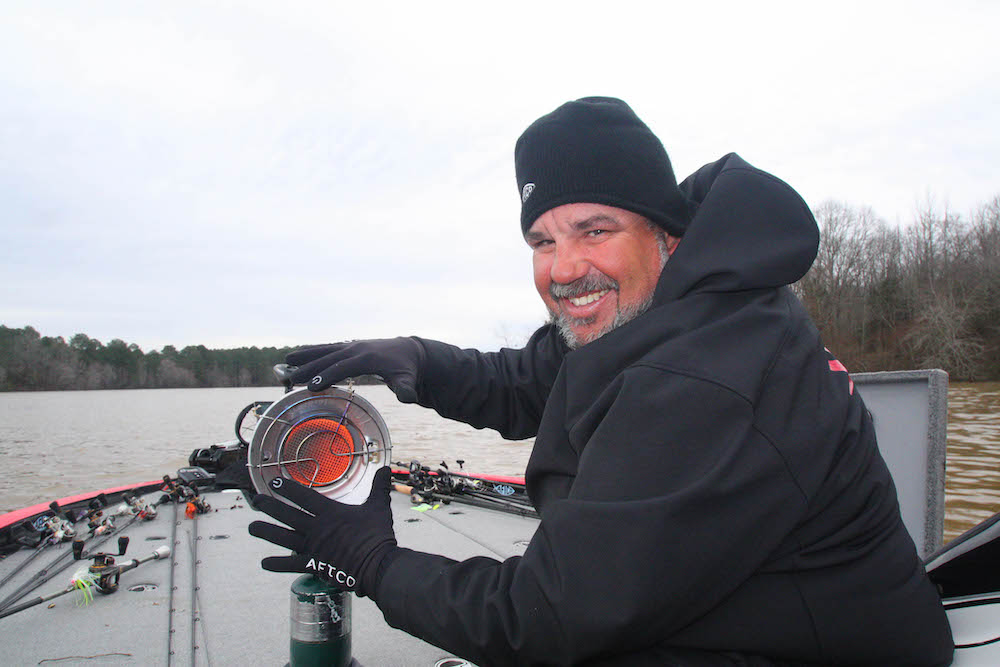
“The flood conditions and cold front combined to beat me down today,” Talley told Bassmaster. “I spent most of my day uplake in the warmer, muddier water and thought I’d get way more bites up in that flooded cover. But the front was moving in so rapidly, I think it pushed the fish back out toward more open water. If I were to fish here tomorrow, I’d try something different, like flipping docks or hitting long points with a shaky head. And I’d definitely bring that heater with me!”
WHERE AND WHEN FRANK TALLEY CAUGHT HIS TWO BIGGEST BASS
1. 1 pound, 4 ounces; 1/2-ounce chartreuse Angler Assets spinnerbait; back of flooded cove; 6:56 a.m.
2. 2 pounds, 5 ounces; 1/2-ounce chartreuse and white Strike King Thunder Cricket bladed jig with white Strike King Rage Minnow trailer: flooded brush in pocket; 8:08 a.m.
TOTAL: 3 POUNDS, 9 OUNCES