Date: July 28, 2025
Venue: Lake L, a small, flatland reservoir
Weather: Clear, light breeze, high of 94
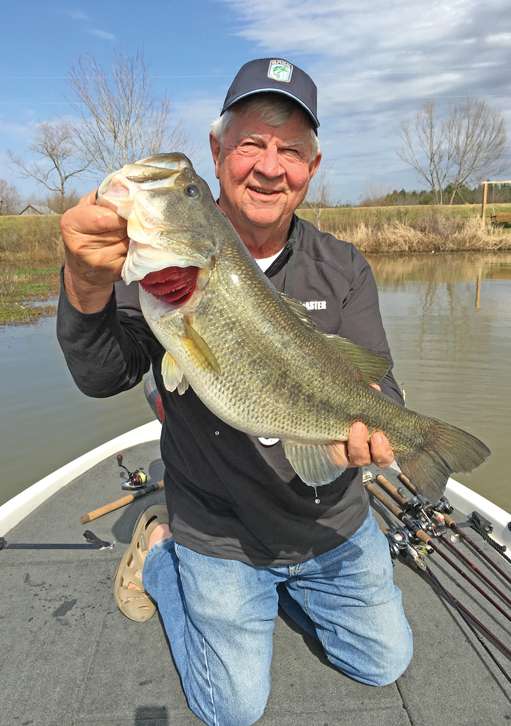
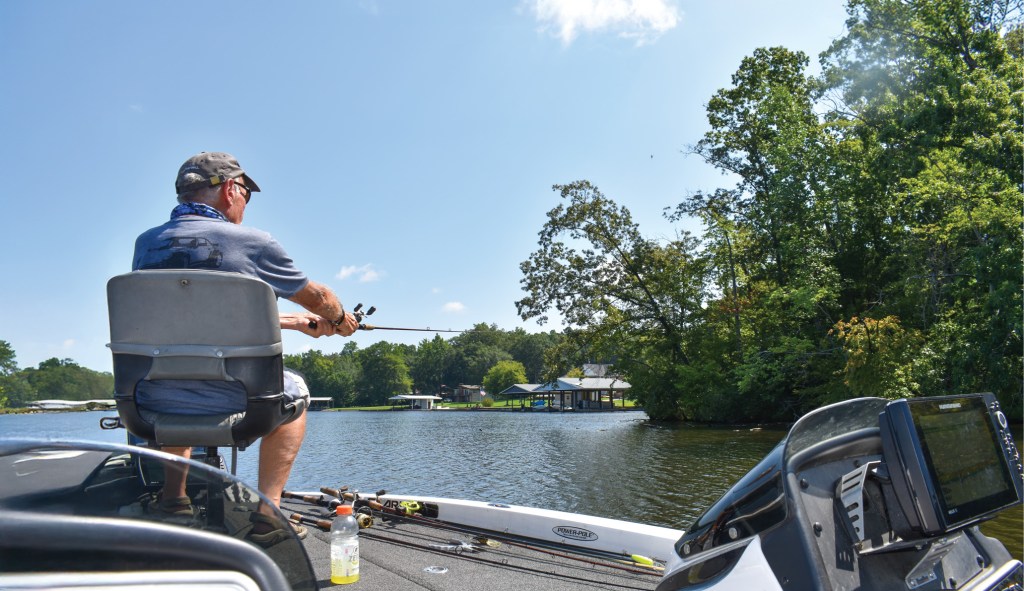
Angler: Don Wirth, 80, Nashville, Tenn. Wirth is the most senior of Bassmaster’s Senior Writers, having written for the magazine nonstop for 54 years. He’s the creator of the “Day on the Lake” feature, and this is the first time for him to occupy the front deck.
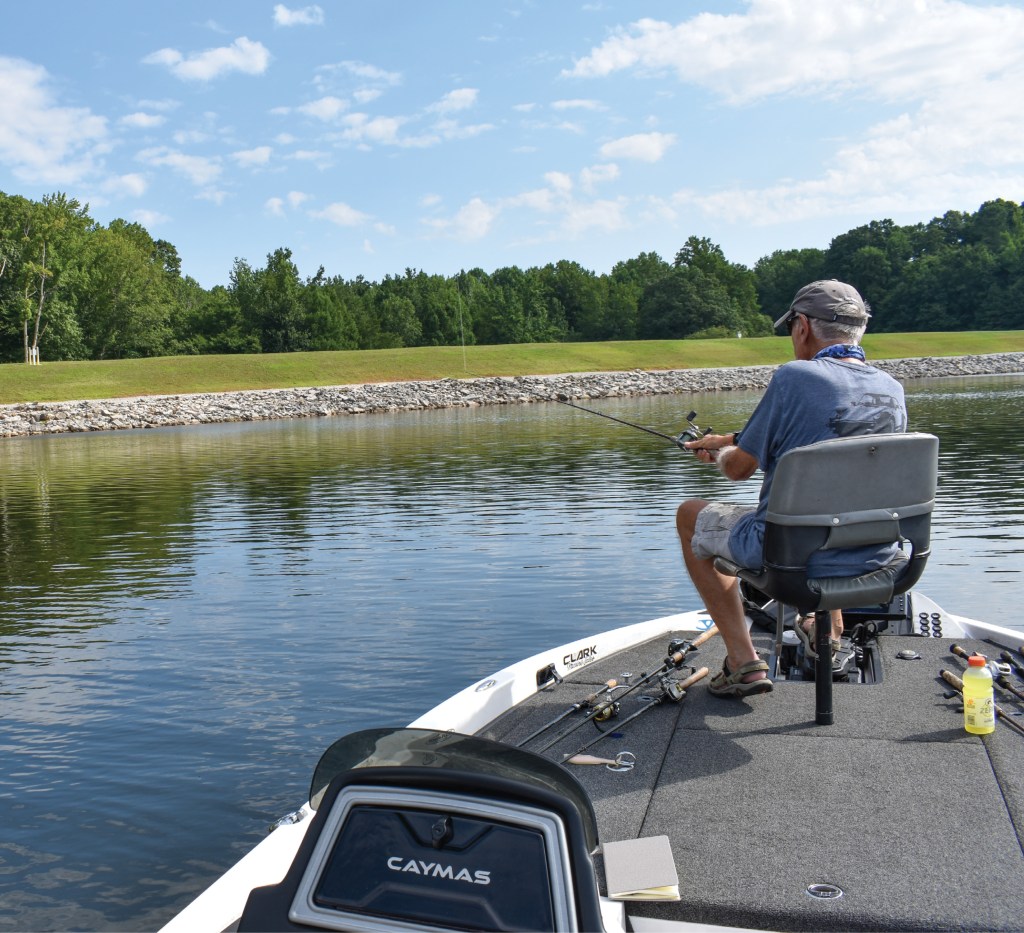
Boat: Caymas CX 20 with a Mercury 250-horsepower Pro XS outboard, Minn Kota trolling motor, Power-Pole shallow-water anchors and Humminbird and Garmin electronics

After 54 years of writing for Bassmaster Magazine, Don Wirth, who turned 80 this year, has retired. The originator of popular features, including “Harry ’N’ Charlie” and “The Weekend Angler,” Wirth is most closely associated with — and proudest of — his “Day on the Lake” series.
For 26 years and more than 225 issues, Wirth has been challenging B.A.S.S.’s top pros to quickly find and catch limits of bass on obscure lakes they’ve never fished. To commemorate Wirth’s remarkable career in outdoor journalism, we found it fitting to turn the tables and put him in the hot seat for a day on the lake. Here’s a diary of how he fared, along with occasional reminiscences of his long career.
SIX HOURS LEFT
• 6:35 a.m. I back Wirth’s bass boat down the ramp of Lake L, a 600-acre body of water in the mid-South. The first time I ever met Wirth was at the 1978 B.A.S.S. Champs tournament in Lafayette, La. He and Cliff Shelby, illustrator of the “Harry ’N’ Charlie” humor features, were being towed through the weigh-in line in a replica of their beloved “Ol’ Stump Jumper” johnboat. He has come up in the world with this rig, a Caymas CX 20 powered by a 250-horsepower Mercury Pro XS 4-stroke engine.
The sun hasn’t climbed above the trees and yet it’s already toasty. The water temperature is 86 degrees at the start.
“I’m nervous,” he says while pulling away from the dock. He has been lowering expectations ever since I invited him to participate in this special DOTL. “It’s gonna be really hot today. There’s a heat warning for today; it’sgoing to hit 94 degrees, and the ‘feels like’ is over 100.”
Wirth has an array of six well-used rods and reels of various brands. They’re rigged with a jerkbait, a swimbait, a Carolina rig and three crankbaits.
“I like to crank. That’s my favorite thing in the summer,” he says. “I think fish will be on points or just off points — away from the bank. They ought to be around midlake structure.”
Unlike the Progressive Bassmaster Elite Series anglers who’ve been featured in DOTL, Wirth is familiar with these waters. He has ridden along with pros dozens of times over the years and has recorded their strategies, successes and failures on this lake in every season.
Arriving at a long point extending into the main lake, he hurls a Bomber Fat Free Shad crankbait, white with a chartreuse back, across the structure. “The biggest DOTL bass ever caught, 11 pounds, 14 ounces, was taken on this lure.”
This is Wirth’s favorite lake of the fisheries that have been featured in the “Day on the Lake” series.
“It doesn’t have a ton of fish, but it does have some real big ones,” he adds. “I’ve caught two 10-pounders out of it.”
• 6:48 a.m. Moving shallower on the point, he switches to a Lucky Craft LC 2.5 squarebill crankbait in a gizzard shad pattern. After a few casts, he goes to a black/blue tail 10-inch Zoom Ol’ Monster worm on a Carolina rig. None of these attract a sniff from a bass.
The end of the point is about 7 feet below the surface, with the boat sitting over 10 feet. The bottom is mostly mud with stumps here and there. Wirth tries a Norman DD22 deep crank on the point and quickly finds one of the stumps. He can’t work it free, even with a stump-knocker, and has to break it off.
“One down, only 400 more baits to go,” he quips.
• 6:53 a.m. “I’m seeing lots of fish around this point, but they don’t seem very interested,” says Wirth, while staring at orange blobs on his Garmin LiveScope forward-facing sonar (FFS).
“I’m just not that proficient with this,” he admits. “When I come out and fish, I like to look at what’s around me instead of staring at a screen.”
• 7:07 a.m. Back to the C-rig. His setup features a 1-ounce brass weight with a swivel, a 3-foot leader, a 3/0 hook and the Ol’ Monster.

“I did some of the first articles ever written about this rig,” he recalls. “I wrote about Jack Chancellor and his Do-Nothing worm, which he fished on what we now call the Carolina rig. Jack won a lot of tournaments on that bait, including a Classic.”
Chancellor’s 1985 Bassmaster Classic win on the Arkansas River propelled the Carolina rig into national prominence.
I reminded him about a story he did for Bassmaster in which he had Chancellor re-enact the catching of the 22-pound, 4-ounce world-record largemouth on Montgomery Lake in Georgia.
“He dressed up like George Perry [the world-record holder] might have,” Wirth recalls. “He had an old wooden boat tied in the back of a Model T Ford pickup that he borrowed from a friend, and he fished that legendary oxbow. It was cool to be there, where history was made.”
Wirth pulls out a white, 6-inch Megabass Magdraft swimbait and fancasts it around the point.
“Jacob Foutz holds the all-time DOTL weight record — 30 pounds, 11 ounces — and most were caught on this bait.”
The lure doesn’t elicit any bites, but it does trigger another recollection.
“I probably wrote the first article in a national magazine about big swimbaits,” Wirth says. “It was about guys in California hand-making 12-inch-long [wooden] swimbaits and catching 15-pound bass on them. The joke was that there soon wasn’t a table leg left in San Diego once they got through making those baits.”
• 7:17 a.m. Wirth fishes a deep-diving Lucky Craft Staysee 90 jerkbait around the point. He doesn’t stay with it long. “I’m not much of a jerkbait guy.”
He digs into his rod locker and pulls out his desperation lure, a chartreuse-pepper 6-inch Zoom Lizard Texas-rigged with a 1/4-ounce slip sinker and a 2/0 worm hook.
“This is old school,” he says.
The bass don’t seem interested in old school today.
FIVE HOURS LEFT
• 7:31 a.m. Nearly an hour after arriving at the first destination, Wirth finally gives up on it. He idles across the lake to another long point. On one of his first casts with a crankbait, he snags a long section of fishing line with a slime-covered smoke/glitter soft swimbait attached.
“I always pay attention to what the locals are using,” Wirth says, laughing. He takes note of the bait but doesn’t tie on one like it.
Elite Series pro Robert Gee of Knoxville, Tenn., fished Lake L for a DOTL feature at this same time last year. (Read about that day in the 2025 July/August issue of Bassmaster.) He put together a huge limit with the help of little swimbaits like the one Wirth found on the bottom of the lake. I’m curious why he doesn’t try something like it.
“They’re not much fun to me,” he replies. “If I were on Dale Hollow, where the water is clear, maybe.”
• 7:40 a.m. We hurry around the point and across the opening of a deep pocket.
“The fish will be spawning in the back of this pocket next spring,” Wirth says. “In April, they’ll either be spawning or getting ready to. The water’s dark, but they spawn so darn shallow — you can see the beds in a foot and a half of water.
“I wish we were doing this in April.”
His Fat Free Shad catches another glob of fishing line, but this one doesn’t have a lost lure on the end.

• 7:50 a.m. Wirth motors to a straight shoreline with a long ridge running parallel to it and rakes the ridge with the Fat Free Shad, which he apparently is counting on to be his money bait for the day.
“I can see a bunch of fish along here [on the LiveScope], but they’re not interested,” he says.
He reflects on the past again: “I was there when catch-and-release was born. Before that, [B.A.S.S. founder] Ray Scott would take the bigger fish caught in a tournament and stick ’em on a braggin’ board. Then they’d fillet them and give the meat to a local orphanage.”
Scott introduced the catch-and-release concept in 1972, and — thankfully — it has been the ethical standard in bass fishing ever since.
• 8:11 a.m. Wirth tries another point in the midsection of the lake. This one, too, has a mud bottom with scattered stumps. We see shad dimpling the surface of the water, but nothing is chasing them. Rounding the point, Wirth notes: “Keith Combs caught some good ones off this bank. He’s one of my favorite guys to fish with.”
We talk about Wirth’s favorite fisheries.
“Dale Hollow Reservoir has to be one of them,” he says. “I’ve done so many articles on the lake. It’s so scenic, with the rock points and bluffs and clear water. And of course, that’s where the world-record smallmouth was caught.”
Wirth’s best smallie from that lake on the Tennessee-Kentucky border weighed 7 pounds and ate a grub.
“So many pros tell me about reading my articles about smallmouth when they were kids,” he says. “They never forgot what I used to say about how different these fish are from largemouth. I loved writing about Billy Westmorland and other Dale Hollow guides. They were fun characters.”
• 8:15 a.m. Wirth moves to a riprap bank broken by an occasional boat dock. We’re in 7 feet of water and in the shade, which is providing welcome relief from the sweltering heat. He begins flinging the Magdrafttoward the bank.
“I don’t know if there’s anything around these docks right now, but I can’t go by one without throwing a swimbait to it,” he explains.
• 8:21 a.m. As we motor toward another point, we see our first fellow fisherman on the lake.
“He’s either catfishing or he has forward-facing sonar,” Wirth suggests.
The fishing action on Lake L is slow to nonexistent this morning, so Wirth and I chat about fishing in better times and cooler conditions.
“From the middle of March through the first of May, I’ll go twice a week if I can. I try to go at least once a week,” he says. “When the weather gets hot, I switch to fishing rivers for trout and stripers. I like to fish for everything, including walleye and muskies.”
He’s in good health and stays in fishing shape with the help of a personal trainer.
“I love winter fishing for bass. In February last year, I caught a 10-pounder on this lake. The water was 45 degrees. I had one strike. I told my buddy that I should probably quit because I wouldn’t catch another one that day. And I didn’t.”
• 8:26 a.m. A fish boils on shad off a long point ahead of us. Wirth heads that way and pulls out his squarebill. The bass is long gone before we get there.
“I have three guys I fish with. They’re the only ones I can stand to fish with that can also stand to fish with me,” he jokes.
The trio of fishing buddies represent Wirth’s favorite pastimes: One he met through the Porsche Club of Nashville, two are musicians but all three are passionate about bass fishing.
The typical man experiencing a midlife crisis drives a bright red sports car. Wirth bought a Porsche convertible in bright yellow. When he brought it home, his wife, Linda, described the color as “arrest me yellow.”
“I’ve never been stopped by police, though,” says Wirth, who enjoys touring back roads around Nashville with his car club buddies. “I absolutely love it. It’s the coolest thing I’ve ever done.”
Until recently, Wirth spent his days fishing and writing and his weekend nights playing nightclubs and other gigs with a popular ’60s cover band. A talented musician, he plays guitar and keyboard, but he played electric bass for his band.
“I love playing bass,” he says. “It’s like I’m driving the train.”
FOUR HOURS LEFT

• 8:37 a.m. I can tell he’s growing steadily more frustrated that the fish aren’t cooperating this morning.
“The water is so darn hot right now,” he notes. “I don’t believe the bass are going to move around and chase shad in water this hot. It stresses them out too much. That’s why they hang around baitfish schools.”
• 8:48 a.m. He locates one of those baitfish schools suspended above an offshore hump and runs his Fat Free Shad through it. Scattered blips on his forward-facing sonar screen might represent gamefish.
The hump rises to about 7 feet on top and drops abruptly into 11 or 12 feet.
At long last, Wirth sets the hook on a fish. Unfortunately, it’s the wrong species, a little yellow bass.
“That’s what we’ve been seeing on the ’Scope out here, I imagine.”
To prove that point, he catches two more yellow bass in quick succession.
• 9:04 a.m. A slight breeze kicks up, making the rising heat almost bearable. Something bumps the Fat Free Shad.
“I just had a hit, but it came unbuttoned,” Wirth announces. He saw the fish on the Garmin screen and thinks it was a largemouth. He continues to focus on the screen. “I just had another one follow it.”
But they’re not hitting. His hopes of catching a keeper are dwindling by the minute. The day reminds him of fishing for muskellunge: “Muskie fishing is seven hours of boredom followed by five minutes of mayhem.”
Right now, he’s hoping for one minute of mayhem.
“I wish you’d have brought some bass up from Alabama with you,” he complains. “I’m not sure we’re going to catch anything here today.”
• 9:15 a.m. Unable to catch a keeper there, Wirth gives up on the spot and moves to yet another point. This one is littered with brush, so he pulls out an odd-looking Sebile crankbait with a single, weedless, upturned hook at the tail.
“I’ve had this in my tacklebox for 30 years, and I’ve never thrown it,” he says. “I’m thinking maybe it’ll go through these brushpiles without hanging up.”
It does that.
THREE HOURS LEFT
• 9:29 a.m. Wirth fires up the Mercury for a run to the dam. The ride cools us off, briefly.
Stopping near a small point at the edge of the dam, he briefly tries the Staysee and then makes a couple of casts to the rocks with the lizard. Next, he goes back to the Fat Free Shad. He winds the crankbait slowly, all the way to the boat, ready for a late strike.
“I feel sorry for you, having to write this article,” he says. “I’ve been in your shoes; it’s not fun when the pro isn’t catching anything.”
• 10 a.m. Two and a half hours left in his day on the lake, and Wirth has nothing to show for his efforts.
“I’m giving up on the offshore stuff,” he announces.
Moving to a wooded shoreline, he quickly catches a nonkeeper largemouth, a little under 12 inches, on the lizard.
“I fish this lizard a lot on lakes around home this time of year.”
Wirth uses straight mono. “I can’t afford braid,” says the man who drives a Porsche. “Actually, this line is from a 2,000-yard spool I’ve had for 15 years.”

• 10:16 a.m. We move to the upper end of the lake to try the squarebill on a stumpy flat in a creek arm off the main lake.
“The first time I saw a squarebill was when I had Scott Rook of Arkansas out for a cold-weather ‘Day on the Lake.’ He fished it through submerged limbs and stumps, and I thought he would be hung up all the time, but he wasn’t, and he caught several real good fish out of the trees that way.”
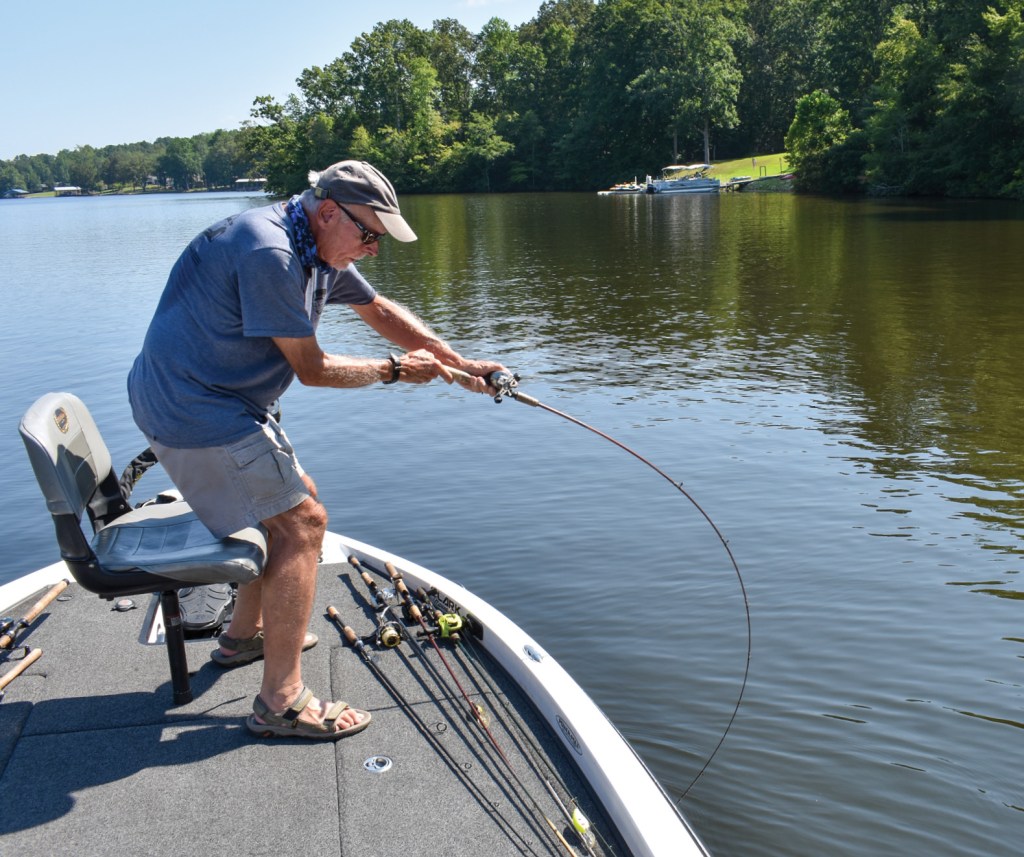
• 10:20 a.m. On the third cast at the spot, Wirth’s rod loads up and then bends sharply. He works the fish carefully.
“It’s a big catfish,” he says. “It’s not coming up … no, wait! It’s a bass.”
I grab the net and scoop it into the boat. On Rapala scales, the largemouth registers 5.1 pounds.
Wirth is both relieved and ecstatic. After releasing the bass, he pauses to wipe the sweat off his forehead and chug a Gatorade.
“I was afraid we weren’t going to catch anything,” he confesses. “We’ve been nosing around offshore, but there’s nothing going on out there like there should be in classic summer fishing. The bait isn’t clumped up; there’s only yellow bass, if anything.
“But this shows that bass will still stick tight to cover in hot weather because that is a high-opportunity situation. They’re not going to roam around for one shad. They’d rather sit tight and wait for something to come to them.”
He continues to relish his catch.
“I beat Denny Brauer!” he muses, referring to one of the first summertime “Day on the Lake” forays, when the legendary pro failed to catch a keeper bass. “In fact, a lot of the guys who have fished a ‘Day on the Lake’ didn’tget 5 pounds all day long.
“I was sort of disappointed in the way this morning was going, but now I feel better. I used to tell the guys I’d go out with for a ‘Day on the Lake’ that I’d rather they catch one big fish than five little ones.”
Most pros see it differently. They have a tournament mindset and want to catch a five-bass limit, at least.
TWO HOURS LEFT
• 10:33 a.m. The monkey off his back, Wirth returns to bass-hunting mode with renewed enthusiasm, hoping to add to his day’s weight.
Shad are starting to bunch up, rippling the surface over a shallow, offshore flat. Wirth rakes a crankbait through the schools, hoping to attract a bass lurking beneath the bait.
When that fails to pay off, he moves to an offshore hump with a shallow-water hazard marker on top. The bottom drops from nothing at the buoy into 11 feet of water where we’re sitting.
• 10:40 a.m. Next, we try another creek arm with lots of brush and laydowns in shallow water.
“One of the most exciting ‘Day on the Lake’ articles ever started right here,” Wirth remembers. “I was with North Carolina pro Dustin Wilks on a cold April day. We came to this place right after launching, and he caught a 6-pounder here on a buzzbait.”
Throughout the day, Wilks caught over 28 pounds, all on buzzbaits.
“His timing was perfect,” Wirth notes. “The little males were on their nests, and the big females were cruising around them. If he had come a day earlier or a day later, he’d have caught nothing but the males.”
• 11:08 a.m. I’d have fished a buzzbait for old times’ sake, but Wirth continues chunking the squarebill.
“This cove should have fish in here all year long,” he says. It features stumps, brush, logs and 7 feet of water. He makes his way around an island, casting to the shore and working the lizard thoroughly around whatever cover it encounters.
• 11:20 a.m. My cellphone beeps with a notification from the National Weather Service. We’re under an “Extreme Heat Warning.” No kidding.
The air temperature is well into the 90s, and the heat index is approaching its maximum for the day, 114 degrees. Heatstroke is becoming a very real threat.

ONE HOUR LEFT
• 11:34 a.m. During his final hour of fishing, Wirth tries the lizard and the squarebill around a variety of banks, points and shallow structure — all for naught. One good bite does not a pattern make.
• 12:30 p.m. Time to quit.
THE DAY IN PERSPECTIVE
“I did a ‘Day on the Lake’ with Robert Gee on this lake in July of last year, and he had what he called one of his most unbelievable days of bass fishing ever,” Wirth says as we seek refuge in his air-conditioned SUV. “He had 26 keeper bass with the best five totaling 29-4. But conditions were totally different then. Today, there weren’t any big clouds of bait, like there were last year. I was glad to catch that one good fish. The water temp was over 90 degrees, but that 5-pounder was in less than 2 feet of water. Just proves that old-school bass tactics still work.”
A special note from Don Wirth:
My first Bassmaster article was published way back in 1971, and after writing for this esteemed publication for more than 50 years, I’ve decided it’s time to reel in and head for shore … in other words, retire! My earliest Bassmaster articles were humorous yarns about Harry ’N’ Charlie, two redneck bass nuts from the bayou who refused to fish water over 2 feet deep. As Bassmaster’s “most senior” Senior Writer, I’ve worked with all of the magazine’s editors, shared a boat with (and picked the brains of) the best bass anglers on the planet and tried my darndest to pass along their expertise to help our loyal readers catch more and bigger bass. Along the way, I’vecovered virtually every seismic development in our sport, all while making countless friends in the fishing industry and having a helluva lot of fun. Thanks to all my readers for accompanying me on this journey. I plan to keep on fishin’, so hopefully I’ll see you on the water!
WHERE AND WHEN DON WIRTH CAUGHT HIS BIGGEST BASS
(1) 5 pounds, 2 ounces; Lucky Craft LC 2.5 squarebill crankbait (gizzard shad); stumpy flat in a creek arm off the main lake; 10:20 a.m.
TOTAL: 5 POUNDS, 2 OUNCES