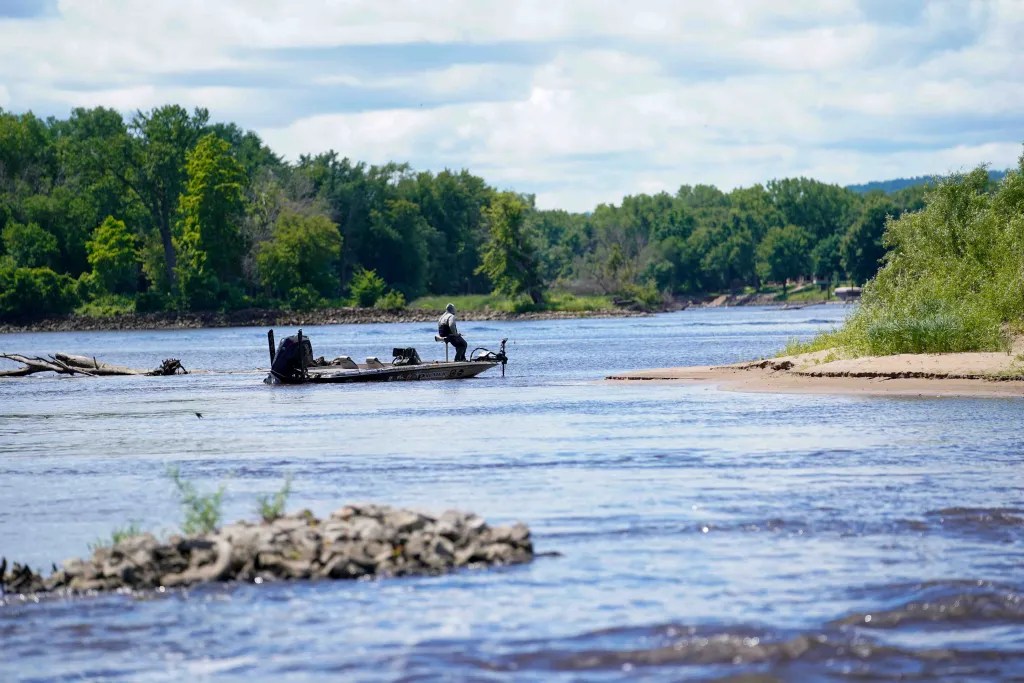
It was a common sentiment at the Day-1 weigh-ins: The Upper Mississippi River’s fishing tough.
You’ll always have a handful of anglers that land on ‘em, and the Day-1 leaderboard showed 23 anglers breaking 14 pounds. However, about 65 percent of the field caught limits and the standings showed a baker’s dozen goose eggs.
Tournament leader Tom Monsoor caught 19 pounds, 6 ounces, but it wasn’t easy. The local pro described a seasonal transition where the fish are moving from their postspawn bream munching to their summer patterns.
In between, Monsoor said, is a disjointed period that delivered bites where he wasn’t expecting them and left him scratching his head when his best practice areas seemed like ghost towns.
With tournament boundaries comprising pools 7, 8 and 9, the playing field is massive. However, Michigan pro Bo Thomas points out that present conditions have complicated matters.
“The water’s about 1 1/2-feet low and that has completely changed this place with the way it has shifted some of the sand bars and affected the way you get into places,” Thomas said. “Some of the places we’ve been used to getting into, you can’t get into.
“It’s making the river fish a little smaller, so it feels like you’re right on top of (other anglers).”
Noting that he experienced the toughest practice he’s ever had on the Upper Mississippi River, Thomas said he found only a small fraction of the 30-50 fish he normally expects to catch each day.
Echoing Monsoor’s analysis, Thomas said: “We’re hitting it at a very weird time when they’re in that transition from postspawn to summer patterns. I feel like, in a lot of areas, the bass are coming to you and you just need to be patient, take your chances and go try something. That’s what I’m doing this week.”
A few more points relevant to this week’s tournament.
Clarity and Current: Thomas points to Wednesday’s thunderstorms as a complicating factor.
“With the water being low and then getting a lot of rain, the fluctuation is stirring this place up,” he said. “It doesn’t help that the current seems like it’s absolutely ripping out there. With the water low, it narrows the current and that makes it go faster than normal.
“This is blowing out some areas and making them dirty. There are some clean areas and the guys that area catching (14-plus) are finding the clean areas. They’re few and far between, but if you can find a clean area like that, it really pays off.”
Diminished Habitat: With the river level down, a lot of the shallow pad fields have been drained down to muddy banks with pad stems laid over. Local pro Aiden Denzer, who placed second on Day 1, said this has taken some of the key areas out of play.
“I didn’t touch a frog rod all day,” Denzer said. “Normally, in June, I’m supposed to be frogging.”
Keep Moving: Alex Wetherell (third place) said that he rotated through about 20 spots on Day 1. Several of them he hit multiple times. The strategy, he said, was to give what he considered promising areas as much opportunity to produce as possible.
That’s always a good strategy, but it’s especially applicable in a river scenario.
“Some of these fish won’t be (on a spot) the first time I fish it, but then I’ll roll back through two or three times,” Wetherell said. “With this current, a lot of times, these fish will pull on and off this stuff. I’m running a bunch of stuff, but I’m also revisiting my best stuff multiple times.”
Focused Attention: Notwithstanding his mobility strategy, Wetherell said that one of the keys to success in a tough river scenario is recognizing when a spot is worth a more patient treatment.
“There was one spot where I got four or five bites. I ran through there and got two bites. I ended up coming back through later and slowed down and got a couple more.
“There were more fish than I realized. You’re trying to balance hitting so many spots, but hitting them efficiently when you do.”
Thomas agrees and adds this: “Because of the fishing pressure and the dirty water, I think you have to slow down. You could literally miss a fish by less than a foot and it will never see your bait.”