PARIS, Tenn. — Down with the bad, up with the good. That’s an oversimplification of Kentucky Lake’s complex ecosystem, but it’s a fair summary for a major chapter in the lake’s history.
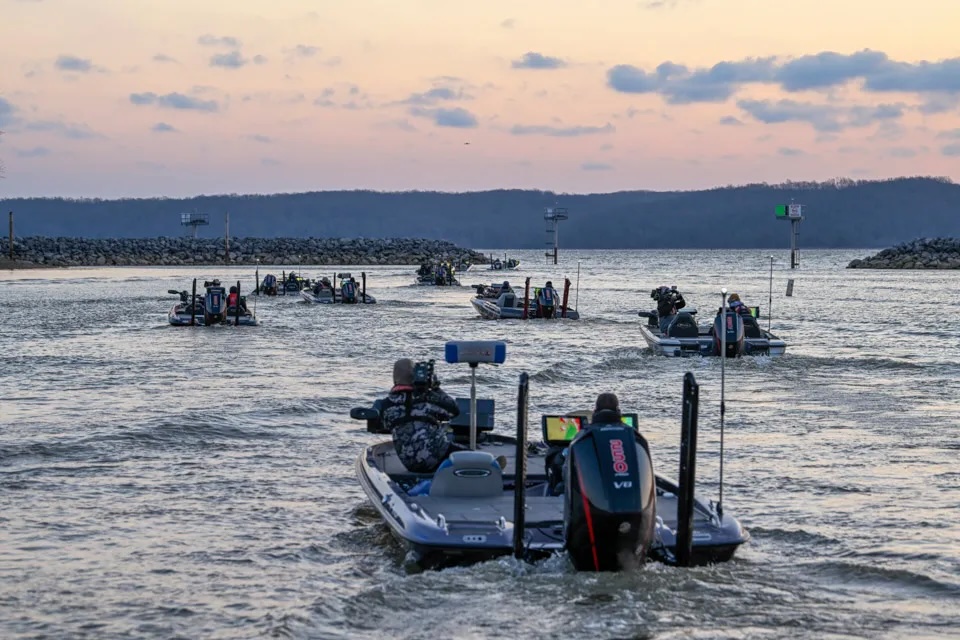
The final impoundment in the Tennessee River’s nine-lake chain, Kentucky Lake will host the majority of the action during the Turtlebox Bassmaster Open at Kentucky Lake/Lake Barkley presented by Battery Tender. Competition days will be May 20-22 with daily takeoffs from Paris Landing at 6:30 a.m. CT and weigh-ins each day at 3 at 2:30 p.m.
Mark Menendez, the veteran Progressive Bassmaster Elite Series pro who calls Kentucky Lake his home waters, will be competing in this tournament, and he’s chomping at the bit with excitement for what he believes will be a stellar event. That’s because the fight against invasive Asian carp — a grass-roots campaign for which Menendez has been one of the foremost voices — is showing promising signs of significant progress.
“The fishery has bounced back really well from the deficit (incurred) when the Asian carp got in the lake,” Menendez said. “It has been remarkable how the old girl has come back. It’s not at the stages it was at her peak, but she’s pretty darn good right now.”
Summarily, Asian carp (bighead, silver and black) have been part of the U.S. aquaculture scene since the 1970s, when they were imported to help southern fish farmers control algae and phytoplankton in grow ponds and wastewater pools. Through major flood events in the 1990s, carp escaped their enclosures and spread throughout the Mississippi and other rivers.
Asian Carp entered Kentucky Lake through lock and dam openings in the late 90s and by the mid 2000s, an established population was in place. These fish commonly reach 20-plus pounds and their frequent leaping has created a serious boating hazard.
Bad as that is, Menendez said the environmental impacts have been much worse. According to the Kentucky Department of Fish and Wildlife Services, female Asian carp can produce more than a million eggs. That has created intense competition for space and resources needed by native species, including largemouth and smallmouth bass.
Large scale commercial netting has been the main weapon in the Asian carp battle, while public awareness initiatives have focused on stopping the spread by thoroughly cleaning and drying fishing gear, boats and trailers, while also draining bilges and livewells before leaving a boat ramp. Combined, these efforts have shown encouraging results.
“The Tennessee Wildlife Resources Agency (TWRA) hasn’t found any young-of-the-year Asian carp in their electrofishing studies in quite some time,” Menendez said. “That tells us that spawning is limited at best.
“The second factor that has reduced the carp population is our biologists in Kentucky and Tennessee have realized that the longevity of each fish is not quite what we thought it was gonna be. We thought the lifespan of an Asian carp was gonna be 15 to 18 years, but the actual lifespan is probably 6 to 8 tops.”
As Menendez explained, the combination of commercial fishing pressure, shorter-than-anticipated Asian carp life spans and decreased spawning has shifted the balance back in favor of native species. This, of course, is good news for Turtlebox Bassmaster Open presented by Battery Tender anglers.
“The lake has a carrying capacity — whatever the lake can possibly hold — whether that’s carp, bluegill or largemouth bass, it can only hold so many fish at any given time,” Menendez said. “We’re reducing the number of carp and it’s giving our gamefish the opportunity to take those percentages of the pie and increase their population.
“In the last four years, we’ve seen a proliferation of our game fish. I started seeing good largemouth spawns about six years ago and it is really starting to become exponential now.”
That being said, Menendez said Kentucky and Barkley lakes will offer a diverse menu of opportunities. With most of the fish in a postspawn stage and some heading toward their summer haunts, options abound.
“We haven’t had a lot of rain, so the lake’s pretty clear and that will hamper us in terms of (fish wariness), but I expect a lot of fish catches just about anyway you want to catch them,” Menendez said. “It will be all over the board; shallow, mid-level and deep. I’m interested in seeing where those masses of fish are found.”
Noting that this event will see everything from heavy flipping gear to 6-pound line, Menendez said he expects to see anglers throwing topwaters, Texas-rigged soft plastics, jighead minnows and deep-diving crankbaits. While tournament boundaries include Barkley Lake, which connects to Kentucky Lake through a 1.75-mile canal, Menendez doesn’t believe many will venture the trip.
“It’s a long run over to Barkley, but it can play,” he said. “I think you’d have a lot less pressure, but it’s a big risk. I think that with the number of fish on Kentucky Lake, there’s not much reason to gamble the time.”
Menendez said the keys to success on Kentucky and Barkley lakes will be finding a consistent group of fish and then managing the opportunity across a multi-day tournament. Predicting a highly entertaining event, Menendez said he’s looking for a three-day winning total of 62 to 66 pounds.
“Big fish will be the outlier,” Menendez said. “You look at certain tournament results and you’ll see the big fish of the event was a 5- to 5 3/4-pounder, but then an 8- or a 9-pounder will show up. We do have a population of big largemouth in the lake that are 7-plus pounds, so I look for one or two of those to show up, as well.
“It’s going to be interesting. We’re gonna catch the heck out of them. Everybody’s going to have (a five-bass limit).”
Follow along with all of the action from the Turtlebox Bassmaster Open at Kentucky Lake/Lake Barkley presented by Battery Tender on Bassmaster.com.
Henry County Tourism Authority is hosting this event.