
From time to time, I’m asked if the techniques I use in saltwater help with my bass fishing. The answer is always, “Yes!”
There’s no doubt about it. Many of the things I learned in the brine have helped, particularly when the fish I’m after are up shallow and in super-clear water.
We all know that bass, for the most part, are cover-oriented creatures. Unless they’re out chasing schools of baitfish, they’re usually relating to some type of cover, like stumps, brush, rock or grass. That speaks for numerous species of saltwater gamefish as well.
Snook, redfish, seatrout and tripletail, too, will relate to cover or structure whenever it’s available. And a big advantage to pursuing these various saltwater species is that they’re often visible. When conditions are right you’ll not only see them, but you’ll see how they’re set up on various types of targets — like pilings, grassbeds or oyster bars — and that helps in both approach and presentation.
Catching any type of fish in super-shallow water can be challenging, but it’s even more so in saltwater. They’re far less tolerant of movement or noise than black bass. To fool them, stealth is essential.
Learning that helped me to become much more successful when trying to catch bass that are bedding or cruising in the shallows — situations where lengthy casts and quiet presentations make the difference in either catching or spooking the fish.
Angle of Attack
One of the most valuable lessons I learned was how to “lead” cruising fish with a cast. It’s something I picked up while trying to catch bonefish and tarpon on the flats — fish that are sometimes so nervous, they’re afraid of their own shadows.
The trick is to present the lure ahead of the fish at a distance where he’ll find it without “feeling” it hit the water, then subtly teasing it away in the same basic direction he’s traveling. This not only looks natural — like bait trying to escape — but it helps to conceal the line. And believe me, bonefish and tarpon see line really well. When they do, they’re gone!
Using this same presentation on cruising bass has worked for me countless times. Show them the right lure without them detecting the cast or seeing the line, then make it appear as if it’s trying to get away. They’ll eat it every time!
Of course, boat control is a big factor in making this scenario work.
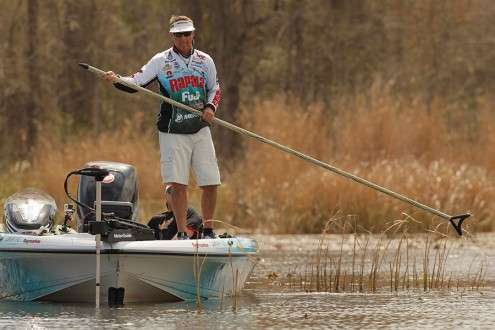
Even though bass in shallow water are sometimes tolerant of noise or boat movement, learning to use some stealth will improve your odds of fooling them. That means minimizing the use of the trolling motor and relying more on a push-pole and shallow water anchoring devices like the Power-Pole.
Even then it’s critical to keep some distance between you and the fish (or the cover they’re relating to). Again, we’re talking about clear, shallow water here. By doing so, you’ll greatly reduce the chances of alerting the fish to your presence.
While it’s sometimes possible to catch fish that know you’re there, I guarantee you’ll fool a lot more of them by using a quiet approach … bigger ones too!
Tackle and Technique
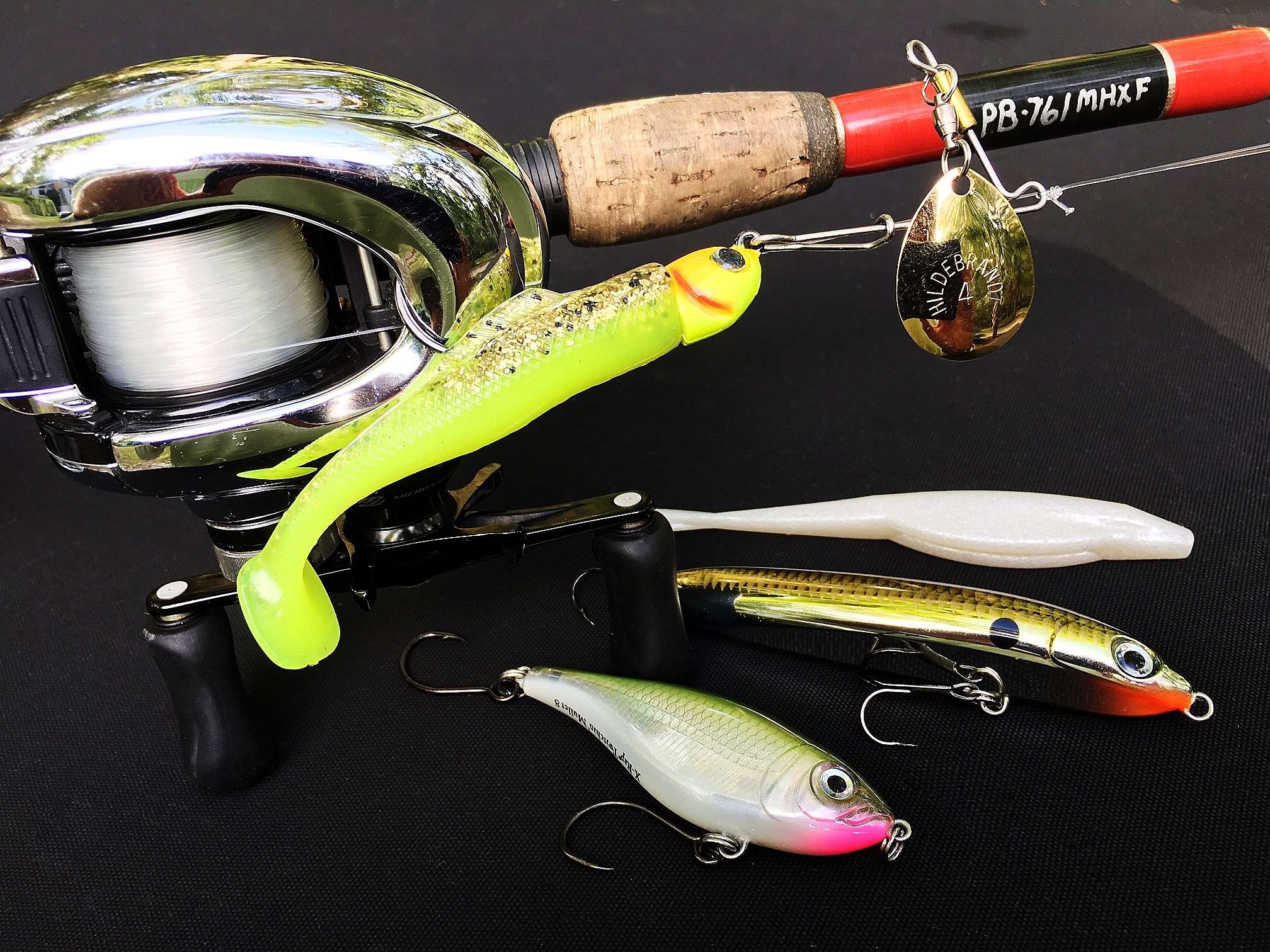
Much of the tackle I use for bass fishing overlaps to saltwater. Take my rods, for instance. Most are 6 feet 10 inches and 7 feet 2 inches in length, medium or medium-heavy action. That goes for both casting and spinning.
Rods in this range provide the distance and accuracy needed to put the lure where I want it, while giving me the length and leverage required to control the fish.
My knots and rigging are essentially the same. The only differences might be line size and strength. I frequently use a heavier main line with lighter leader for bass as opposed to a heavier leader with lighter main line for certain saltwater fish. Fish like tarpon and snook have sharp gill plates, and they shake their heads violently during battle, so a heavier leader is necessary. That’s not the case with bass.
Lures overlap as well. Topwaters, swimbaits and jerkbaits (soft and hard) work equally well in fresh- and saltwater. Spinnerbaits are great, too, but with a slight twist. The most effective spinnerbaits in saltwater feature a single blade and grub body (rather than tandem blades and silicone skirt).
The techniques I use in fresh and salt aren’t all that different either. Lure action, cadence and retrieve speed are pretty much the same. How I vary those depends more on conditions or the mood of the fish rather than the species I’m after.
So, if you want to learn a few tricks that will improve your bass fishing, consider spending a little time in the brine … or at least in tidal water. You’ll find a variety of species ready to strike a well-presented lure.