
JEFFERSON COUNTY, Tenn.—The St. Croix Bassmaster Southern Open at Cherokee Lake presents unique circumstances that the weekend tournament angler can universally apply in spring events, where largemouth and smallmouth share the same water.
The competition is two days, just like a weekend tournament, with many variables compressed into that shortened timeframe. Among them, a smallmouth and largemouth population eager to move shallow to spawn, with a series of cold snaps and warm-ups causing fluctuating water temperatures. The push-back, move-forward migration has evolved all week, a common scenario in early spring when cold fronts throw curveballs into the mix.
A consistent message punctuated the irony of what occurred when the tournament start was delayed by one day. Wednesday was a short practice day, due to the mandatory registration, and Thursday was canceled. The overarching message was that the off day improved the fishing.
“I’ll argue with anyone, an off day in every tournament makes the fishing better,” Bryan New said. “They smashed them today. If we didn’t have that off day, basically a day and a half off, we would have caught some, but it wouldn’t have been like this.”
“This lake fishes small with 225 boats in a tournament,” said David Kilgore. “The fish were hammered all week, and I truly believe that day and a half off the water made a difference, as it allowed them to settle down.”
Anglers at the top of the leaderboard were interviewed about lessons learned between practice, the down time, and the first day of competition. Here are takeaways you can use this spring.
Bryan New (1st; 19-3)
New’s mixed bag of largemouth and smallmouth didn’t come easy; he fished hard all day.
“It looks like I smashed them, but I didn’t,” New said. “I think I caught seven bass and lost two. It was one of those grinder days. This place had so much pressure this week and it is hard to run one deal. You have to do a little of this and a little of that.
The takeaway from New is on highly pressured lakes, keeping an open mind to the ever-changing conditions during spring is a must. New used three different lures to catch his limit, adding more to the arsenal as previous choices became less productive.
Shane Lineberger (2nd; 18-11)
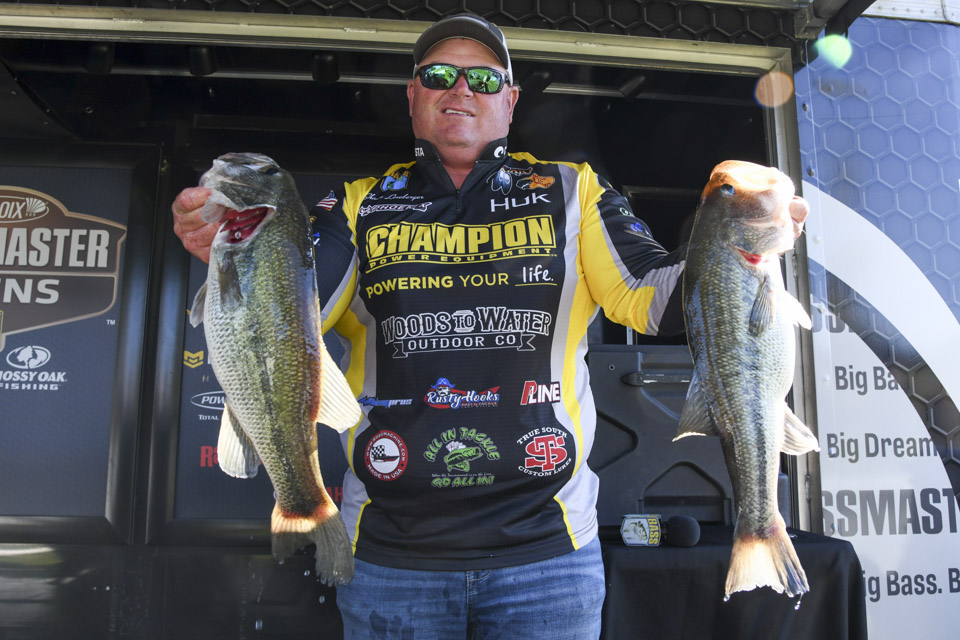
Lineberger’s limit of all largemouth was part of a plan that was a key lesson learned for anyone, anywhere.
Without a keeper in the livewell by mid-morning, Lineberger ditched tactics that he was forcing to make work, as those were patterns known to produce on Cherokee under the prevailing conditions.
“I picked up a bait I throw at home this time of year and started doing things I do around the house,” Lineberger said. “The first place I fished I caught three and I ran the pattern from there. It held up until I quit running it.”
Around the house is Lake Norman, a North Carolina impoundment that Lineberger said fishes very similar to his home lake. On Cherokee, Lineberger was trying to force a smallmouth bite, which didn’t work. Instead, he regained his confidence, and put himself in contention to win, by switching to familiar tactics that lined up with the conditions at Cherokee.
Frank Ramsey (3rd; 18-5)
The sun flipped the switch on largemouth movement and the bite lasted all day for Ramsey. He fished on the strength of a universal textbook pattern for spawning smallmouth. That was catching them around angler-planted brushpiles located near gravel shorelines favored by bedding smallmouth.
Ramsey discovered the pattern one week prior to the tournament. A cold front dropped water temperatures into the low 50s, with a warmup preceding the competition day raising temperatures into the high 50s. That required daily adjustments by Ramsey, to keep up with the movements of the bass.
“My lesson learned is to never stop practicing, even during a competition day,” Ramsey said. “I continued practicing, not locking into a pattern in other words, to relocate the bass as the moved,”
Jamie Bruce (4th; 18-2)
The Canadian angler is fishing in his first U.S. event, applying smallmouth tactics that work at home to Cherokee. Bruce is running an offshore pattern of 25 spots while fishing his strengths. He recognized the pattern could lose its productivity as warming water temperatures push the smallmouth from offshore to the shoreline.
“It’s a dying pattern but so is the shoreline bite, because those fish are getting so much pressure with most of the anglers beating the banks,” Bruce said.
The takeaway for Bruce, like Lineberger, is to play your strengths on unfamiliar lakes.
David Kilgore (6th; 17-13)
Kilgore killed time by first following the crowd. After two hours without results he gave up on the smallmouth.
Kilgore’s home water of Smith Lake in Alabama also fishes similar to Cherokee. The bulk of his weight came after he switched to largemouth, also landing a quality spotted bass to the livewell, all of which lined up with his skills on Smith Lake, where he dominates local events.
The lesson learned, like Lineberger and Bruce, is to fish your familiar strengths when what should be working, locally, is not producing.
Coop Gallant (8th; 17-8)
Gallant applied his Canadian skills to Cherokee, catching 14 pounds of his limit in 7 casts. Like Bruce, Gallant assembled a productive offshore bite, also recognizing it could become unproductive with the warming water.
The warming trend should continue on Saturday, the final day, although Gallant planned to stay with his offshore program until being forced to move shallower.
“If they relocate, I’ve got an idea where they will go,” Gallant said. “I’ll make adjustments in the afternoon if they do.”
The takeaway is gain confidence in using your angling strengths, while being prepared to refine those tactics as needed with the changing conditions.