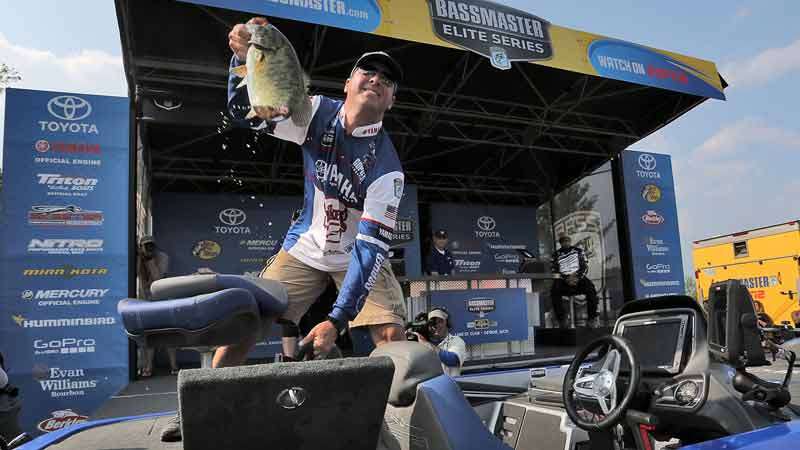
JASPER, Texas – Todd Faircloth figures fishing points a fickle finger of fate. Things can turn quickly, good or bad, and he doesn’t have a definitive answer why. Both are just part of the sport.
So Faircloth can’t really explain why he suffered one of the worst slumps in his career last season, or what he did to rally out of that low and secure a berth in the 2016 GEICO Bassmaster Classic.
“I’ve been fortunate to be on those real highs in the sport,” the five-time Elite winner said. “It seems like everything is just rolling. You’re instinctively making good decisions out on the water. I’ve been on the other side of that where it seems like every decision you make is the wrong decision.”
In his 20 years of fishing B.A.S.S., Faircloth has made more right decisions. He’s been one of the steadiest hands, finishing in the money 139 times in 192 events, an impressive 72 percent. That consistency has quietly put him 12th on the all-time money list with B.A.S.S., his latest win putting him over $2 million.
He’s also one of three Top 12 earners who haven’t won a Classic or the Toyota Bassmaster Angler of the Year. But he’s been heartbreakingly close to each.
“This sport can be very humbling,” he said. “Just when you think you’ve got it all figured, it can be reversed real quick.”
LIVING IN LAKE COUNTRY
There’s a sign about 10 miles north of Jasper on Highway 96. It points out that west on Highway 255 is the Sam Rayburn dam, and east is the Toledo Bend dam. Both are famed bass fisheries. Heading into town, the first several businesses are boating and fishing related.
Jasper is definitely lake country … bass country … fishing tournament country.
Faircloth has lived his entire life here. He started fishing young and found success in local events. He worked for his father’s business, Albert Faircloth Construction, and even teamed with him in local tournaments.
“I think one year me and Dad probably won four or five boats,” he said. “We won some championships.”
Working for his father afforded Faircloth the leeway to save up and branch out. After his first B.A.S.S. tournament in 1996, it was several years before he went full-time and began finding tournament success.
“The very first year I fished the tour was one where they didn’t have an off-limits,” he said. “B.A.S.S. only did it for one or two years. It allowed me some flexibility as far as going and getting more than three days of practice. I think that benefited me.
“Going to a body of water you’ve never seen and trying to figure it out in a short process, that’s the biggest learning curve.”
His first Bassmaster check came on Sam Rayburn. While he had some sponsorship help, he said it takes some stability and performance before most sponsors consider backing an angler.
He said once he established himself and qualified for a few Classics, “They start seeing value in Todd Faircloth and start stepping up to the plate,” he said. “It’s a growing deal to work relationships. It’s just a process.”
Long business relationships have been made with Skeeter and Yamaha, among others, and he said it’s great to align with companies and products he believes in and wants to use.
“I don’t know if a professional angler gets to a point to where he feels like he’s made it,” he said. “I’ve been doing it now for 16 years full-time. I guess when I finally started feeling some stability, it was five years in. I’ve been fortunate to make a living at it and provide for my family.”
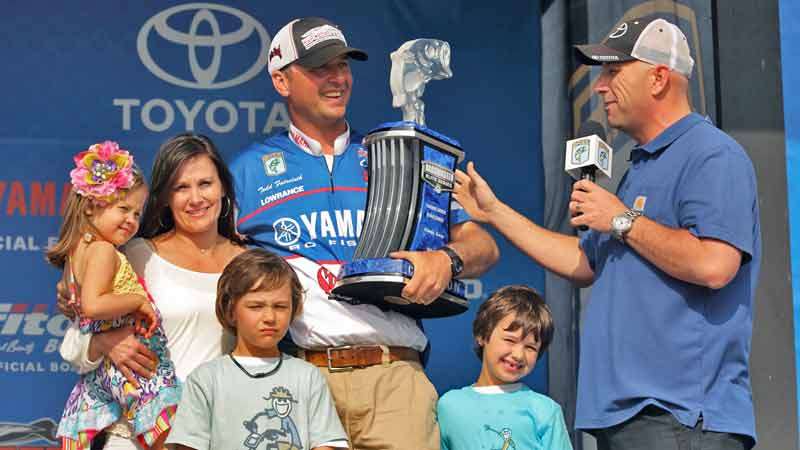
Faircloth, his wife, Angie, and their three children live in a beautiful home in a quiet neighborhood. It’s next door to a house he grew up in. Faircloth likes the small-town atmosphere the city of 7,590 affords his family. They’re not going anywhere.
LEARNING TO WIN
Swinging for the fences is not Faircloth’s game. He simply tries to take what the fishery gives him – he evaluates his practice and adjusts accordingly. He’s most comfortable and calm fishing once he gets a limit in the boat. The first spot he hits is one he believes will give him the most bites.
“Sometimes you have to go on damage control. Take what you’ve got,” he said. “I feel if you can consistently cash checks, take what the lake gives you, not try to hit a home run every time, points add up at the end of the year.”
Faircloth wasn’t even thinking win when he did capture his first Elite title. He was among the leaders on Table Rock in 2006 after Day 2, but his mind was concentrating solely on qualifying for the Classic. Then Alton Jones posed a question that woke him up.
“Alton asked, ‘You think you can win?’ ‘Man, I hadn’t really thought about it,’” Faircloth said. “He’s like, ‘You need to start.’ And he was right. Until that moment, it hadn’t crossed my mind.”
The opportunities to close out a tournament win are few and far between. He’s gotten better at seizing those moments, but there are no events he circles on the calendar. He just goes and fishes.
“I can’t explain the tournaments I won. It’s really kind of weird,” he said. “I’ve had good practice and felt like I was going to do really well, and not do good at all. There’s so many variables in our sport.”
That was the case when he faltered at the final event in 2008, allowing Kevin VanDam to steal the AOY from his grasp. Faircloth had a great year, making the cut in every Elite event. He won his second event and had six top 10s, including the week before on Lake Erie. So heading into Oneida, he had the points lead and then had one of his better practices, finding three or four schools of fish. He felt confident.
“I go out there to the first spot and it’s like somebody flipped a switch. They’re gone. It just snowballed from there,” he said. “I couldn’t get anything going. I kept going back, thinking those fish would show up at a different time of day.”
They never did. He missed the cut and finished 93rd. KVD finished 38th to claim his fourth AOY. What hurt more was Faircloth only needed a decent finish to add AOY to his resume.
“If I had one tournament to take back in my career, that would be it,” he said. “That was hard on me. It was probably harder on my wife. That was probably the most important tournament of my career, and it was probably the worst finish of my career. I almost finished dead last.
“You can try to learn from it. Every time I’ve been back to Oneida, I’ve done really well. You try to learn from that. It still stings to this day when I talk about it.”

RISING FROM THE ASHES
Fortunes can turn quickly; Faircloth proved that again last year. He was down and out, thinking there was no way he could climb in the points standings to qualify for his 14th Classic. He had a Top 10 in the season opener on the Sabine River, where he had won two years earlier.
“After that, it’s like the wheels came off the bus,” he said. “I started second guessing my decisions on the water. It had been a long time since I did that.”
He only got close to cashing a check in one of the next five events, his worst stretch ever. He said he went to the second-to-last event with one goal.
“When I left the house, I told myself I just want to cash a check and end the season on a positive note. I didn’t think there was any way possible I could qualify for the Classic,” he said.
He finished 17th at Cheasapeake Bay to climb from 81st to 63rd in the AOY points standings. His victory at St. Clair salvaged the season, propelling him to 40th and into the AOY Championship. His 11th at Sturgeon Bay secured a Classic berth.
“It all worked out. That’s just how our sport is,” he said. “I don’t have a textbook answer. It’s just the nature of our sport.”
ON THE HORIZON
Like every angler, Faircloth has dreamed of winning a Bassmaster Classic. He’s come pretty close. His concentrated efforts on winning the championship have led to six Top 10 finishes in 13 appearances, including a third in 2010 at Lay Lake.
Faircloth was within 3 ounces of leader Jeff Kriet heading into the final day, but VanDam overtook them both in Beeswax Creek. Faircloth thought Kriet would win because he had the biggest stretch that he could protect. KVD had an area to himself while Faircloth had a couple spots he couldn’t protect.
“Kevin was catching them in the very back, and I felt like with the cold water, more fish would come out toward Kriet,” he said. “But it’s like they swam in there overnight and KVD just kicked our butts.”
Afterward in the press room, the anguish of coming so close showed in Faircloth’s face. Most anglers realize they will only have limited chances to capture any title, even fewer with the big ones. He saw that he missed a golden opportunity.
“You have to realize that situation and take advantage of it, because there are not a whole lot of opportunities during your career, or during a year,” he said.
Faircloth said he feels fortunate to have won five Elite tournaments, but he’s no different from other anglers who have put a premium on winning the Classic and an AOY. But he tries to keep that in proper perspective.
“Those are two of my goals to accomplish before I’m done,” he said. “If I do it, that’s great. If I don’t, I’m not going to dwell on it either because I’ve been successful. I’ve had a great career.
“I’m one of those people who believe, if it’s meant to be, it’s meant to be. If it’s my turn, I’ll gracefully enjoy it, but if it doesn’t happen, I’ll be OK with it too. If I don’t ever win either of those, I won’t feel like my career is incomplete.”
As long as he maintains a competitive edge, Faircloth said he will continue to compete at the highest level. Next up is the Classic on Grand Lake, where Faircloth took ninth in 2013. After finishing last season on such a high note, he’s excited for the season to start.
At 40, he believes he’s near the prime age to win. That’s around the age many anglers have won major titles. They still possess the physical skills and can use past experiences to have the fickle finger of fate point their direction.
“In other sports, you have to be a lot younger,” he said. “In fishing, you have to be older … and a little bit wiser.”