
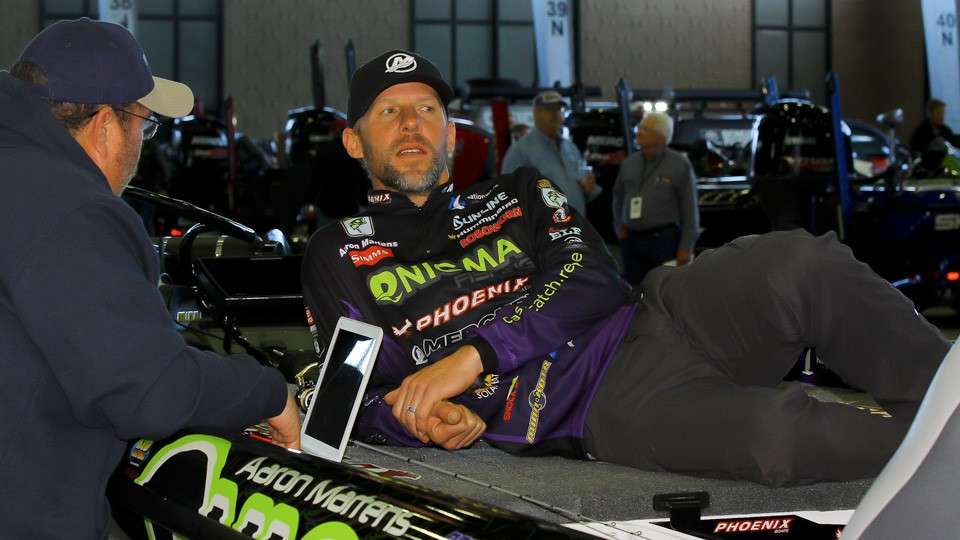
TULSA, Okla. – Martens is leery, KVD grateful, Edwin honored, Ike thrilled and Casey jealous. Anglers have different takes on the dynamic of how Bassmaster Classic LIVE will affect fishing.
LIVE will air for six hours each of the next three days starting at 7:30 a.m. Friday, Day 1 of the 2016 GEICO Bassmaster Classic presented by GoPro.
Aaron Martens, who had a LIVE camera with him the most last year as he dominated in a third Toyota Angler of the Year run, said being among the six anglers with a transmitting camera on Day 1 is slightly unnerving.
“I think about last year, (LIVE) didn’t seem to affect my performance as much, so maybe I just ignore it?” he asked. “I have stuff I consider secret, and it’s a little unnerving. I had some things last year I didn’t want a lot of people to see.”
His blackbird pattern among them. Their deepest fishing secrets are potentially the concern of every angler with a camera in their boat. If they do well, other anglers could see their lures and areas and replicate it, even steal a fish from their spot that could cost them the title.
“I got the best bait figured out,” Martens said. “But you can’t really hide bait that much.”
B.A.S.S. hopes it remedied the potential for improprieties by holding the archival LIVE videos until the event is over. Don’t expect to see a rerun of LIVE this weekend. If you want to watch an angler catch the potential winning fish, viewers will have to watch LIVE live. Or wait till Monday.
In that case, Martens said anglers with cameramen in their boats would have recourse if another angler shows up at his spot using an identical bait. Only anglers are allowed to share information, and none can watch LIVE during their day fishing. That information would have to be shared by an outside source and therefore be illegally obtained.
“If somebody does end up finding out what I’m using, they’re breaking the rules,” Martens said. “They can get disqualified.”
Martens said instead he might be more worried about the overzealous spectator who gets so hepped up watching all the pros catch fish that they feel compelled to fish.
“There’s going to be lots of spectator traffic, especially with the weekend being nice,” Martens said, “and they’re going to see what I’m throwing and a lot of them are going to have the same baits … and lightbulbs are going to go off.”
He sees that scenario when a non-competitor tries his spot and plucks out what might have been a winning fish for him.
Besides Martens, the Day 1 lineup of anglers with cameras in their boats is Kevin VanDam, local favorites Edwin Evers and Jason Christie, and Mike Iaconelli, who finished fourth in the 2013 Classic here. Brandon Palaniuk (runner-up in 2013) hzs a camera in his boat, but not a live feed.
VanDam, who’s absence last year was his first from a Classic in a quarter century, said he’s comfortable with a cameraman in his boat but relates the concerns.
“In a three-day Classic, to be able to maybe have that one day without all the extra attention, it’s beneficial, there’s no doubt, but I understand that’s where I’m in the sport,” he said. “It’s good that I’m relevant before the start. It’s a good problem to have.”
KVD said he thinks he and Iaconelli are probably the two anglers who best understand how to deal with things like 50-boat spectator galleries and cameramen.
“I’ve always figured out that you worry about variables you can control, but you have to understand every variable you have to deal with. And that’s one that I understand,” VanDam said. “Is it exactly the way I would prefer from a competitive standpoint? No, but you make the most of it.”
Like Martens, KVD said he thinks news does travel fast at any Classic, because they certainly aren’t fishing in a vacuum.
“This is the biggest stage there is, and nobody is going fly under the radar for very long,” he said. “With BASSTrakk and that, if somebody is doing well, they may get one little jump, but (attention is) going to happen pretty quick.”

Edwin Evers has been known to play most events close to the vest. One of his main tactics in winning back-to-back events last year was staying off the beaten path, and to keep moving. He’s fine with a camera on Day 1.
“It’s one of those things you can get upset about, but nobody is going to listen to you,” he said. “Now it’s a part of the Classic, every day, and I’m actually very honored.”
An angler might hope to keep a potential winning bait to themselves for an entire event, but he knows in this day and age that’s impossible. There’s hopes LIVE cameraman won’t zoom in on baits to show every nuance, but anglers have no sleight of hand tactic or alteration in their fishing style to really prevent it.
“No, because then it affects the outcome,” Evers said. “In my opinion, I think the camera guys are going to try to respect that — I think they’re going to try to not focus in on the baits.
“But I’m ready to go. I’m excited about it.”
Mike Iaconelli views a camera in his boat very positively. He said it’s a definite win-win situation for him.
“I love it. The first win is you get coverage no matter what happens. From a business perspective, that’s a great thing,” Ike said. “The other win is having a camera does different things to different people. For some guys, they get nervous, they get uptight.
“For me, it pumps me up, takes me to the next level. I want to perform better. That’s important. It’s going to help me.”
Jason Christie might seem quiet like his Oklahoman brethren Evers, but he sees having a camera mostly as a position. It could turn the pressure up if things to south.
“It’s good — whatever we have to do to grow the sport,” said the former basketball star. “It’s just like playing in a gym full of fans. You start making them, you can feed off that camera. But if you don’t make it, you can go the opposite direction.”
That would be one potentially huge downfall.
ASHLEY KINDA JEALOUS
Yes, defending Classic champion Casey Ashley admitted he’s a skoosh jealous that he won’t have a LIVE camera in his boat, at least not Friday.
“Last year, I think I was the first one to catch one on LIVE,” he said. “Me knowing now how it really works – I didn’t know anything then – I see how big a tool it is. I can tell you if you get it in your boat, you better make the best of it.”
That speaks to Christie’s thought that a bad start could add pressure. Ashley said during the Elite season he was able to watch LIVE, figure out its affects and see how much it could benefit an angler who has a fantastic day.
“It’s you and the audience — it’s not Mercer interviewing you, not Zona interviewing you. It’s just you,” Ashley said. “Your way to be yourself and delivery how you want to deliver. You’re fishing and you’re explaining what you’re doing, or not.
“They’re sitting there watching you and how the day is going and what you’re thinking, if you’re willing to tell them. That’s a big part of it. That’s something that nobody’s ever seen before.”
Ashley had a thought similar to Jerry McKinnis when the B.A.S.S. owner first heard of the new technology. McKinnis said he envisioned someday when there were a dozen windows on a screen and viewers could click on which angler they wanted to watch live. Ashley took that a bit further.
“I’m waiting for them to get a hundred of them — you talk about changing the sport – whooo!” he said. “I turned it on and couldn’t stop watching, and I don’t watch internet.”
MERCER DISCUSSES LIVE NEW WORLD
TV host and Elite emcee Dave Mercer said even he was somewhat enlightened with the advent of LIVE.
“What I like is it exposes what these guys go through,” he said. “Even myself, I don’t truly see what happens in an entire day. Up until last year, we would see just a little, the beginning and the end.”
Martens’ big rebound at Chesapeake Bay after a morning of struggles is a prime example. Mercer said by just seeing the weigh-in it would appear he hammered fish all day, when in fact he had basically nothing midway through the day.
“It has helped show just how mentally strong they have to be,” Mercer said, who then addressed the concern of secrecy. “As an angler, I understand that, but it’s also now part of the beast.
“It’s something you deal with as a tournament angler, even at a lowest level, even in the Tuesday night jackpots. The best way to keep a spot is to never show it, but if you fish, you have to go to it at some point.”
He said there is a learning curve, and while not really calling out Bill Lowen, he points out that he was too nice in that Chesapeake event.
“Aaron talked but he never stopped casting” he said. “Bill, every time he got into explaining something, he stopped. There was a point where he didn’t cast for almost four minutes.”
Take note guys.
FORECAST SHOWS SMOOTH SAILING
No record lows are predicted this year for competition days of the Classic. Compared to 2013, when icicles formed on trailers in minutes, this year will be downright balmy.
The low Friday morning at launch is expected to be 38 degrees for the 7 a.m. launch, but sunny conditions will help temps rapidly rise, to 55 by 10 a.m., 63 by noon and near 68 when the first flight is expected in at 2:45 p.m.
Saturday’s temp at launch is forecast at 44 and sun will have temps rise similarly to Friday. Sunday’s forecast is a near identical repeat of Saturday. There was no rain forecast on any day.

KEEPING UP WITH JONES’ PRACTICE
Alton Jones, who won his Classic back in 2008 on Lake Hartwell, has been at this game for awhile now and knows how to develop a game plan. We asked how to approach Classic practice.
“During the first three days of practice, we have tried to put together as much information as we can about what the fish are doing, the types of place they’re using, types of water they’re in,” Jones said. “Now we try to expand on what we’ve learned and fill in a few more gaps.
“It’s a puzzle out there and every day you put a few more pieces in and hopefully by the time the tournament starts you have a pretty good picture.”
Jones said one thing he didn’t do Wednesday was recheck areas he already had down as definite places to fish on Day 1.
“If you go back into an area where you found fish in practice, there’s only two things that can happen and both of them are bad,” he said. “One is, you’re not going to get a bit and you’ll lose confidence in a good area. No 2, you’re going to stick a fish that you’re going to wish you waited until Friday for.”
Jones doesn’t just shake off fish during the Wednesday practice, he cuts the hooks off his baits so there’s not even a chance of an accidental hooking. He also accomplished some goals.
“I eliminated a lot more water and I found two more places that made my checklist to hit,” he said, “and I found a plan B.”