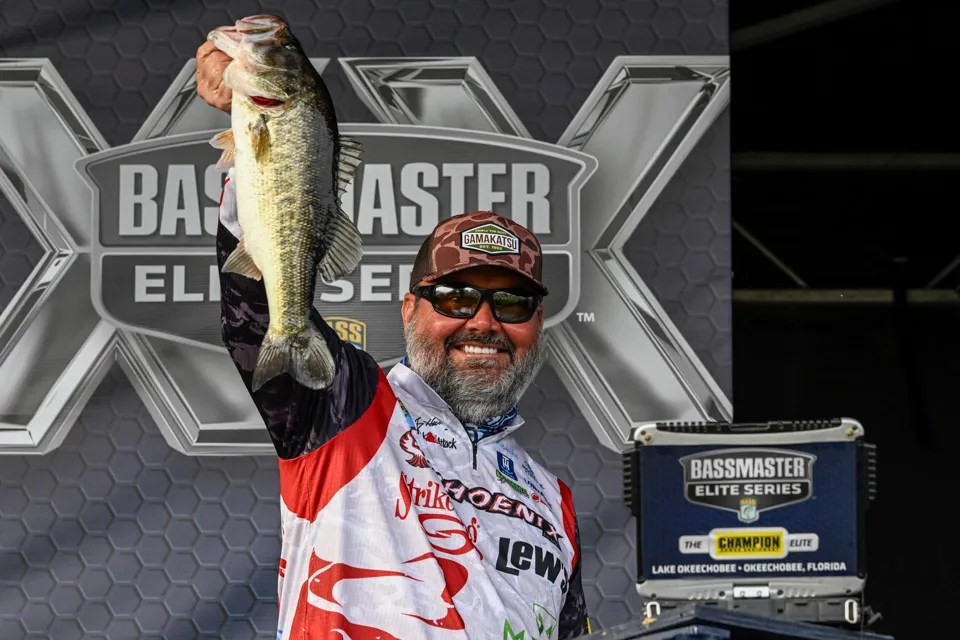
FORT WORTH, Texas — Greg Hackney’s an easygoing guy who typically keeps to himself and avoids irritating others around him.
Most of the time.
During the prespawn, it’s a different story. Throughout this seasonal phase that’s likely to backdrop the 2025 Bass Pro Shops Bassmaster Classic presented by Under Armour, the seasoned veteran from Gonzales, La., does his best to grate the nerves and provoke violence.
Wait, we need to clarify.
Hackney’s not randomly picking fights with fellow anglers; rather, he’s leveraging the annual grumpiness typifying big bass demeanor by employing the tools that really press their buttons.
“I think it’s about the mood those fish are in,” Hackney said. “They don’t have to eat a lot because they don’t lose weight in winter when their metabolism is slower. I think a lot of times in the prespawn, they bite because they don’t like a lot of commotion around them.”
Dynamic duo
Many baits and tactics will deliver big bites during the sport’s biggest event and Hackney realizes that having a mix of spinnerbaits, swim jigs and topwaters handy just makes sense. However, anywhere on southern waters, his early spring go-to baits are lipless crankbaits and a vibrating jig.
In his view, those are the perfect tools for poking the bear, so to speak. Both visually bold and intrusive, Hackney turns up the volume by selecting the loudest versions — the Strike King Redeyed Shad Tungsten 2 Tap and the Strike King Thunder Cricket Vibrating Swim Jig.
Rattle time: “I think it fires an aggressive nature in those fish,” Hackney said of his Redeyed Shad. “You can catch bass on a lipless bait anytime of the year, but it always seems to be most effective in the prespawn.
“Realistically, to me, 48 to 55 degrees is when that Redeyed Shad performs the best. You can catch them on it when it’s colder or warmer, but during that 48- to 55-degree period, this is my No. 1 bait for prespawn largemouth. That rattle triggers their instinct.”
Whether prespawners are staging on low vegetation (old growth that winter withered, or new growth) at the edge of flats, or following drains, Hackney likes the fact that he can cover lots of water and present a bait with a hard knocking sound that just bugs those big fish into snapping out of irritation.
“Typically, I start with the regular Redeyed Shad, but I always have the two baits rigged up in the same color,” Hackney said. “That way, I’m able to show those fish something different throughout the day. Or, once I’ve fished for them, I can come back through there and utilize both lures.
“Changing the sound will get you some extra bites, because if you’re sitting on a school of fish and you’re constantly fishing them with the same bait, they will eventually get acclimated to it. Typically, if you show them a different sound, you can fire them up again.”
Hackney most often uses the 1/2-ounce bait, but he may go to a 3/4-ounce on windy days. On flat days with high clarity, or chilly postfrontal days, he’ll downsize to a 1/2-ounce Redeyed Shad.
Blade runner: Once spring water temperatures break 55 degrees, Hackney goes straight to the Thunder Cricket’s tungsten model.
“It has a tighter action, it’s faster, which I think is better in colder water, and it’s more compact, so it’s easier to fish deeper,” he said. “It’s easier to get the 3/8- or 1/2-ounce down to the fish, especially if they’re relating to cover.”
Expecting fish to ease shallower once the water heads into the upper 50s, Hackney knows the vibrating jig’s larger profile and greater commotion plays upon the fish’s increasing aggression.
“It’s like those fish go into a different mood as it warms up,” he said. “The Thunder Cricket is good when you get good weather, but it will catch them under a wider range of conditions that are not as conducive for the Redeyed Shad — the wind slacks off, it’s a little warmer, those fish start to move up. The Thunder Cricket is a better choice.
“Much like the lipless bait, you can go into those flat pockets and bays and you can cover a ton of water and generate big bites. You can fire it out in 5 feet of water and turn around and throw it up in 1 foot. That tungsten is easier to get deeper because it’s denser than lead, so it has a smaller profile.”
Hackney prefers a Strike King Blade Minnow for its slender fish like form that allows him to fish his bait deeper. When he’s targeting cover in stained water, a Strike King Rage Swimmer gets the call, as it helps hold the bait higher in the water column.
Lauding the seasonal efficiency of his Redeyed Shad/Thunder Cricket combo, Hackney said, “I could take those two baits and fish prespawn and spawn. I use the Redeyed when they transition, and the Thunder Cricket will carry me right into the spawn.”
Tactical tips
Throughout the spring season, tempting big bites requires attention to detail and intentionality. Here’s a parting roundup of presentation strategies that’ll tilt the odds in your favor.
Pushing water: Bill Lowen, who won the 2025 Bassmaster Elite Series season opener at the St. Johns River, often pairs his signature series Lure Parts Online swim jig with a Zoom Super Speed Craw. An enhanced version of the popular Ultra Vibe Speed Craw, this 4-inch bait features wider, bulkier claws made for maximum motion.
As spring unfolds, Lowen measures his retrieves based on water temperature. When it’s on the rise, he can put on a show with a peppy pace, but when a lake’s lagging on the warmup, or maybe he’s simply dealing with the impacts of a late-season cold front, he knows that slow and steady gets the bites.
“The reason I use that trailer is so I can bulge it almost like a single blade spinnerbait,” Lowen said. “Those big (claws) on that trailer have a lot of resistance and that allows me to fish it really slow when the water’s cold.”
In their face: John Garrett, who placed fourth at the St. Johns Elite, caught several of his key fish on a black and blue Strike King Tour Grade Swim Jig with a Strike King Scounbug trailer. This setup, plus specific rod work, enables Garrett to search shallow areas for spring fish on the verge of committing to beds, and the highly territorial ones that recently committed.
“I keep that bait really high on top and even the ones that don’t eat it show themselves,” Garrett said. “That Scounbug is probably more of a flipping bait, but it has those two big claws, so I put in on the back of my swim jig to lift it up.”
Garrett makes a noteworthy point: When he can’t eyeball bass beds, he wants to find active areas and then pick them apart with a flipping rig. If a fish bites the search bait — wonderful. However, even the ones that simply dash out to run off intruders offer valuable insight.
“I use a 7-6 rod just to keep it high in the water,” Garrett said. “They would probably bite it better if I swim it lower, but I would never know if I had a follower.”
Diversity delivers: As Hackney points out, the bladed jig is the four-wheel drive vehicle of spring fishing. From open water to snagging grass, to bumping cover, this bait does it all.
David Gaston placed sixth at the Lake Okeechobee Elite with a four-day total of 68-4 buoyed by an 11-pound, 8-ounce Florida tank — the largest fish caught at Lake Okeechobee in Elite history. Catching all his fish on a 1/2-ounce Z-Man ChatterBait in the black/blue and golden shiner colors, Gaston said this presentation is ideal for a classic prespawn habitat — riprap like the stretches he fished in the Indian Prairie Canal.
“I can catch on a wacky rig, a Texas-rigged worm and, sometimes, a frog, but a ChatterBait is the only thing I can keep in my hand and get them to bite on the bank, or out there in 3 to 4 feet of water,” Gaston said. “I can cover the whole place and comb it over.”
Close contact is Gaston’s key and, even though he suffers the occasional snag, he finds that grinding the bait against the rocks is the best way to capitalize on the season’s transitional zone.
“I might go an hour without a bite and all of a sudden, I’ll catch two or three of them,” Gaston said. “You gotta be there when they pull up.”