If I had to pick the waters that have had the most powerful influence on my bass fishing education, strip mine lakes would be my primary mentors.
In fact, the soft spot I have for finesse fishing is because of the unwitting largesse of Peabody Coal Co. and its open-pit mining ventures.
To this day, I trace my recognition of the subtle tap of a largemouth bass inhaling a plastic worm with the comparable pluck of a bass taking a nightcrawler in those clear, steep-banked strip pits near my home. And any sensitivity I may have cultivated in fishing deep clear lakes with jigs and plastics has come from plumbing the 20-foot-plus depths of the pits as well.
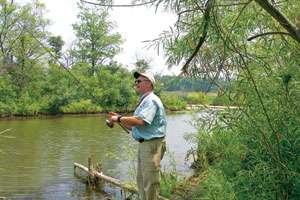
But something else makes fishing the haunting hills, clear trenches and pothole ponds of the old mining areas memorable. It's the solitude and enjoyment of discovery that comes with finding and fishing waters sometimes miles from the nearest road and next angler.
Strip mine lakes are the aftermath of open pit or "surface" coal mining, a common excavation practice in Midwest states such as Illinois, Missouri, Kentucky, Ohio, Iowa and Indiana. Strip mining digs away the top layer of earth, called the overburden, to access coal deposits. Deep pits and hills of earth remain. Seeps and springs fill the cavities, creating waters that range from fraction-of-an-acre frog ponds to chains of finger lakes that can stretch for miles.
Environmental controversy has compelled more careful reclamation practices on strip mine lands in recent decades. In some states, the mining practice has been banned altogether. Yet many strip mine areas have become de facto wildlife oases amid highly developed agricultural lands and are cherished by nature lovers.
Despite the challenges the pits pose, they can be unbelievably bountiful to bass anglers. Sometimes 40-, 60- and 80-bass days are possible in particularly fertile waters. The fish may range from aquarium-size specimens to the lunker of a lifetime.
Depending on where you are and whom you talk to, the "pits" are overfished, underfished, hard to fish, or just plain puzzling and unpredictable. Indeed, plenty of strip mine waters fit each description. Some are mud holes where water has seeped into mere depressions, while others are deep, clear, high-sided trenches.
Many fishermen avoid strip mine lakes because they are hard to access. On top of that, their depth, clarity and steep banks overgrown with vegetation make for tough fishing whether you're casting from bank or watercraft.
The acid test
Most confusing of all is strip mine lakes' fish-producing capacity. Some are highly fertile with an impressive pound-per-acre fish yield while others can sustain almost no life at all.
"With the fertility of our land, the strip mines in western Illinois are very productive," said Ken Russell, district biologist for the Illinois Department of Natural Resources. The fertility of the impoundment basin and water draining across fertile land feeds a healthy food chain. In general, mined areas with deeper topsoil will yield more productive fishing lakes.
"Our waters can support more pounds of fish life per acre — up to a third more in many cases — than strip mine lakes in other areas."
Yet even infertile strip mine lakes sometimes produce big fish. "Strip mine bass may live a long time and grow to large proportions even in more sterile waters," said Dale Cornelius, fisheries management biologist for the Missouri Department of Conservation (DOC).
"Learn to avoid acidic pits," warned Rick Horton, biologist for the Missouri DOC, who stressed the "tremendous variance" in strip pit fertility. "Hot" pits result from a basin or runoff high in sulfuric acid. "Some have a pH of 3.0, almost that of lemon juice." High acid waters will affect bass growth and numbers. Some support no fish life at all.
Expect the unexpected. Pack bug repellent to ward off the chiggers, ticks and other insects that often thrive in these wild lands. Tread carefully along strip mine shorelines, which may be very steep or eroded and undercut.
"Not all the lakes are fisherman friendly," said Horton. "You can step or fall from the bank into 25 feet of water."
Yet the remoteness and degree of difficulty that comes with fishing the pits is part of their unique charm — and why they often produce oversized bass specimens. Big bass deep in the strip pit wilds may see few, if any, angler offerings.
"The more you dig around, the better your chance of finding that pot of gold," said Mitch Carpenter, representative for the Ohio DNR Division of Wildlife. He also recommends small and even backpack watercraft to reach prime waters. "There's lots of kayak and belly boat opportunity."
"Spring produces a good proportion of the lunker bass," said IDNR's Russell, who has captured bass up to 9 1/2 pounds — and many more than 8 pounds — during strip mine population surveys. The fish are spending more time on or near shallow lips and flats at this time, he noted. Many pits have a distinct deep area where the mining shovel stopped and a "spoil side" with telltale piled earth and shallow water.
The "shallows" can be small and crowded in spring on many pit lakes. With lots of fish competing for prime spawning areas, interesting things happen, including uncommonly high natural hybridization within the sunfish family. Hybrids of green sunfish and bluegill as well as redear sunfish and bluegill are particularly high, though anglers and biologists frequently report other sunfish gene combos, too.
Clear water tactics
Despite wide variation, the prototypical pit is deep and clear. Fertile basins host an abundance of aquatic plants, at least in the shallows and fringe areas.
Clear water means spookier bass, and IDNR's Russell advises anglers headed to the pits to change to deep-water tactics.
"On the biggest lake at Snake Den Hollow, we dropped a secchi dish and found visibility to the 30- to 35-foot depths," Russell said. "That is extremely clear water!"
"Long casts and light line … and camouflage yourself," recommended Ohio DNR's Carpenter to get an edge on spooky pit bass. He also opts for natural finish baits, slender Original Rapalas, along with bread-and-butter baits such as tube jigs and plastic worms.
"It's not uncommon to work an area for a couple of days and start catching numbers of 3-, 4- or even 5-pound bass, with a good chance at a 6- or 7-pounder," Carpenter added.
Sure, strip mine lakes can take you to school. But learn them well, and these deep, strange waters can earn you, too, an advanced degree in Bass Mining.