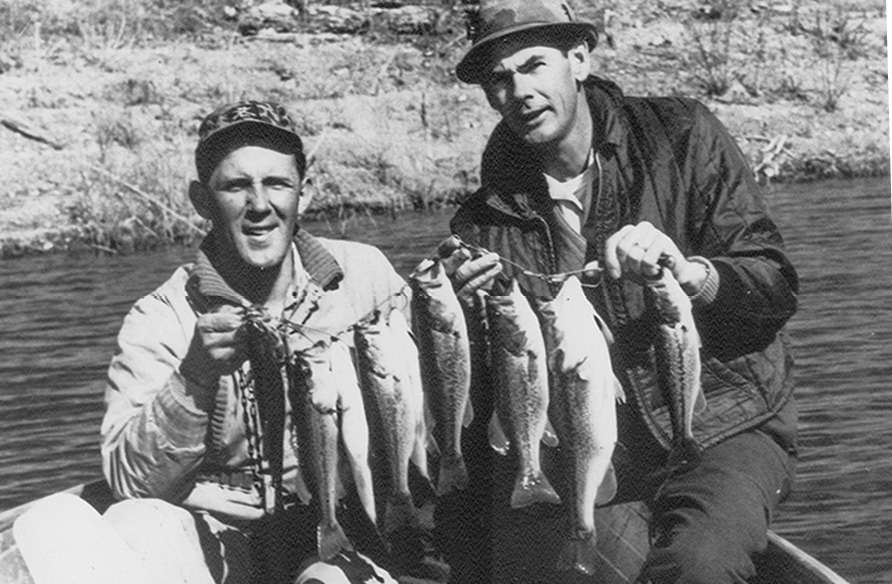

When anglers think about the history of the Bass Anglers Sportsman Society, legendary B.A.S.S. names like Ray Scott, Bill Dance and Roland Martin often come to mind. Yet one of the most influential figures in the development of tournament bass fishing was a man whose contributions extended well beyond victories.
That man was Glen Andrews, who passed away on June 23 at the age of 95. The Bass Fishing Hall of Fame 2023 inductee not only established himself as one of the sport’s earliest champions but also helped create the competitive standards that continue to guide B.A.S.S. tournaments today.
A loosely defined definition of tournament fishing was evolving in the early to mid-1960s and Andrews developed a reputation as a feared competitor. Andrews hailed from Lead Hill, Ark., located on Bull Shoals Lake and near other bass-fertile waters that include Table Rock Lake and Beaver Lake, all lying within the Ozark Highlands of northern Arkansas and southern Missouri.
Andrews won three Missouri State Championships, an Arkansas State Championship, was twice runner-up in the World Championship and won it twice between 1962-1966. The World Championship was formally known as the World Series of Sportfishing and were the first national fishing contests involving anglers from all over the country. Andrews was the only angler to win two of those titles.
By 1967, when Ray Scott’s vision was coming together for his first bass tournament on Beaver Lake, Ark., he enlisted Andrews as his rules committee chairman, effectively preventing him from competing (to keep the playing field level), but more importantly to make sure that tournament rules would be strict, fair and consistent in aligning with Scott’s vision to elevate bass fishing to the level of pro sports like golf, football and others.
First, there were hurdles to overcome in convincing local officials in Rogers, Ark., to host and sponsor the All-American. The powers that be would not approve the event unless Andrews gave it his blessing. Once he signed off, Andrews assisted Scott in filling the field with anglers ready to travel and compete. He also served as the Rules Chairman during that tournament and helped install the framework of rules that tournament anglers still compete under today.
Although Andrews was not the sole author of the rulebook, his influence reflected the philosophy that successful tournaments required more than talented anglers. They required fairness, consistency and clearly defined expectations.
While he didn’t collect a dollar of prize money from his competitive exploits, he gained respect and success as a guide and lure designer. He helped develop and was the first man to market what is now known as the Texas rig. Back in the 60s, it was the Andrews Slip-Sinker Worm. Some of the sport’s most revered legends gave deference to Andrews, who served as a mentor for the likes of Bill Dance and Bobby Murray.
“Glen wasn’t one of the best, he was the best,” said Dance. “I can say without hesitation that Glen helped make me a better fisherman. He taught me how to fish deep water, read structure, understand maps and electronics, and think differently about finding bass.
“Beyond all his accomplishments, Glen was simply a good man. Kind, humble, generous, and always willing to help someone else. Nobody deserved induction into the Bass Fishing Hall of Fame more than my mentor and great friend.”
Andrews’ success in pre-B.A.S.S. competition, combined with his reputation for integrity, innovation, and sportsmanship, made him one of the respected voices consulted as competitive bass fishing evolved. Bassmaster once described Andrews as “the only two-time world champion” from bass fishing’s formative years, while fellow legends praised both his fishing skill and his professionalism.
Andrews’ greatest legacy may not be measured in trophies. Instead, it can be found in the credibility of tournament bass fishing itself. His commitment to honest competition, respect for fellow anglers and clearly defined rules helped transform bass fishing from loosely organized local contests into a respected professional sport.
More than half a century later, Andrews remains one of the quiet architects of modern tournament bass fishing. His influence lives on every time competitors take to the water knowing that everyone is playing by the same rules.