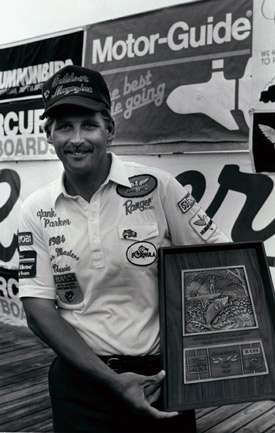
One of fishing's most recognizable figures, Hank Parker has enjoyed tremendous success both in competitive fishing and in front of a camera. A former Toyota Tundra Bassmaster Angler of the Year and two-time Bassmaster Classic champion, his nationally syndicated television show, Hank Parker's Outdoor Magazine, has been running for 26 years. Here's how a legend stacks up against our 20 Questions:
1. Where are you from, originally?
An itty bitty town called Maiden, N.C.
2. How did you get started in bass fishing?
My dad took me when I was little, and at first we went for anything that would bite. We went to farm ponds and small waters, but when I was 9 or 10 we got really excited about bass. By 11 or 12, I was slipping into places I probably shouldn't have been, but I was intrigued by bass and have been obsessed ever since.
3. Who were some of your earliest fishing heroes?
Blake Honeycutt and Buck Perry. Blake lived down the road about 30 miles in Hickory, N.C., and I'd go down to these little tournaments and watch him blow everyone away. Buck Perry was the original structure fisherman. He had that old Spoonplug and was catching them off structure way before depthfinders were out.
4. When did you realize you had made it in the bass fishing industry?
I don't think I have yet. I've had a television show on now for 26 years, and I still don't feel like I've made it.
5. What's the biggest bass you've ever caught?
Thirteen pounds, three ounces is the biggest one I've ever weighed, but I've caught several at BASS events in practice that weighed every bit as much as that. I had one on the St. John's River in a Super BASS event that was bigger than any fish I'd ever caught before. I kept it to weigh, but when I got to the marina the scales were broken, so I took her back where I got her from. I didn't catch her in the tournament, but I did end up getting a 9-pounder about 50 yards away and won the event.
6. What do you love most about bass fishing?
I love figuring the fish out. I love going to a lake I've never been to before and putting the pieces together. I like it even better when it's especially tough. I'd rather go out when it's tough than just going out catching a fish on every cast.
7. What is your greatest strength as a bass angler?
Determination. I don't have one lure or technique that is my favorite, because I love finesse fishing, sight fishing, spinnerbait fishing, crankbaiting, flipping and pitching — all of it. I look at lures as tools, and I take into account the conditions then try and pick the right tool for the job. I pride myself on being versatile and being able to find what is best and giving it to them.
8. What is your greatest weakness as a bass angler?
Not being able to fish in a crowd very well. When you've got spectators and other tournament fishermen following you because of who you are it really makes you lose focus on what you need to do and screws up your concentration.
9. What question do you get asked most by fans and how do you answer it?
The thing I get asked most is, "Why did you retire so young?" The answer is, I had four boys and a daughter at home and I wanted to spend more time with them. The number one fishing question I get is folks wanting to know how I am able to find fish on a strange lake. I answer that by walking them through the process I follow to find fish. Take into account the water temperature, the season and on down the line until we arrive at the right answer.
10. What's the biggest mistake you see from casual anglers?
I think it's the biggest problem most anglers face, not just casual anglers. A lot of guys will get hung up on one technique or lure and use it when they shouldn't. If you want to be a better fisherman, the best way to go about it is to leave that lure at home or not use that technique for one year. This forces you to find other ways to get fish and makes you more versatile.
11. Do you have any fishing superstitions?
None at all.
12. What has been your greatest accomplishment in the fishing industry?
Completing the Grand Slam. Years ago, there was always bickering about who's the best angler, and there were some big names around then. When Ray Scott heard all the speculating going on, he said the best angler would be whoever won the Grand Slam. We all said, "What in the heck is a Grand Slam, Ray?" and he said it would be whoever won Angler of the Year, a Classic and the Super BASS tournament first. I won that and was also the first one to win both a Classic and Angler of the Year. I'm proud of those things.
13. What goals have you yet to accomplish in your bass fishing career?
I have no more tournament fishing aspirations, but it has always been a goal of mine to get more kids involved in the sport. I want to get whole families out on the water because it is such a wholesome sport and offers so much.
14. What has been the greatest regret of your fishing career?
Looking back, I made a lot of boo boos — things like lost fish — but there's one thing that gets me from time to time. It was 1982 or 1983 and I was fishing an event on Lake Toho down in Florida. I was fishing with a guy named Richard Vance, a local guy, and when he knew he was paired with me he invited all his buddies to come along and follow us during the tournament. I was leading, but having those other guys right there in my honey hole was so frustrating I couldn't take it. I fired up the motor and left. I was on the fish to win — all I needed was one or two more fish and I would've had it. Ken Cook won it, and I think I ended up in second or third. I really wish I would've stuck it out and not left because I know I would have won.
15. When you're not bass fishing, how do you like to spend your time?
Hunting. Well, actually I split my time between hunting and fishing evenly, and the rest of the time I'm working. I like working the least.
16. What profession (other than your own) would you like to have tried?
A professional hunter. Well, actually I guess I sort of am, so I'd have to say a competitive archer.
17. When it's all over, how do you want people to remember you?
I want to be seen as someone who gave back. He didn't just take and take, but he gave back — also as an honest person.
18. Did your television career have an adverse impact on your fishing career?
Yes. It is hard to do both, and I tried it for five years. The last two years were really difficult because as I gained popularity people would flock to me. I think I had one of the first enclosed trailers on the BASS circuit — it had Humminbird all over it — and when people heard you were coming to town they'd go to the hotel and wait. It was so distracting that I couldn't prepare for the tournament.
19. How did you get started on your television program?
For me, it was a natural progression. Back in the '70s and '80s the way you justified the support sponsors gave you was by getting written up in Bassmaster Magazine. The more events you won, the more press you got. If you got enough, it was a matter of time before you either started your own magazine or went into TV, and I gravitated toward TV.
20. What's the biggest misconception that people have about you?
I think the biggest misconception people have about me — or Skeet Reese, Kevin VanDam or any of those guys — is that our job is easy. The only thing harder than getting to the top is maintaining your standing up there. There's no way anyone could possibly understand the things those guys go through without traveling with them for a year. I know we mentioned this before, but you never feel like you've made it until you're done with it, simply because it's so difficult and demanding.