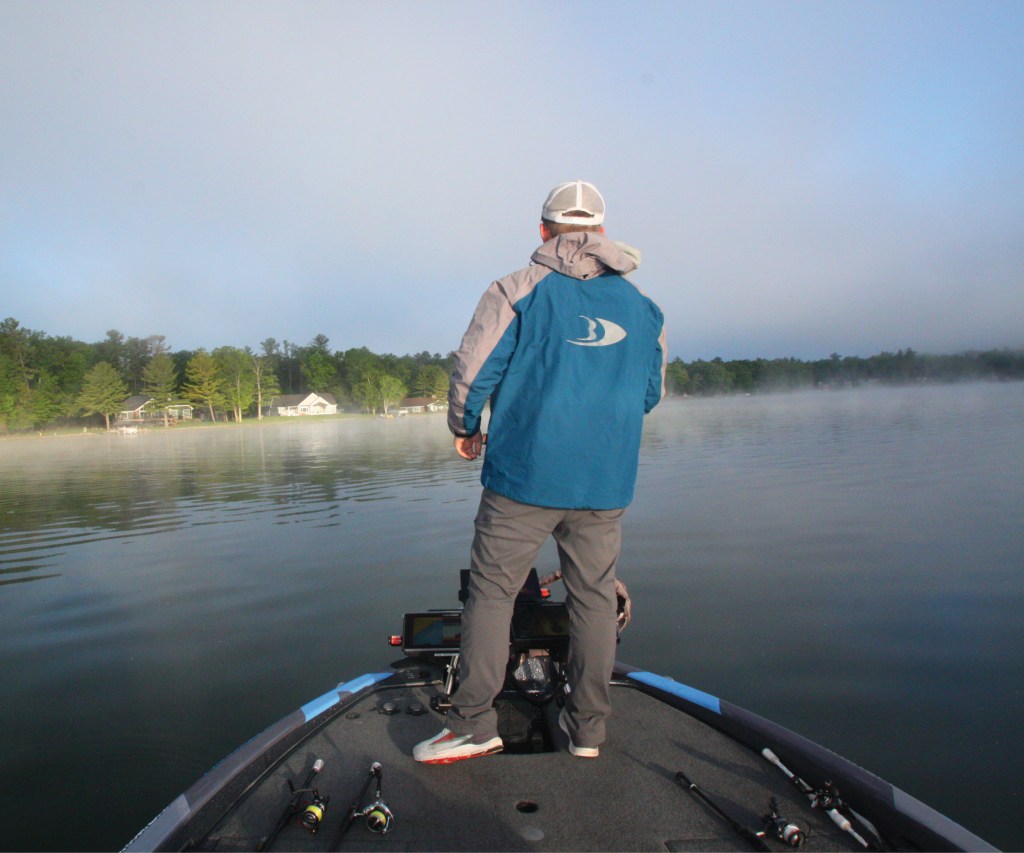
Date: June 1, 2024
Venue: Lakes A and B, two connected Northern natural lakes
Water: 64 to 69 degrees, clear
Weather: Cold front, clear, high of 63 degrees
Pro: Alex Redwine, 24, Blue Ash, Ohio. Redwine was active in high school fishing, attended the University of Cincinnati, then qualified for the Elite Series in 2021 after successfully competing in the Bassmaster Opens for two seasons.
Boat: Phoenix 921 Elite with 250-horsepower Mercury outboard, Minn Kota trolling motor, Garmin, Humminbird and Lowrance electronics and twin Power-Pole shallow-water anchors
Alex Redwine may look like a clean-cut young man, but he’s got a serious addiction: He’s a smallmouth junkie. “Growing up around Cincinnati, there’s not a lot of great places nearby to fish for bass, so my dad and I would often travel to Lake Erie [in northern Ohio] and Lake St. Clair [in Michigan], both of which are loaded with big smallmouth,” he told Bassmaster. “I grew to love everything about these fish — the clear water they thrive in, the way they smash a lure, their raw pulling power — yep, smallmouth are totally awesome!” The many trips Redwine made to these prime Northern venues taught him that the haunts and habits of smallmouth are different from those of their big-mouthed cousins, and he quickly became adept at deciphering the seasonal patterns of these ferocious fighters. Redwine caught his personal-best smallie, a 7-4 behemoth, from Lake Erie in the fall. “But I’ve always wondered how much she’d have weighed in June when she was full of eggs,” he confessed. Which probably explains why Redwine jumped at the chance to take our special spring DOTL challenge on Northern smallmouth waters! But early June weather in the North Country can be unpredictable, and as luck would have it, Redwine faced a major cold front on the morning of his DOTL outing. But did a crazy-cold morning put a damper on the bronzeback bite? Stay tuned to find out!
6:43 a.m. It’s an unseasonably frigid 39 degrees and foggy when we arrive at the boat launch on Lake A, a shallow (30-foot max) natural lake replete with weedbeds, stumps and fallen timber. It’s connected to Lake B, which is much bigger, deeper (nearly 200 feet max) and relatively devoid of weed and wood cover. Redwine will be allowed to fish both lakes during his seven-hour outing. “It was 85 degrees here two days ago, then it rained 3 inches and this cold front blew in,” he says as he readies his arsenal of Abu Garcia rods and reels. “This should be prime time for smallmouth to be spawning, but this front could make things tricky. Ideally I’d be able to sight fish for bedding smallies up shallow, but if they’ve already spawned, or if the front has delayed the spawn and pushed them out deeper, I’ll have to do some searching.”
SEVEN HOURS LEFT
7 a.m. We launch the Phoenix. Lake A is glass-calm and shrouded in fog. Redwine checks the water: It’s 69 degrees and gin clear. “There’s a steep 12-foot breakline close to the ramp; I’m going to idle down it to see if there’s some rock, weed or wood that might hold fish. I’m also seeing lots of mayflies on the surface; smallmouth will gorge on these.”
7:12 a.m. Redwine makes his first casts of the day to the breakline with a generic shad-pattern
3 1/2-inch swimbait rigged on a quarter-ounce All-Terrain Tackle Smallie Smasher jighead. “This is my go-to smallmouth search bait; it should quickly show me whether or not these fish are active.”
7:14 a.m. He gets a hard strike on the swimbait; the fish comes unbuttoned at boatside. “Good sign!”
7:20 a.m. Redwine notices fish occasionally slurping mayflies off the surface. He switches to a black 1/8-ounce generic marabou jig, casts it to the dropoff and gets an immediate strike. His first keeper smallie of the day weighs 1 pound, 9 ounces. “First cast with that jig! It sinks real slow and looks like a dying bug. I thread a little piece of plastic worm on the hook shank to give it some casting weight.”
7:22 a.m. The mini-marabou bags his second keeper, 1 pound even.
7:30 a.m. Redwine catches keeper No. 3, 2-2, on the jig. “They obviously think they’re munching mayflies!”
7:36 a.m. Back to the swimbait as Redwine continues along the breakline. “There’s a bunch of fish roaming along this drop.”
7:41 a.m. Redwine rigs a fresh marabou jig and catches a 1-12 (No. 4) on the breakline.
7:48 a.m. Redwine hangs a good fish on the black jig. His fifth keeper weighs 3 pounds, 12 ounces. “That’s a better fish! Now I can start culling.”
7:50 a.m. Another keeper smallie (No. 6) smacks the jig; it weighs 2-8.
SIX HOURS LEFT
8 a.m. Redwine ties on a bluegill-pattern Berkley Bullet Pop surface bait. “It’s fun catching smallmouth on sinking baits, but it’s more fun to catch ’em on top!” He twitches the popper along the breakline through a concentration of surface mayflies. “This popper has a feathered tail hook that mimics a bug struggling on the surface. They should eat it.”
8:02 a.m. A big fish boils on the popper but doesn’t hook up. “I saw that fish swim straight up off the bottom and swipe at it on forward-facing sonar!”
8:08 a.m. No more action on the popper, so Redwine reverts to the swimbait. He follows the breakline as it swings in a castlength closer to shore.
8:10 a.m. The sun is slowly burning the fog off the water. Redwine moves into the 6-foot zone and looks for silvery bottom depressions indicating spawning beds. He spots two buck smallies cruising the shallows. “I’m not seeing any fish on beds yet. If there are any spawners, they’ll be much easier to spot once the sun gets higher.”
8:24 a.m. Redwine makes a short hop to a shallow point at the juncture of lakes A and B and bags his seventh keeper, 1-0, on the marabou jig. “There’s current here where these two lakes meet, and smallmouth love current.”
8:26 a.m. He switches to a green pumpkin/purple Berkley tube on a quarter-ounce All-Terrain Tackle jighead. “Since the fog started lifting, I’ve had several follows on the marabou jig but they wouldn’t hit it. There’s some grass and scattered laydowns on this point, and I figure the tube might be a better bet here.”
8:40 a.m. Redwine is moving around the point with his trolling motor while casting the tube. “It breaks off pretty fast here from 3 to 12 feet.”
8:50 a.m. Redwine abandons the point and runs back up Lake A to probe more surface mayfly clusters along the dropoff.
8:56 a.m. He catches a fat rock bass on the marabou.
8:58 a.m. Redwine catches a 1-4 smallmouth (No. 8) on the marabou. “There’s a bed down there. I saw the bigger female swim off when this buck hit.”
FIVE HOURS LEFT
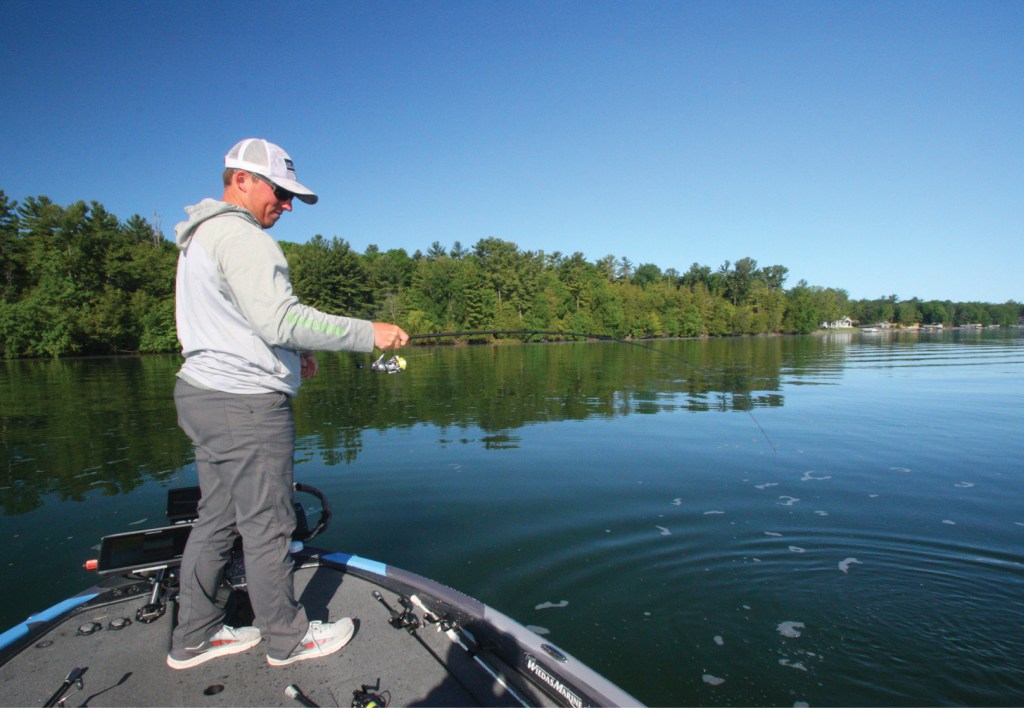
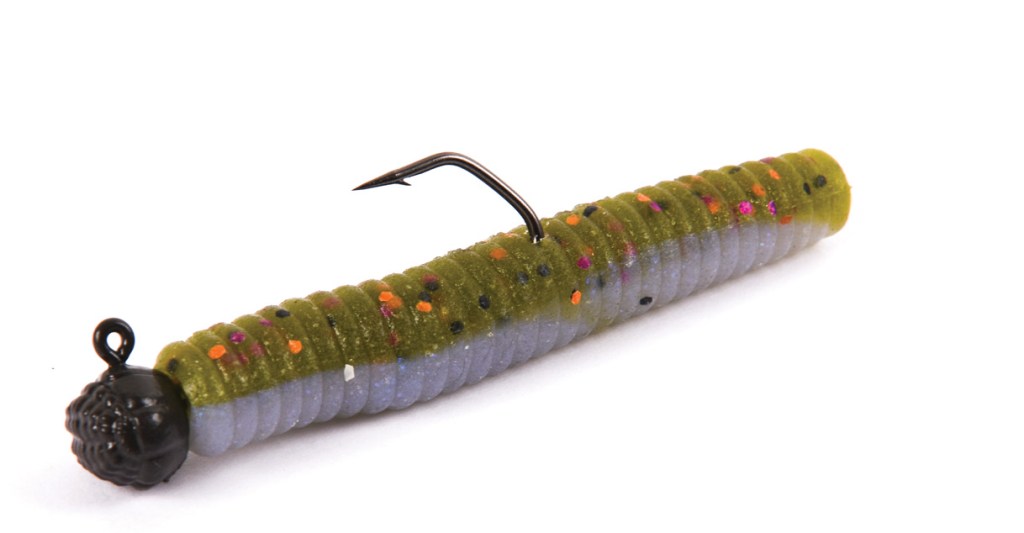
9 a.m. Redwine pitches a Berkley Lil’ General 2.75-inch stickworm in the Gobyashi color rigged on a 3/16-ounce All-Terrain Tackle Ned-style jighead to the bed. The big female immediately grabs it, and Redwine racks up his ninth keeper, a fine 4-4 smallie. “Wow, that’s a beauty! This was a classic smallmouth bedding scenario: The nest was next to a lone stump on a clean sand bottom 8 feet deep. Hopefully, I can spot more bedding fish now that sight-fishing conditions are improving.”
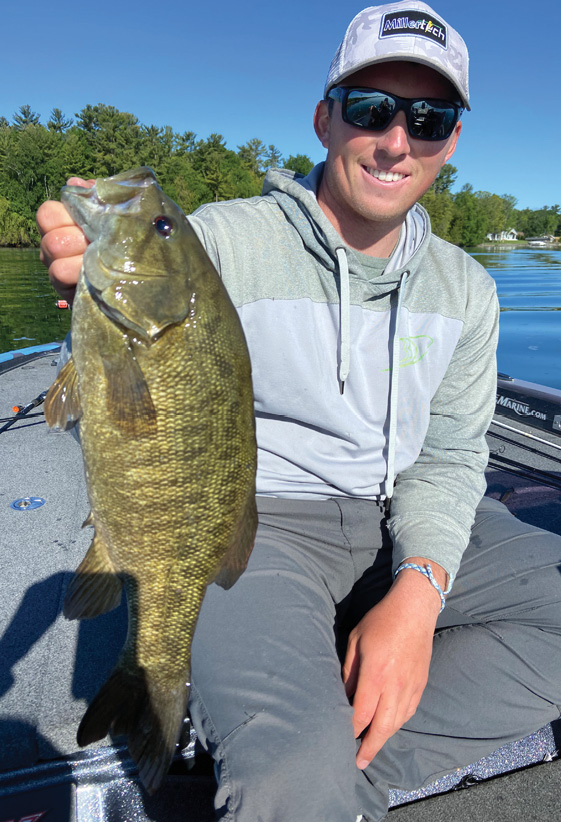
9:09 a.m. Redwine continues along the drop and catches a 2-10 (No. 10) on the marabou.
9:11 a.m. Two casts later, a bigger fish sucks in the marabou; keeper No. 11 weighs 3-10. “The 8- to 12-foot zone has been money so far! I’m wondering if these are prespawners, postspawners or bedding fish that got pushed off their shallow nests by the cold front.”
9:13 a.m. Redwine breaks out the surface popper and catches a 1-3 (his 12th keeper). “I’d like to see a 7-pounder plaster this thing!”
9:15 a.m. He spots another spawning bed, casts the Lil’ General to the nest and catches a 2-15 (No. 13).
9:24 a.m. Redwine retrieves the popper through some dead mayflies and catches a 2-12 smallmouth. “This action is unreal! But these 1- and 2-pounders will distract you. I need to find some bigger fish.”
9:38 a.m. Redwine has his trolling motor on high and is moving quickly along a big sand flat, scanning the 3- to 6-foot zone for bedding fish. No love here, so he hoists the Minn Kota and cranks the Merc’. “Better zip up your jacket. I’m going to make a long run up Lake B and see if I can spot any big bedding fish there.”
9:45 a.m. Redwine has made a brutally bone-chilling run to the north end of Lake B, which is unbelievably clear. “This water looks like the Bahamas! If there are any bedding fish here, I’ll be able to see ’em a mile away.”
FOUR HOURS LEFT
10 a.m. There’s a cold northerly breeze rippling Lake B’s surface as Redwine continues scouting for smallmouth beds.
10:19 a.m. Still covering water while hunting beds. What’s Redwine’s take on the day so far? “The morning bite was really good on Lake A with plenty of keeper-sized fish roaming the dropoff feeding on mayflies. I only saw a couple of beds on that lake; the cold front may have pushed some spawners out deeper. I’m still wanting to look for beds because in late spring the biggest smallmouth are usually the spawners, and a couple of giants would bump up my weight total significantly. So far I’ve been disappointed in Lake B; it’s really sterile looking with hardly any weeds, zero mayflies and no beds so far. I’ve got plenty of time remaining, though, so I’m going to keep scanning this lake in hopes of running across some big girls.”
10:26 a.m. Redwine catches a 2-pound male (No. 15) off a bed on the Lil’ General. “Smallies usually spawn in clusters; if you find one bed, there are often others nearby.”
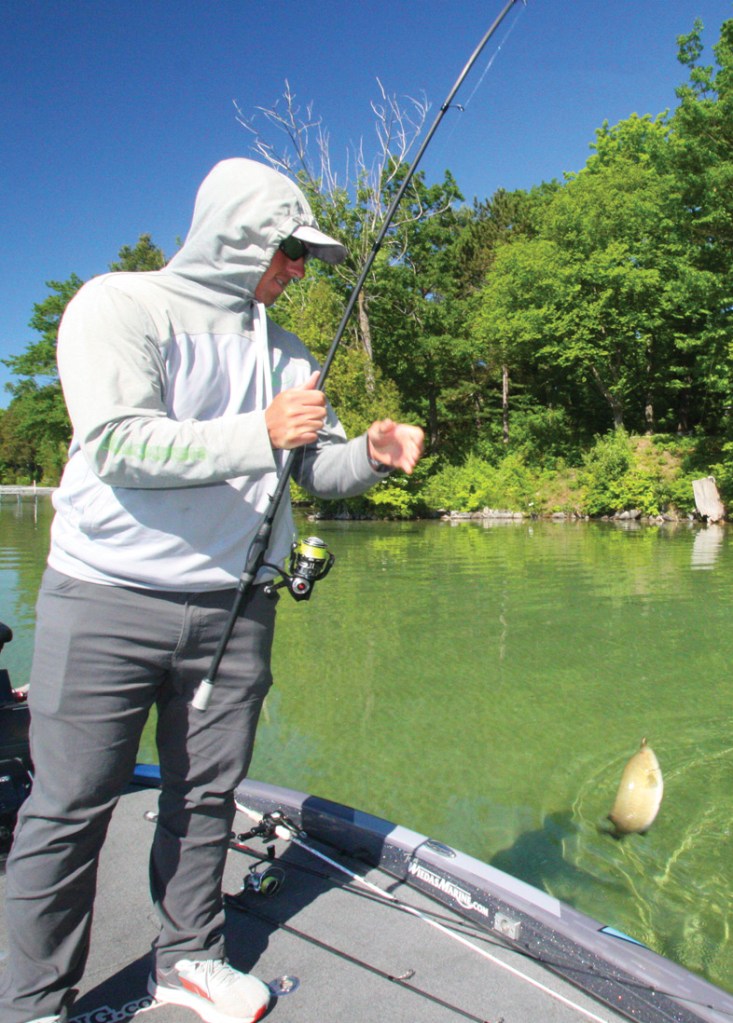
10:33 a.m. Redwine catches a 2-1 keeper (No. 16) off another nearby bed on the tube. “That’s a buck guarding fry. The female is long gone.”
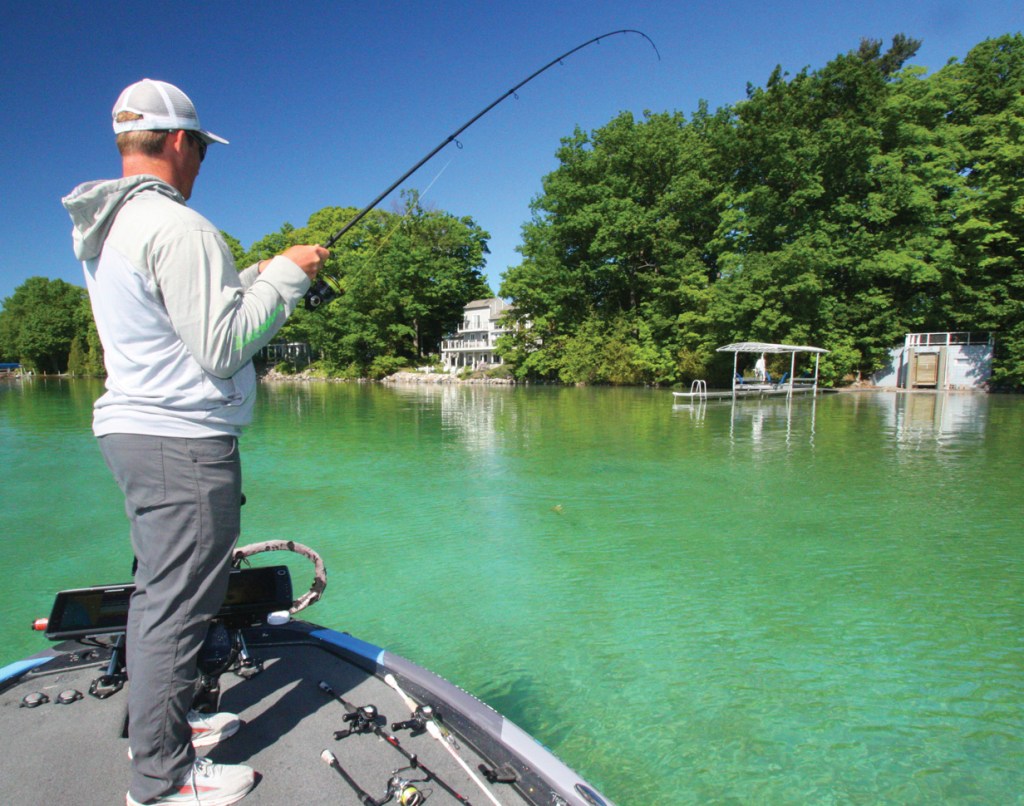
10:54 a.m. The sand flat transitions into a sharp-dropping point. Redwine casts the Lil’ General to the structure, eases it down the drop and catches his 17th keeper, 3 pounds even. “I knew a fish should be there! If you aren’t seeing shallow beds in smallmouth lakes, always hit that first deep water adjacent to the spawning areas.”
THREE HOURS LEFT
11 a.m. Redwine makes a short run to another fast-dropping point and tries the tube.
11:28 a.m. Redwine has made a long run toward the south end of Lake B. Here he targets a steep drop close to shore with the tube.
11:40 a.m. After making another run farther south in hopes of spotting more bedding fish, Redwine scans a sand flat with some isolated logs on the bottom but can’t entice any spawners. “The water here is 65 degrees; there should be beds everywhere! Maybe they spawned last week during that warm spell.”
11:42 a.m. He bumps the marabou jig around a submerged log, the only piece of cover on a big sand flat. Nothing there. “All right, enough of this. We’re heading back to the other lake.”
TWO HOURS LEFT
Noon. Redwine is back on the point at the juncture of the two lakes and is nudging the tube through scattered grass.
12:08 p.m. He switches to a blue pearl Berkley Stunna jerkbait on the point. “I’m seeing a few fish roaming around out here on FFS but they aren’t very big.”
12:13 p.m. Redwine catches a 2-2 (No. 18) off the point on the tube. “The wind is blowing straight onto this point; there should be a bunch of fish here.”
12:19 p.m. He slow-swims the marabou jig down the point and catches a 1-2 keeper (No. 19). “Hey buddy, where’s your big, fat girlfriend?”
12:26 p.m. Whitecaps are rolling across the point as Redwine contemplates his next move. “The bite has definitely slowed down. The wind is scattering those mayfly concentrations off the surface, so that pattern is fading fast. I’ll try moving out deeper on this point to see if I can find anything.”
12:38 p.m. Redwine has hauled water while dragging the tube around the deep end of the point. “So far I’ve mainly fished breakline structures in Lake A; I’m going to check some shallower water here for beds.”
12:47 p.m. Redwine moves to the edge of a sand flat, retrieves the swimbait past the break and catches his 20th keeper, 2 pounds, 13 ounces. “There’s some long, stringy submerged grass off this flat. Smallmouth love this stuff, but it’s hard to swim a bait through it.”
ONE HOUR LEFT
1 p.m. Redwine is fishing a crater-like hole in Lake A’s bottom with the swimbait. “The surface temp is actually colder here than when we started due to that north wind.”
1:14 p.m. He’s tried the swimbait, tube and jig in the crater without a bump.
1:26 p.m. Redwine idles farther up Lake A and spots a huge sunken log on his side-imaging sonar. He circles back around and grinds the swimbait over the cover.
1:29 p.m. A bass pecks his tube near the log; Redwine swings and misses. “That fish acts like a spawner.”
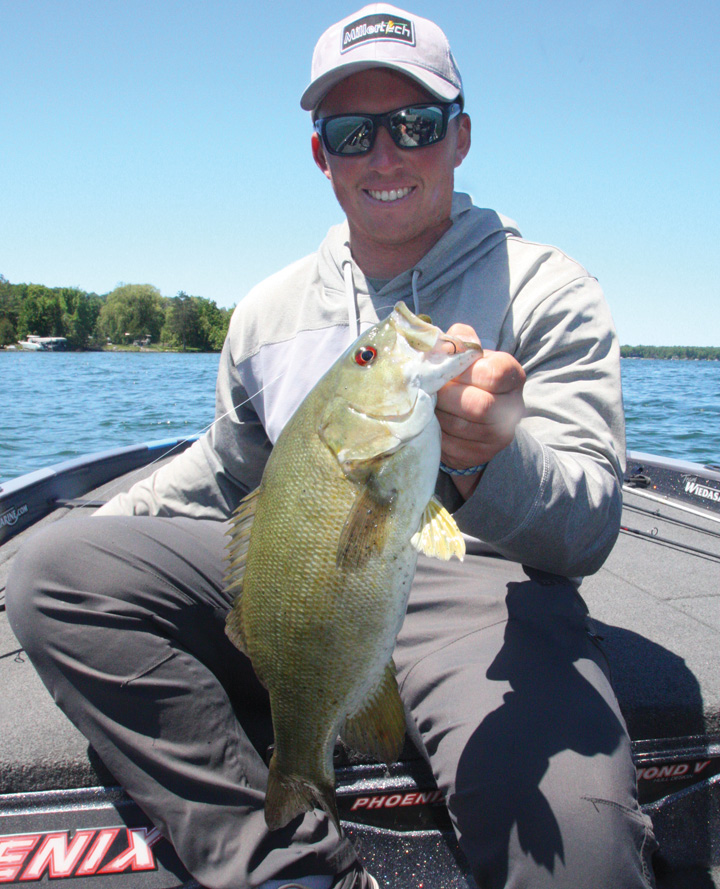
1:34 p.m. Redwine catches a nice 3-4 smallie near the log on the tube. “I guarantee that fish was on a bed!”
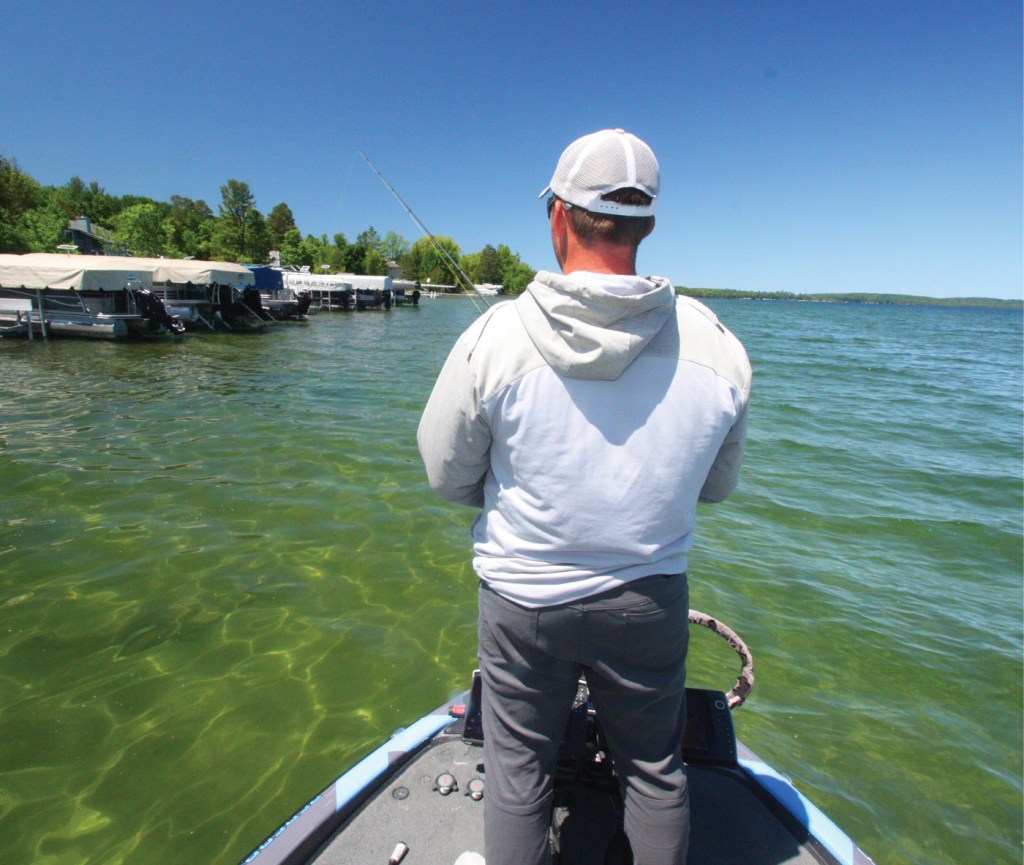
1:42 p.m. Redwine has spotted two big fish on another bed near a group of moored pontoon boats. He drops his Power-Poles, breaks out a baitcasting outfit rigged with a big Spro Chad Shad glidebait, flings it past the nest and works the bait enticingly across the bed. Both of the spawners skedaddle. “Heck, it was worth a try — I’ve caught some whopper smallmouth on big swimbaits and glidebaits.”
1:50 p.m. Redwine bags a 1-8 keeper (No. 22) off a dock on the swimbait.
2 p.m. Time’s up! Redwine has had plenty of action during his DOTL challenge, boating over 20 keeper smallmouth between fishing the two lakes. His five biggest fish weigh an impressive 17 pounds, 14 ounces.
THE DAY IN PERSPECTIVE
“In spite of the cold front, I had a lot of action in the morning on Lake A,” Redwine told Bassmaster. “Most of my early bites came along a 12-foot breakline where mayflies were concentrated on the surface. I was able to find a few fish on beds in lakes A and B, but the majority of my keepers either (a) had already spawned, (b) were staging on deeper drops and points waiting for conditions to improve before moving up to spawn or (c) were driven off their nests by the frontal passage. If I’d been able to find a lot of bedding fish, I’m certain I could have caught a heavier bag; it’s not uncommon to sack 25 pounds of smallies off of beds in prime Northern smallmouth lakes like these two. If I were to fish here tomorrow, I’d focus a little longer on the active mayfly bite in Lake A and maybe not spend so much time in the bigger lake.”
WHERE AND WHEN ALEX REDWINE CAUGHT HIS FIVE BIGGEST BASS
(1) 3 pounds, 12 ounces; 1/8-ounce marabou jig (black); dropoff with surface mayflies on Lake A; 7:48 a.m.
(2) 4 pounds, 4 ounces; 2.75-inch Berkley Lil’ General (Gobyashi) on 3/16-ounce All-Terrain Tackle Ned-style head; spawning bed on Lake A; 9 a.m.
(3) 3 pounds, 10 ounces; same lure as No. 1; same place as No. 1; 9:11 a.m.
(4) 3 pounds; same lure as No. 1; deep point on Lake B; 10:54 a.m.
(5) 3 pounds, 4 ounces; Berkley tube (green pumpkin/purple) on 1/4-ounce All-Terrain Tackle jighead; spawning bed in Lake A; 1:34 p.m.
TOTAL: 17 POUNDS, 14 OUNCES