
When you want someone to cut the superfluous chatter and focus on facts, you say, “Get to the point.”
For a lot of anglers fishing Lake Hartwell, points are the point. Always relevant on this lake, such extensions play a significant role during the blueback herring spawn currently underway. Often spawning over points, thousands of these speedy baitfish remain in one area long enough for bass to gorge.
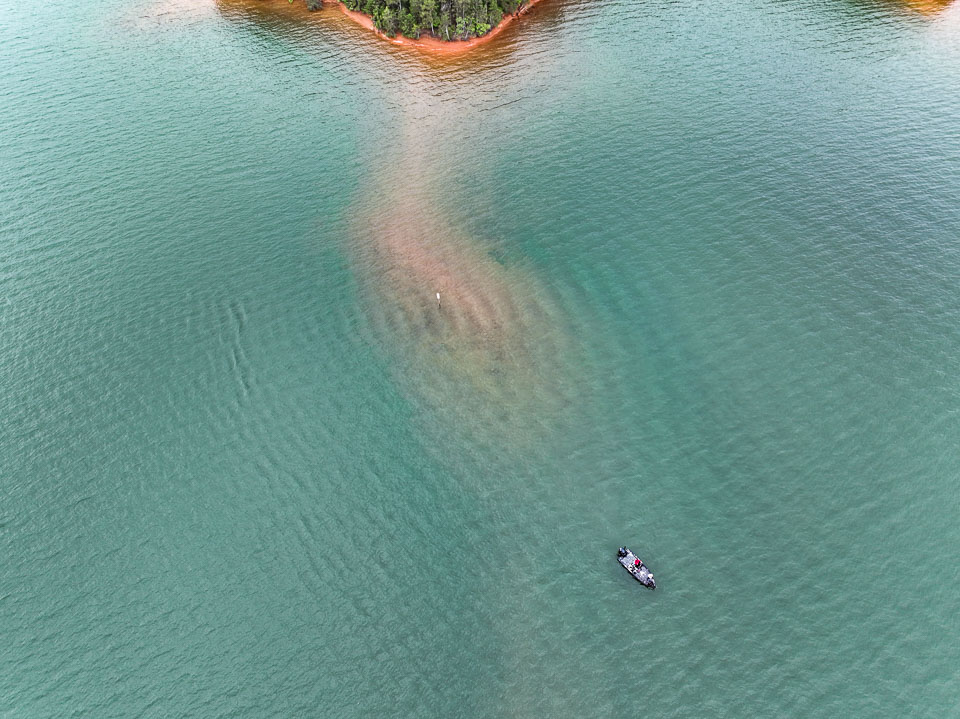
Like most reservoirs the inundation of natural topographical features leaves land protrusions reaching off the bank and into the lake. The generic term, point, catches a lot of different looks, but while it’s easy to assume homogeny, subtle and not-so-subtle differences are worth noting.
We quizzed a handful of Bassmaster Elite anglers competing on Hartwell for their best point picking advice. Here’s what they had to say.
Jay Przekurat
The 2022 Dakota Lithium Rookie of the Year currently leads the Progressive Bassmaster Angler of the Year standings. He’s keeping himself near the top of the leaderboard, partly with bass caught on Hartwell points.
“I’m looking for a point that has a good tip,” Przekurat said. “It has to have some hard bottom like chunk rock; it can’t just be all sand. Then, it has to have access to deep water.
“The herring actually spawn on soft bottom, but the bass like to have something to hang out on. Generally, bass aren’t going to hang out on a straight sand bank. They have to have somewhere to position.”
Think of it like chairs in the dining room.
Emil Wagner
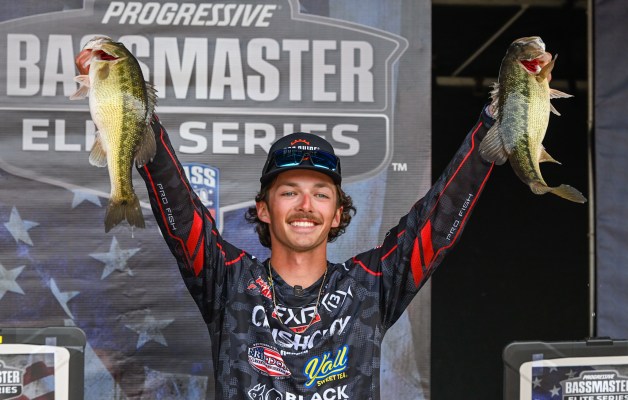
The Rookie Elite guides on Lake Lanier, about 90 minutes west of Hartwell, so he’s well-schooled on the right seasonal habitat. In his experience, seasonal needs play a big role in narrowing down the best points.
“This time of year, the fish use those really flat points with a little bit of scattered rock on them and then later in the summer, when they get deep, they like those ones with sharp breaks really close to deep water,” Wagner said.
Wagner also pointed out an interesting seasonal occurrence. While much of the largemouth spawn concludes before the blueback herring spawn, Wagner often finds spotted bass spawning on the same points where the herring are doing their thing.
“They overlap every year,” Wagner said. “Spots will spawn all the way from late-March to early June.”
Patrick Walters
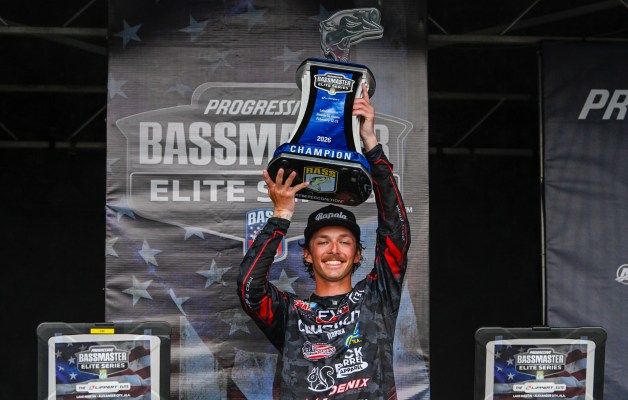
A legit killer in the herring spawn game — a truth cemented by his 2024 Elite win at Lake Murray — Walters won the 2020 Bassmaster Eastern Open at Hartwell. When it comes to point selection, he keeps it simple and lets the fish define the daily preference.
“What makes a good point? When the fish are actually on it,” Walters said. “Mainly, you just cover a bunch of points until you develop a pattern and when you find the fish, you’ll dial something in.
“It could be a matter of one point getting too much pressure and one point’s not getting pressure.”
Walters warns against becoming closed-minded. Replicating similar habitat features often proves prudent, but not always.
“You could find fish on a rocky point, but they’re also on the point next to it that’s just a clay point,” Walters said. “Sometimes, it will be zones that have fish. You mainly have to find the zone, not the pattern.”
Bryant Smith
An impressively versatile angler, Smith owes his deep well of experience to the diverse fisheries of his California home state.
“Just like I fish back home on Shasta Lake, Oroville, New Melones — all the Motherlode lakes, anywhere you have spotted bass and largemouth, it seems like those longer, flatter points are everything,” Smith said. “They can slide up and down and have a distinct feeding advantage on those points, because they can see a lot farther than if it drops right off.
“If there’s a school of bait, they can corral the baitfish a lot better.”
Brandon Cobb
With many years of Hartwell experience punctuated by a victory at the 2019 Elite event here, Cobb agrees that long, flat points are the spring favorite. However, he’s adamant, about finding a target zone.
“You want a point to run out far, but I don’t like the ones that are flat for 500 yards; you want a shelf for them to feed on,” Cobb said. “I like the ones that have a good flat and then it tapers down. I don’t want it to drop off into the abyss.
“The super long ones are tough if they’re 3 feet deep for a mile, because it’s hard to figure out where to fish. If they’re super short points, the fish don’t use them.”
Jordan Lee
Having claimed the second of his back-to-back Bassmaster Classic wins at Lake Hartwell in 2018 (following his 2017 win at Lake Conroe), Lee points out the benefit of clandestine operations.
“The better spots are the underwater points where it’s not a point coming off the bank, but it sticks out, like an underwater shoal,” Lee said. “It just doesn’t get hit as much as (an emergent) main lake point.”
Beau Browning
The same herring that feed postspawn bass also feed Hartwell’s seagulls, loons, blue herons and great egrets. Noting where the feathered predators congregate guides Browning to promising points.
“This time of year, I’m looking for birds and any type of surface activity,” Browning said. “My practice was spent just running around and looking for that activity — even stripers, because that indicates where the bait is.”