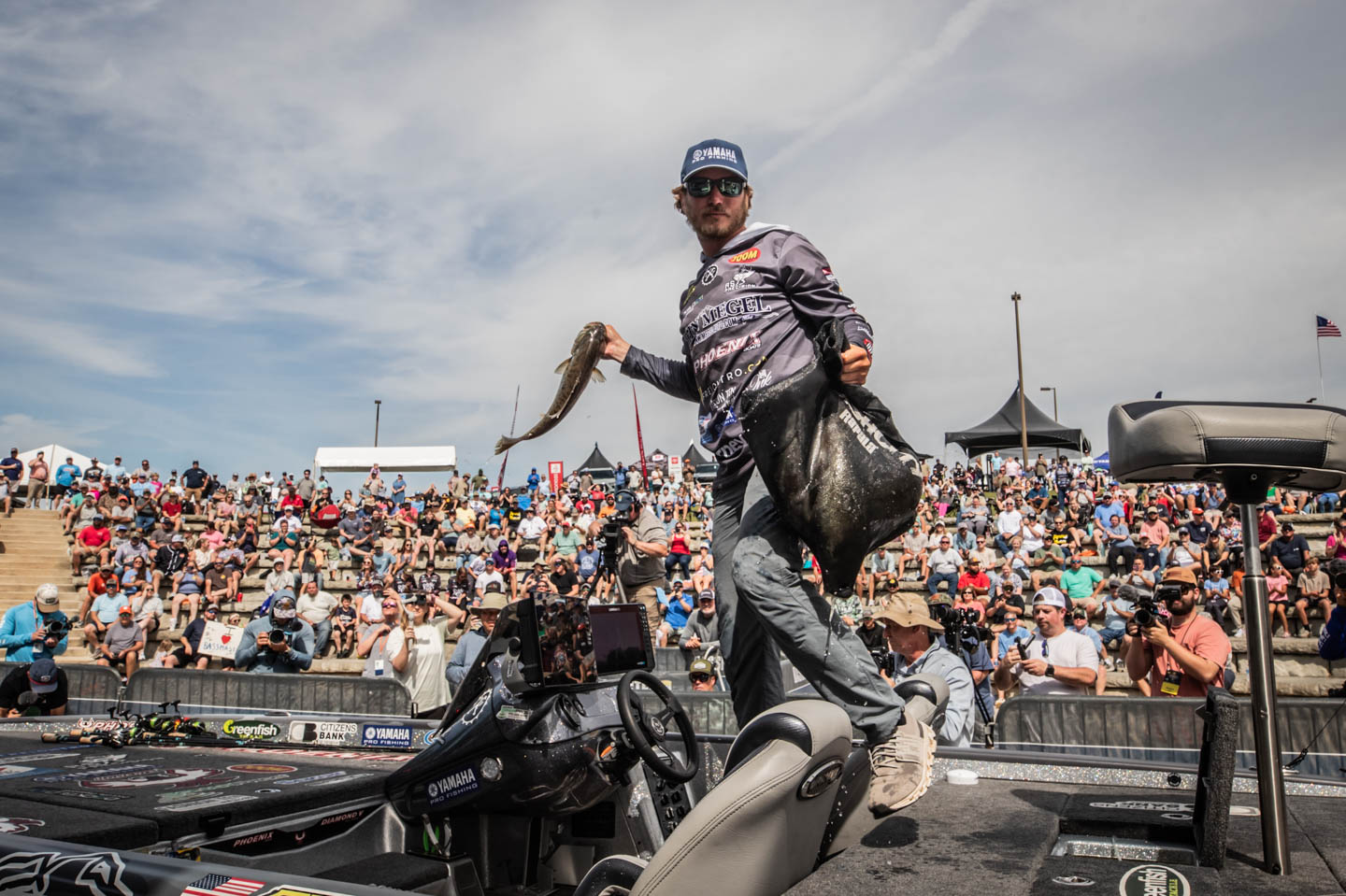
Event: 2025 Whataburger Bassmaster Elite at Lake Hartwell
Scenario: As this late-April event brought fairly stable conditions with varying, but manageable wind levels, Marks found his dream scenario and wasted no time in capitalizing on a game with which he’s keenly familiar.
No doubt, with the blueback herring spawn in full swing, Marks knew this event would sit squarely in his wheelhouse, but he made no assumptions. Rather, he mapped out a game plan that maximized seasonal options, with enough flexibility to leverage key opportunities and get him through unexpected droughts.
“Growing up at Lake Lanier, I’m pretty experienced at herring fishing, so I did that every morning until 9 or 10 o’clock to catch my spots, then I went bed fishing the rest of the day,” Marks said. “I was looking for big largemouth in the afternoon.”
As it turned out, the front half of that plan delivered most of Marks’ winning weight, but the first round saw him anchor his bag with a 5-pound largemouth early into the day.
“I went and caught about 16 pounds of spots in, like, an hour and then I went to a bed fish I had found the last day of practice,” Marks said. “I caught that 5-pounder and another that was 3 3/4 on a white pearl Zoom Z Craw Jr.
“I went bed fishing early that day because I knew where a big one was and I wanted to catch it before someone else. That 5-pounder was just on a flat bank leading into a pocket. It was just a random spot.”
Randy Howell led Day 1 with what would be the event’s biggest bag — a limit of 21-11 — but Marks’ morning bonus positioned him for a run at the blue trophy. It also eased the disappointment of another opportunity that eluded him.
“I had 19-something when I caught that 5-pound fish, so the rest of the day, I went and bed fished,” Marks said. “I found a 7-pounder and sat on it most of the day, but it wouldn’t bite.”
Specifics: Marks, who lives about two hours west of Lake Hartwell spent most of his time focusing on a mix of points and brushpiles. That’s nothing terribly novel, but having logged a lot of hours and a lot of miles on Hartwell, he confined himself to the region most likely to kick out the right fish.
“I fished from the Green Pond area to the Hartwell Dam,” Marks said. “That’s where the biggest spots live. It’s just the biggest water, more open water and way more (habitat) for them to live around. I was fishing all kinds of stuff. I was just running around, because (that) time of year, there are fish on everything.
“I looked for points with rock or (hard) clay. They’ll get on longer or shorter points, but if you have rock or clay, that gives the herring somewhere to spawn and then the bass sit around them.”
Marks targeted his herring fish with Zoom Fluke Stick Jr. and a Super Fluke on a 5/0 round bend worm hook.
“Long casts were important; you want to hit them pretty far out there and hope they eat your bait,” Marks said. “When the bite got tough, I started working my baits a little slower — a little more subtle and not ripping them around so much.”
The Decision: As Marks explained, knowing what to do is one thing; knowing when to do it, is the key. To maximize his time, while capitalizing on peak opportunities, he made the morning herring spawn his foundation.
“The herring spawn only lasts the first couple hours of the day, especially if it’s sunny,” Marks said. “Also, you can’t really see bed fish anyway until it gets sunny, so it’s kind of a no brainer.
“That 5-pounder I caught on Day 1, I just kept pitching to the area and it bit in, like, five casts.”
While the bed fishing part of his plan sought big kicker fish, the herring spawn was a numbers game, in which weeding through lots of little ones eventually yielded the quality he sought. As Marks recalls, the biggest challenge was catching a fish over 2 3/4 pounds. Fortunately, he was able to find a handful of those better-than-average bites each day.
One particularly savvy thing that Marks did was to make his transition from the herring spawn to bed fishing a gradual change, rather than an abrupt one. Once the morning sun pushed the herring down, he gave his area a good clean-up run by fishing a 3/16-ounce SPRO Skip Gap shaky head with a Zoom Fluke Stick Jr.
“I was just throwing that to fish on LiveScope once the herring spawn was over in the morning and they weren’t schooling as much,” Marks said. “After the herring spawn was over, the fish would move out deeper, sometimes, as deep as 30 feet.
“That shaky head was just something different. They would eat it on the fall most of the time.”
Marks’ only departure from his two-tiered game plan was Day 3, when calm sunny conditions found him struggling for a bite. Instinctively switching to a brushpile pattern, he threw a SPRO Walking Haint and caught a 4- and a 3 3/4-pound spot back-to-back.
Marks said his plan proved itself in the end, as he placed third with a Day 1 limit of 19-7, then held the No. 2 position for the next two days with 17-4 and 16-5. On Championship Sunday, Marks added 15-8 for a tournament total of 68-8 and edged fellow rookie Tucker Smith by 14 ounces.
Game Changer: Addressing that 5-pound Day 1 bed fish, Marks said: “That fish made my tournament. I was very fortunate to have it.”
That being said, he equally valued the totality of his shad spawn program.
“I caught so many 3-pounders and culled up every day, so every fish was a game changer,” he said. “I caught at least 25 or 30 every day. I would throw them back unless they were 2 pounds. I probably culled 10 times a day.”
Takeaway: “I feel like I trained for this tournament all my life on Lanier,” Marks said. “The stars aligned, and it all worked out perfectly.”