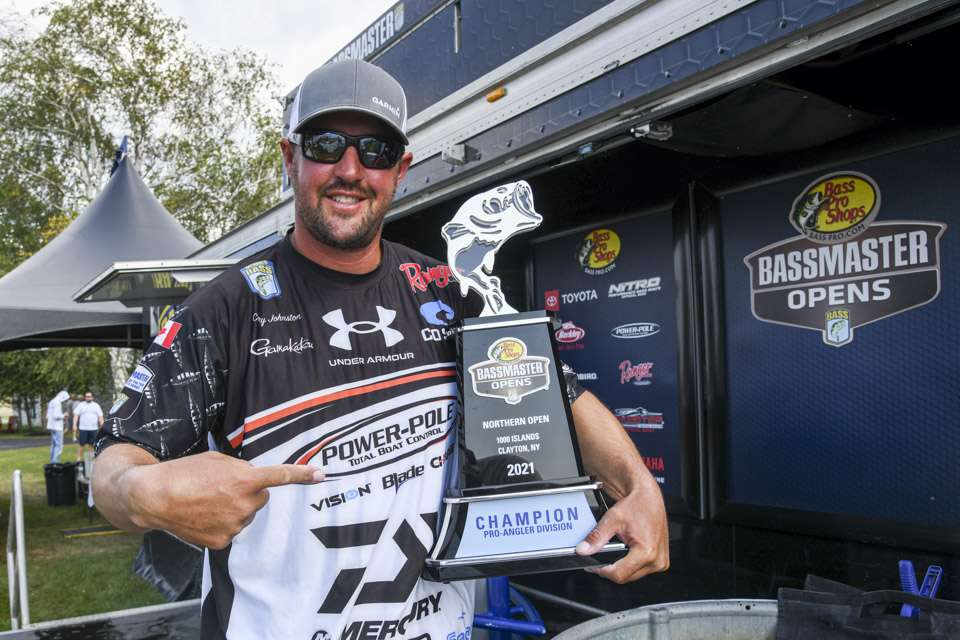
Event: 2021 Bassmaster Northern Open on the St. Lawrence River
Scenario: Experience — it’s the most valuable tool in an angler’s tacklebox. It cannot be bought, bartered or inherited, but the level of hard-earned insight that Johnston used to triumph on his favorite fishery is nearly unbeatable when properly applied.
Run out of Clayton, N.Y., a short run from the mouth of the St. Lawrence, this mid-September event saw the usual seasonal water cooling, with smallmouth feeding heartily for winter’s approach. Days 1 and 2 were fairly calm, but Championship Saturday would see big winds whipping up a Lake Ontario temper tantrum.
Johnston’s never claimed to enjoy rough water, but he’s comfortable running it, plus he knows a turbulent Lake Ontario tilts the odds in his favor. In this event, Johnston needed nothing fancy, just the old tried-and-true.
“It was the same game plan as always — run a bunch of spots and figure out where they’re at,” Johnston said. “In practice, I ran a bunch of new water because I know where they live and what rocks they get on. It was just a matter of finding a few of the right ones.”
Days 1 and 2 saw Johnston make brief stops in the St. Lawrence before spending most of his time in the lake. On Championship Saturday, it was all lake. The run’s not for everyone, but in Johnston’s view, the risk/reward proposition works every single time.
“Even if I only have three hours to fish in the lake, versus eight hours to fish in the river, I’m gonna go to the lake every time,” he said. “That’s where I feel most confident. I know the lake really well.”
The decision: Folks who fish this region a lot know well the propensity for intimidating conditions. Even when it’s not brutally rough, a wind-lashed Lake Ontario will test resolve and equipment.
Johnston minimized wind impact by running the leeward sides of two major islands. The way the wind was blowing, his course kept him sheltered in U.S. and Canadian waters.
“I was able to take a run out there about 20 miles and maximize my fishing time by taking a longer route out there, but it was a calmer run,” Johnston said. “It saved me a half hour to 45 minutes each way, rather than running straight across the lake.”
Johnston also noted that he used his Power-Pole Drift Paddles to control his pace. Overcoming one of the biggest impediments to targeted fishing, he was able to stay locked in on specific boulders.
“I stuck to an area where I knew there were really big fish,” Johnston said. “I had a little bit of company, but not too much. I knew every little sweet spot, so I was able to stay within a 3- to 4-mile area.”
Describing a straightforward strategy, Johnston said he started at his closest spot to capitalize on the day’s early bite. After that, he worked his way out to the farthest spot and then came in.
“It’s pretty simple out there; I had the Garmin LiveScope going and just covered a lot of water,” Johnston said.
Impressive consistency on Days 1 and 2 delivered limits of 25 pounds, 7 ounces and 25 pounds, 3 ounces that put him in fifth and then second place. Championship Saturday saw Johnston step on the gas by weighing the day’s biggest bag — 27-6 — and tallying a three-day total of 78-0. Johnston edged Day 1 leader Cal Climpson by 13 ounces.
Game changer: Another key point in Johnston’s strategy was his milk run. It’s one thing to have several spots, but his game plan was built on diversity. Lake Ontario has much to offer and Johnston integrated multiple elements into his operation.
“I had about 15 spots within my area, so I was able to rotate through them and let the fish rest,” Johnston said. “Every spot was different — sometimes a rock, sometimes it was an isolated piece of grass. My spots were in 5 to 45 feet.
“There wasn’t one specific thing. That’s what I liked about (my plan) — it didn’t have to be (one type of spot in a particular depth).”
By varying his habitat and depth, Johnston gave himself the edge he needed to outpace the field. Particularly in rough water, it’s easy to fall into the mindset of sticking with one main area and investing too much time in working the same waters.
“That was the key to why I had it to myself,” Johnston said. “While most guys would stay out deep. I would run shallow, hit a spot, run out to 30 feet and hit a spot, come back in and hit a spot in 15 feet.”
In Johnston’s view, varying what he focused on, not only kept him away from competitors, it also helped him take advantage of the fact that Lake Ontario smallmouth have different preferences. They don’t all read from the same script, so neither did Johnston.
“I had spots all over,” he said. “No matter what the fish were doing, I could hit something different.”
Takeaway: Looking back on his win, Johnston said his knowledge of Lake Ontario, plus his belief in its superior potential, enabled him to follow his game plan with complete confidence. Moreover, notching his first Bassmaster win on the waters of his youth made the experience especially memorable.
“It felt good to win one here,” Johnston said.
In fact, Johnston’s win provided a much-needed dose of redemption. In the 2020 Elite at the St. Lawrence — won by his brother Chris — mechanical issues derailed his efforts. The following year, Johnston made a solid run at the title during the Bassmaster Elite at the St. Lawrence, two months prior to his Open win.