Jason Christie isn’t one for playing it safe. At Toledo Bend in 2017, a stiff wind blew across the massive reservoir on the final day of Elite Series competition. The majority of the Top 12 stayed close to takeoff trying to maximize fishing time in the rough weather.
Christie, who entered that day in fourth, made the run to his best area, a trek that left him with a little over two hours to fish. He caught the second biggest bag of the day and jumped into second, a decision that earned him 10,000 more dollars.
“I was running 50 miles. And that day I decided I’d rather make that run than fish (close to takeoff). It took me forever to get there and forever to get back, but the whole time I was there I caught the crap out of them.
“It doesn’t matter how rough it is, it is not going to keep me from going.”
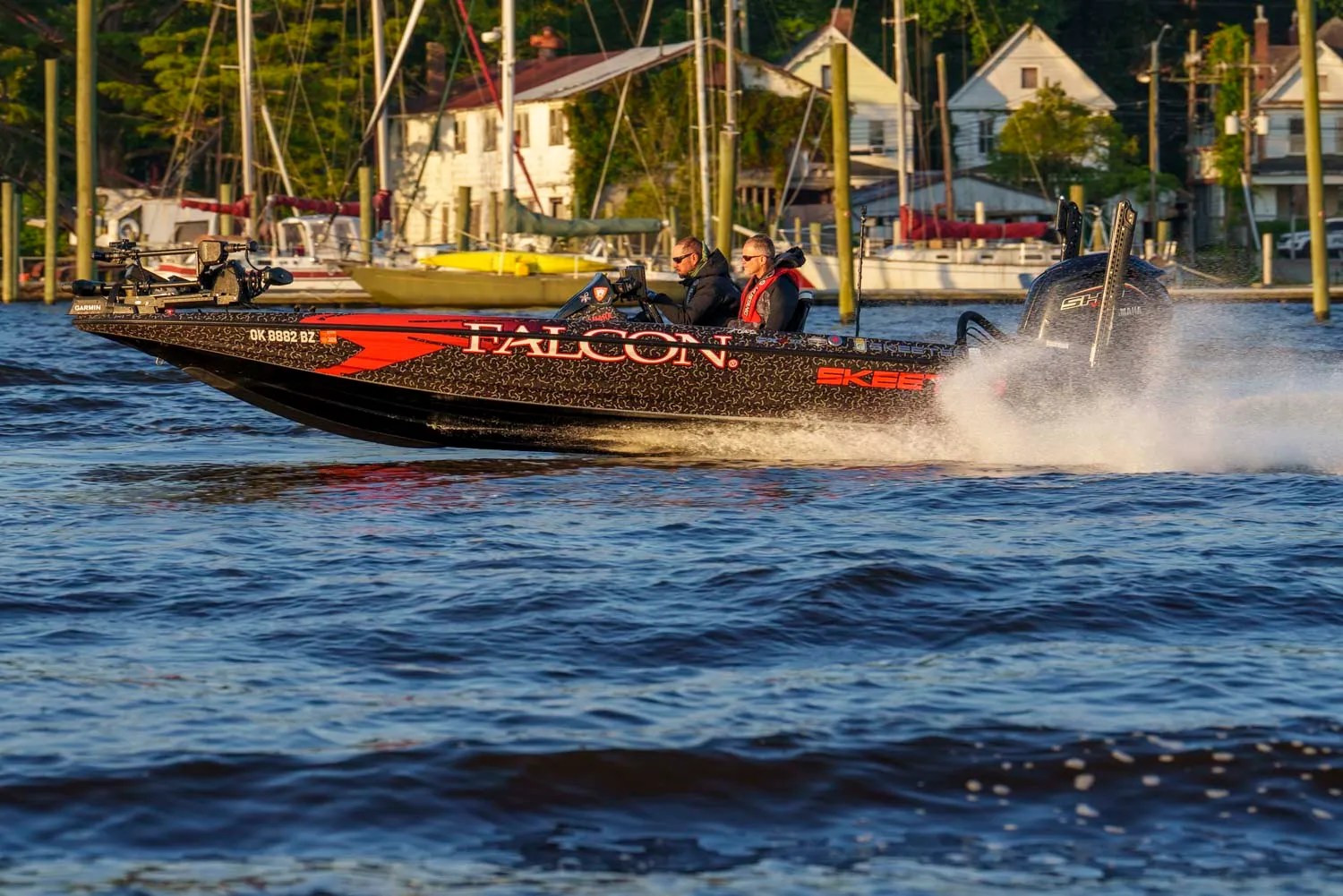
That is his mentality this week at the Maxam Tire Bassmaster Elite at Pasquotank River/Albemarle Sound, a body of water where the wind always seems to blow. On Day 1, Christie and many other competitors bounced and cut through the choppy conditions to the rivers on the far west side of the Sound.
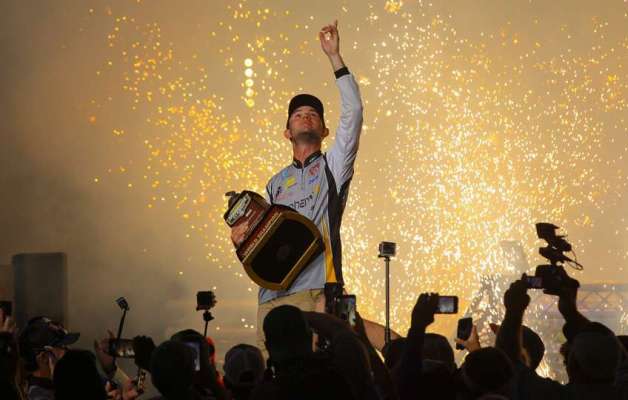
The 2023 Bassmaster Classic champion was rewarded with an almost 9-pounder and a 24 pounds, 1 ounce limit, which has him in second place heading into the second day, just 1-7 behind leader Chris Zaldain.
Christie, a nine-time Bassmaster champion, spent the first two days of practice in the west and saw plenty of potential. The third day, he launched at takeoff on the Pasquotank River and only got two keeper bites. That was all the evidence he needed to commit to the long run.
“I knew I needed to make the run, no matter what,” he said. “I’d rather fish three hours where I’m going than eight hours (in the Pasquotank).”
Jay Przekurat had a similar mindset. The Wisconsin pro knew he could probably land a limit in the Pasquotank River, but there was a defined ceiling. Out in the western section, the 2022 Rookie of the Year felt bigger bass were more plentiful. He made the run, caught almost the entirety of his limit there, and finished the day in fifth with 23-6.
“Around (takeoff), I thought I could catch a limit but that would be about it,” Przekurat said. “Over there I knew I was going to get 10 to 15 bites. Whether that was going to weigh 12 pounds or 23 pounds was the question.”
It wasn’t necessarily easy. Christie only got six bites during his limited fishing time, but they were big bites. Przekurat didn’t get his biggest bite until it was almost time to leave.
Christie believes if the tournament was launching closer to the Chowan and Roanoke Rivers, several 30-pound stringers would’ve been caught Day 1. But with a limited amount of time, and the unknown of the ride back to Elizabeth City, the big bag potential was limited.
A smoother morning run on Day 2 could give someone like Christie just enough time to crack 30.
“I left an hour too soon today,” Christie said. “You just don’t know how the water is going to be.”
North Carolina has experienced an unusually dry spring, and that has also made the fishing a little more difficult than many anticipated. The dry weather has allowed more saltwater to move into the rivers and creeks, and finding fresh water is essential.
Justin Hamner made a long run to find the freshest water he could. It took nearly all of practice, but the area he stumbled into might be as good as $100,000 by tournament’s end.
“I caught a 7-pounder, and the number (of fish) I saw that were that size is incredible,” Hamner said. “The saltwater is pushing back in these (places) further than normal. It really congregates the fish. So, if you aren’t on them, you’re not on them (at all). But when you land on them, it’s pretty insane.”
In his two-mile stretch, Hamner only saw a panfish angler and his roommate Patrick Walters, an unusual occurrence on a fishery where a lot of the best areas have a lot of traffic.
The Zaldain, Patrick connection
Seventh-place Kyle Patrick owes his 22-7 Day 1 limit to Chris Zaldain. After a terrible practice, Zaldain told the New Yorker about an area that was productive for him during practice but would not be fishing during the tournament. Patrick went, and made the most of the gift.
“I told (Zaldain) where I was going, and he said, ‘Well if you are going there, you need to try this.’ I don’t even want to talk about it because it’s his deal.”
After Zaldain weighed in his tournament leading bag weighing 25-8, Patrick greeted him with a bear hug and several “thank yous.”
An interesting note on forward-facing sonar
Several anglers in the Top 10 noted that while forward-facing sonar was utilized during their day, they very rarely saw a bass before making a cast. Instead, finding preferred targets was the best use of the technology.
“A lot of times, you don’t see the bass,” sixth-place Cody Huff said.
Patrick added, “They are really tucked up under cover up there. You are really blind casting for them.”
Zaldain and Przekurat both noted that forward-facing sonar wasn’t employed much of the day.