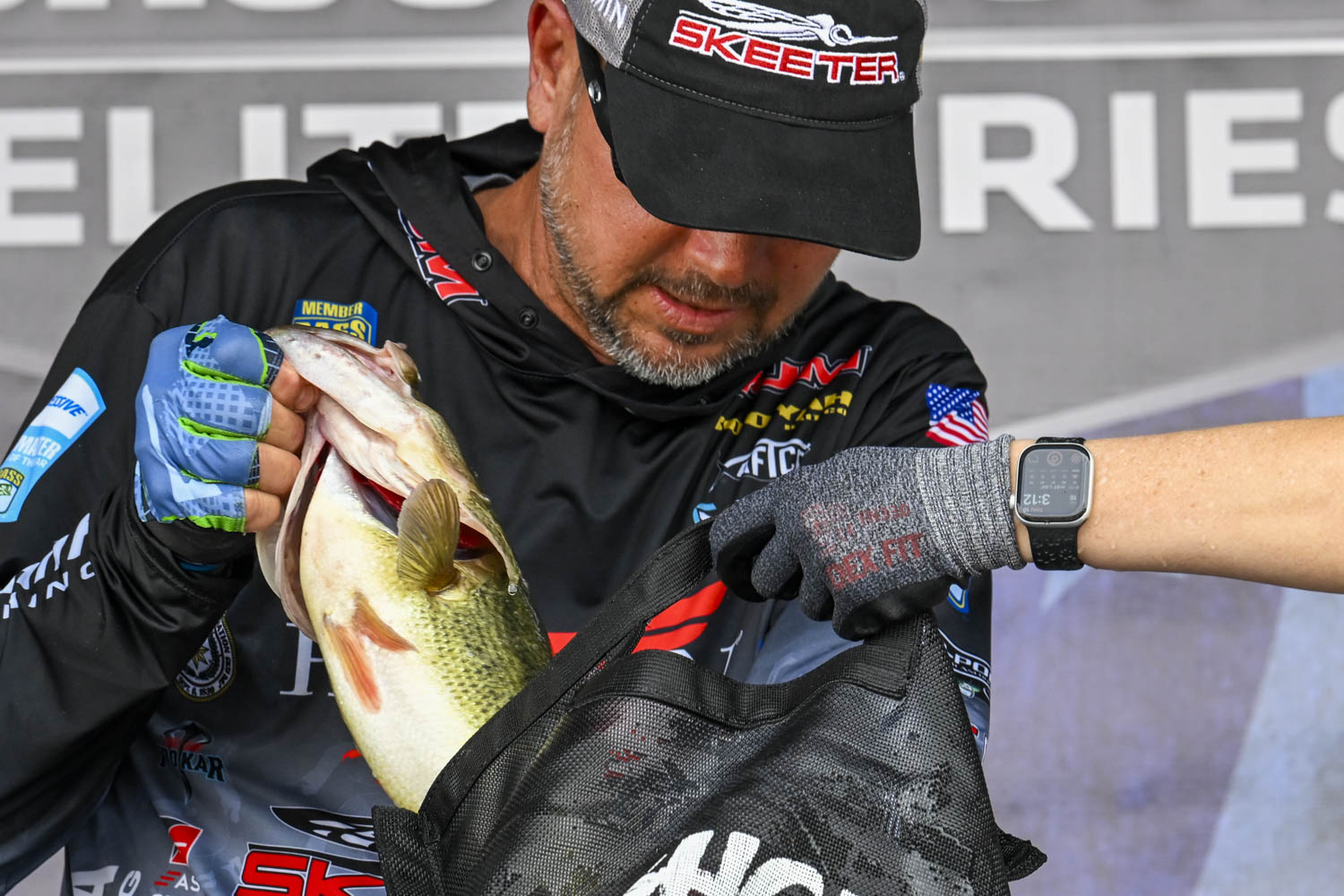
In every Elite event, we want to know where anglers are fishing, but for this week’s Gamakatsu Bassmaster Elite at Arkansas River, the location question starts with a broader application.
Which pool?
The Arkansas River comprises the main component of the McClellan-Kerr Arkansas River Navigation System (MKARNS), a 445-mile inland waterway running through Oklahoma and Arkansas and connecting the Port of Catoosa (near Tulsa, Okla.) to the Mississippi River. With this week’s event based on Pool 16, tournament boundaries also comprise pools 17 and 15.
Day 1 saw anglers fishing all three pools and that diversity was represented across the top-3 spots.
First-round leader Fisher Anaya (20 pounds, 4 ounces) started upriver in Pool 17, then finished his day in 16. Second-place Caleb Hudson parked in Pool 16 and third-place Brandon Palaniuk did his work downriver in Pool 15.
Successful efforts differed in location, but if you think the decisions came down to simple coin tosses, think again. Fact is, several key factors guide locking decisions.
Why Leave?
Every pool on the Arkansas River holds bass, and probably enough to put together a competitive day. That being said, various habitat features, water clarity difference and other localized factors tend to create better opportunities, in terms of quantity and/or quality.
Historically, Pool 15, aka Robert S. Kerr Lake, has held the largest fish in this region of the river. Bigger fish have a magnetic pull, but sometimes, solitude wins the debate.
Case in point: Anaya mentioned that, during the previous Elite at the Tennessee-Tombigbee Waterway (Tenn-Tom), he locked down with about 50 other boats and found that congestion overwhelming. That negative experience steered him in the opposite direction on Day 1.
On the other hand, a competitor’s position in Angler of the Year standings may influence their decision on where to fish.
For example, Austin Felix (fourth on Day 1, 18-15) had a tough start to the season and came into this event seven spots out of the 2027 Bassmaster Classic cut. After a 31st-place finish at the Tenn-Tom, Felix started turning things around, but he knows that getting the ship back on course will require bold decisions.
“I don’t think I can catch 4-pounders on Pool 16,” he said. “I think I can lock up (to pool 17) and catch 13 pounds. That might be enough to make it to Day 3, but when you have an opportunity, you might as well swing for it.
“I did so poorly the first two tournaments, I need to make some moves to get back in it.”
Time Management
Unlike slowing down to idle under a bridge or through a no-wake zone, locks are non-negotiable barriers that require a complete stop and often a long wait. Patience may be challenging for those chomping at the bit, but it is what it is.
In simplest terms, a lock is a chamber that allows vessels to pass from one water level to a higher or lower level. After allowing a designated number of boats into the chamber, the lock master raises or lowers the interior water level to match that of the upriver or downriver pool into which boats will exit.
This is not a quick process and, considering the lengthy downriver run from takeoff to the Webbers Falls Lock and Dam, waiting for the designated locking time, allowing that process to complete and then making another long run to Kerr’s prime areas, you really have to believe in the potential to give up that kinda time — going and coming.
Jason Christie, who said he’ll lock down to Kerr each day, summarized the Day-1 scenario: “I didn’t make a cast where I wanted to fish until 9 o’clock.”
That’s two hours after takeoff.
What’s To Be Gained or Lost
For Arkansas River veterans like Christie, fellow Okies Luke Palmer and Blake Capps, and Palaniuk, experience tells them that trading less fishing time for more big-bite potential is an acceptable transaction. In other cases, the numbers might tell a different tale.
Making his first Arkansas River visit, Keith Combs had his practice shortened by a sinus infection, so he started the event with little insight. In his case remaining in the local pool made more sense.
For Hudson, committing to Pool 16 was more of a strategic call. After struggling in practice, the Georgia pro decided that his best chances for cobbling together a decent day would involve staying close and maximizing his time. As it turned out, he located a 3-acre backwater that yielded a better day with a limit of 19-1 that exceeded his expectations.
Christie gave a nod of respect to Pool 16 and noted that he caught a few fish in the local waters before and after locking. He balanced that with his reasons for running downriver.
“There’s bass up here (in Pool 16), the problem is there’s not a lot places to fish, because there’s not a lot of backwaters,” he said. “I like fishing in (Pool 16), matter of fact, of all the tournaments I’ve won on this river, probably half of them have been in this pool, but it’s been smaller fields.”
Stay On Schedule
Lock operators communicate when they will be opening and closing the gates. Suffice to say, racing up to a closing lock, blasting your horn and waving your arms is nothing more than an exercise in futility.
The biggest consideration for tournament competitors is barge traffic. Commercial vessels take navigational priority, so many anglers will monitor the MarineTraffic app, which shows realtime barge positions. This helps minimize locking issues and prevent costly late penalties.
Realistic Expectations
With 43,800 surface acres, Kerr Lake is Oklahoma’s third largest. Plenty of space to spread out, but the reason anglers make the run is not an everywhere kinda thing. Actually, it’s more about narrowly defined sweet spots with a handful of sneak holes that you have to hope no one else found.
“There’s only so many areas that they live in and everybody figures that out,” Christie said. “These dudes figured it out in the first two hours of the first day of practice.”
Palaniuk agrees and noted that he spent so much of his first day running from spot to spot in search of isolated bites that he became legitimately concerned about running out of fuel.
Considerations are many and each individual must make his own calculations. Prior to the tournament, most believed that the victory would come from Kerr Lake, but it’s likely that Pools 16 and 17 will play significant roles in the event’s unfolding.