
The late-spring-to-early-summer period brings a range of bass fishing opportunity, from late-spawning fish to postspawn patterns. Geography dictates the pacing, but this can be one of the overlooked time frames for big-bass action. Four Progressive Bassmaster Elite Series anglers shared their insights into how they locate and engage June giants.
Cooper Gallant — Great Lakes
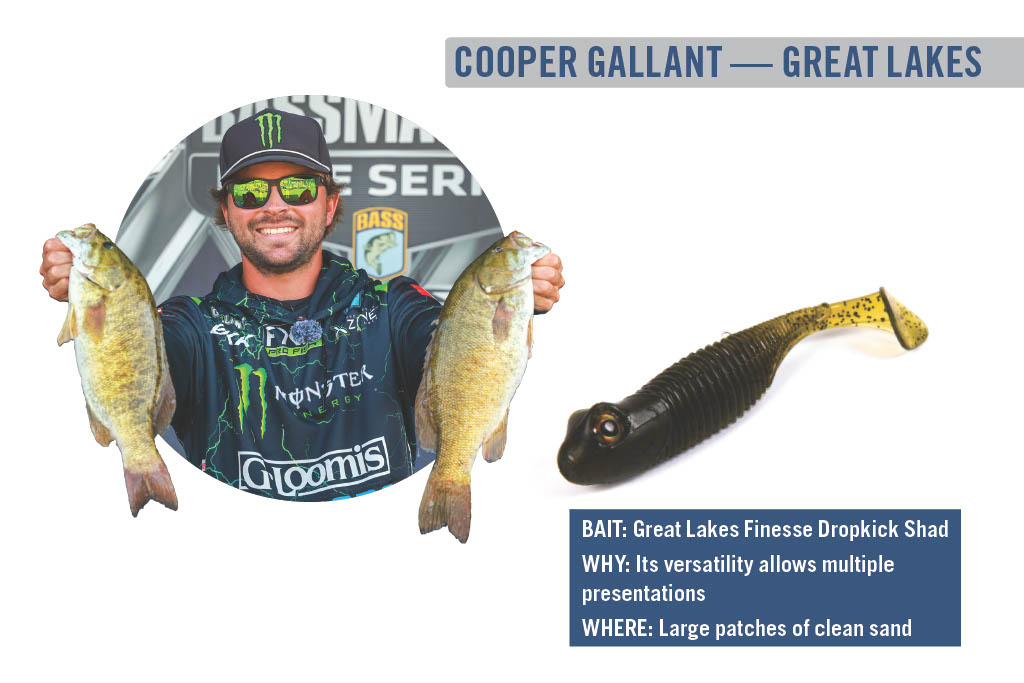
Cooper Gallant has spent a lot of time hunting Lake Ontario’s giant smallmouth bass, and in that time, he’s learned that the shallows hold his best chances of tempting a bragging-rights bronzeback.
“If I was going out on Lake Ontario and the mission was to catch a 6-plus-pound smallmouth, I’m definitely looking shallow,” Gallant says. “This time of year, you have all three stages of the spawn happening, so there’s a lot of big ones up shallow.”
The Ontario pro begins his search in 5 to 15 feet of water, focusing on expansive main-lake flats near deeper water. He puts the trolling motor on high and covers a ton of ground, looking for the clean spots on bottom where smallmouth like to bed.
Finding protected areas can help, especially since this is often a visual type of exploration.
“I’d get on one of those expansive flats and try to find a big sand patch, typically with my eyes,” Gallant adds. “I’m also looking for irregularities like big boulders or a patch of sand within a rock vein. I think the crawfish and gobies get on those sandy spots and it’s easier for the smallmouth to spot them.”
Of course, he’ll also spot big smallmouth cruising on those light, sandy areas. That’s where that Northern staple — the drop-shot rig — comes in handy.
“You can reel a drop shot. You can deadstick it. You can shake it. You can hold it in front of their face,” he says. “That’s one of my favorite techniques to catch a big one because you can use one rod and present the bait to them so many different ways.”
Gallant rigs his drop shot with a Great Lakes Finesse Dropkick Shad in goby colors — like green pumpkin — or matte black on a Size 2 or 4 BKK drop-shot hook with a 3/8- to 1/2-ounce teardrop-shaped weight.
He says he doesn’t like cylinder weights because they flutter off target on the fall, and precision and efficiency are important. If the fish are not committing, he’ll thread the bait onto a BKK straight-shank hook.
“I’ll use the smallest hook possible to maximize the bait’s action,” Gallant says. “Some people may worry about losing big fish on a small hook, but once you get that drop-shot hook jammed into a fish’s mouth, it doesn’t come out.”
His hook choice isn’t the only area where Gallant goes a bit against the grain with his drop shot.
“Also, you hear people say they try to get away with the lightest weight possible, but I may throw a 3/4-ounce weight in 5 feet,” he adds. “It sounds contradictory, but that heavy weight gets down there so quickly it generates a reaction, like punching a mat.”
Gallant’s shallow-water hunts almost always involve single fish. Except for when spawning, the true giants are loners, and despite spawning smallmouth bass’ reputation for being super-aggressive, the big ones are not pushovers.
“When smallmouth are grouped up, they’re typically a lot easier to catch because they’re competitive. The big singles are the hardest to catch. I’ve spent 30 minutes trying to get a big one to eat, but they’re worth it.”
BAIT: Great Lakes Finesse Dropkick Shad
WHY: Its versatility allows multiple presentations
WHERE: Large patches of clean sand
Chris Johnston — TVA Lake
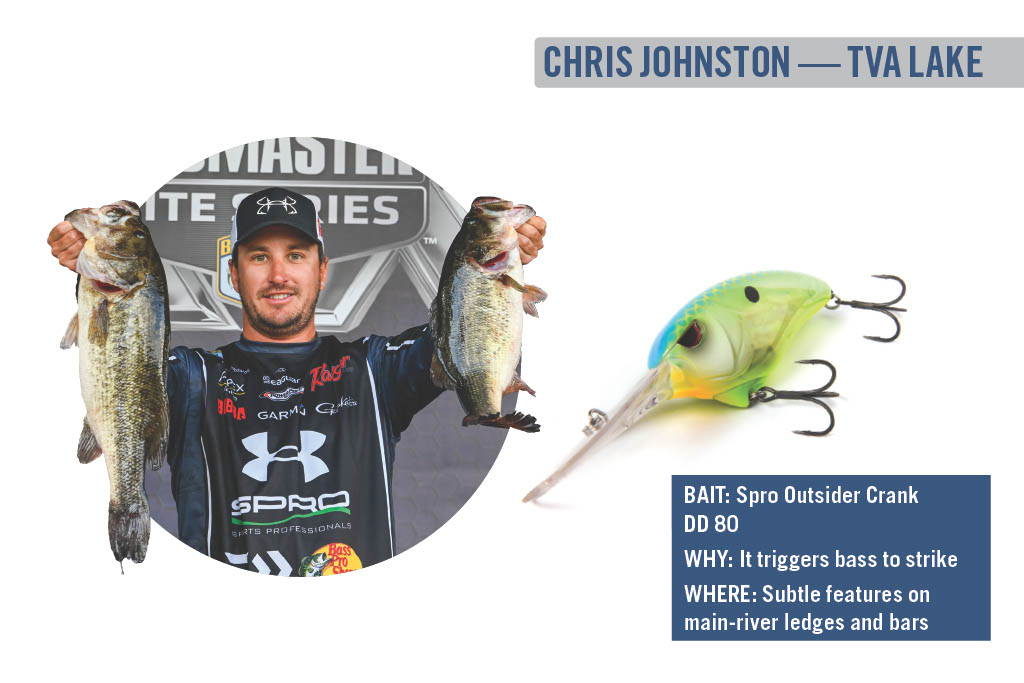
With June typically seeing a major push of postspawn bass heading out to the ledges, bars and other offshore structure, Chris Johnston is keen to capitalize on the fish’s need to feed before they disperse across vast river miles.
“The best areas are the ones out from the spawning pockets, so I’ll start at the mouths of those pockets and follow the main-river ditches offshore,” he says. “I’ll start side scanning underwater island heads and other current breaks.”
Johnston studies his mapping and looks for the subtle sweet spots that are likely to attract giants.
“You could be going along a river bar edge near the main channel and you find a spot where it indents a little bit on the map — that’s gonna be one of those sweet spots,” Johnston says. “Or on that main-river bar, say it’s 20 feet, 20 feet, then all of a sudden you see it comes up to 18. A little high spot on that river bar can be enough to hold them.”
The Ontario pro usually starts with a jighead minnow, like the Hideup Judy Fish. Forward-facing sonar simplifies the process of targeting and teasing, especially during periods of low current flow.
“When the current’s not moving, those fish are not tight on those sweet spots,” Johnston says. “Typically, the fish are still around, but they might be floating 10 feet off. They may be shallower, they may be deeper or they may be floating on the main river channel.
“That’s where the forward-facing [sonar] has really helped us. Maybe you don’t catch them on the sweet spot, but maybe they’re just 50 yards off of it. You’ll see them floating, and that’s how you can target those big fish, even when the current is not moving.”
When the fish aren’t aggressive, Johnston flutters a 7- to 9-inch spoon into the school or cranks a Spro Outsider Crank DD 80 through their position. The big ones can be cagey, so tapping into their instinctive responses might be the requisite strategy.
“You’re just showing them something different,” Johnston says of the hefty hard baits. “Sometimes, they’ll come up and look at your minnow, but they won’t eat it. That’s when I pick up a different bait, and maybe that big spoon is gonna get a reaction out of them. The same with a crankbait — you rip it through the school, and once one gets fired up, they all get fired up, and you keep catching them for five to 10 minutes.”
Finding bass in flooded trees isn’t too challenging, but in Tyler Williams’ view, weeding out the wannabes and locating the difference-makers requires a bold approach. Basically, he looks for the most intimidating tangle fest he can find and throws caution to the wind.
BAIT: Spro Outsider Crank DD 80
WHY: It triggers bass to strike
WHERE: Subtle features on main-river ledges and bars
Tyler Williams — Timber Lake
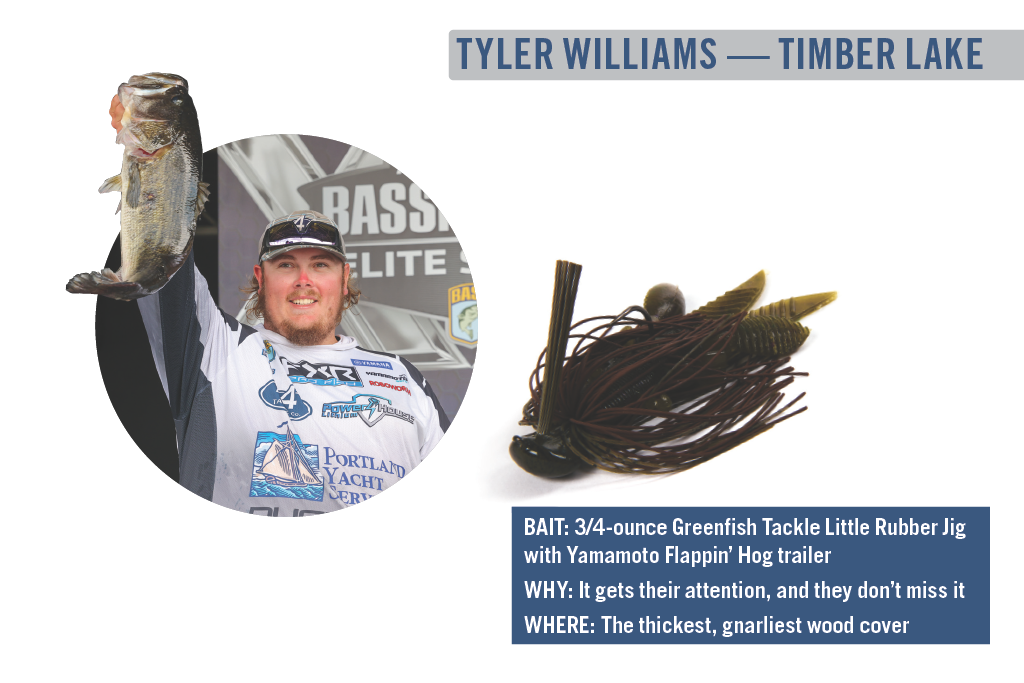
“Using Lake Fork as an example, when I’m looking for a big one, I try to find something nasty,” Williams says. “You’ll see a lot of fish suspended, floating, but then there’ll be a giant one that no one has thrown a bait at in 15 years at the base of the tree, or in a root ball.”
According to Williams, giants will stake out the safest fortress where no one messes with them — except for intrepid anglers.
“A lot of times it’s the fish you can’t see on your screen. Your bait gets down there, and all of a sudden, it just goes ‘thunk!’” he says. “That’s the big one you want.”
Along with standing timber, Williams gravitates to other challenging scenarios, like a channel-swing dropoff with a tangle of dead trees or a brushpile at the base of a deep standing tree.
“In the last couple of years, I’ve learned that a lot of the biggest fish in the lake, you can’t see [on sonar]; they’re ghosts,” he says. “They’re not like big blimps out floating over deep water. I think it’s some of the fish we used to fish for before forward-facing sonar.”
Williams’ go-to for these sequestered giants is a 3/4-ounce Greenfish Tackle Little Rubber Jig with a Yamamoto Flappin’ Hog trailer. He’ll occasionally turn to a power shot with a straight-tail worm on a 4/0 wide gap hook and fish it on baitcasting gear with 16-pound-test Gamma fluorocarbon, but that’s usually a clean-up bait if they’re souring on the jig.
Even when he convinces a giant to bite his jig, Williams knows the hardest part of the whole deal is the exfiltration. Williams finds that a measured approach ends more favorably than brute strength.
“My biggest thing is to not slack line them. I like to lean into my fish, so if they’re in a weird spot, I don’t just break them off on the hook set,” he says. “You don’t need to hit them as hard as you think to get them coming out.
“You just need to get their head in the right direction, and then you just winch them out, rather than dragging them out,” Williams adds. “Once you get them on the surface, that’s when you really start cranking to get them away from all the cover.”
BAIT: 3/4-ounce Greenfish Tackle Little Rubber Jig with Yamamoto Flappin’ Hog trailer
WHY: It gets their attention, and they don’t miss it
WHERE: The thickest, gnarliest wood cover
Bryant Smith — Clear Western Lake
While he spends most of his year competing on Eastern U.S. waters, the pro from Roseville, Calif., still enjoys visiting Western fisheries when he can. And when Bryant Smith is hunting giant bites in the Pacific time zone in June, he’s all about topwater.
“Especially in a clear-water lake, a topwater can draw them up from really far away,” Smith says. “After they spawn, the big ones like to suspend, and I feel like a topwater is definitely the best way to get those bigger bites that time of year.”
Smith starts just beyond the spawning grounds and moves progressively outward. Habitat varies by fishery.
“They’ll go to anything they can get next to, like a bridge piling or a dock, but I’ve also found them suspending over the tips of really long points,” Smith says. “They’re way off the bank, not near the bottom at all, but still relating to the point. They’re just sitting there relaxing.
“In our grass fisheries, like Clear Lake and the California Delta, they’ll suspend high in the grass. You can see them with your eyes. It’s pretty cool. They’ll get up high once the sun comes up. They just kind of sit there and wait for food to come by.”
With Western bass commonly feeding on big baitfish species like trout, salmon, shad, hitch and sunfish, Smith won’t hesitate to throw a full-size topwater like the Strike King Sexy Dawg. In most cases, he’ll go with the noisy Hard Knock model to draw fish from as far away as possible.
“We want to get their attention, and once they have eyes on it, I don’t think there are many baits that talk more fish into biting than a walking-style bait,” he says.
Certainly, a standard walk-the-dog presentation will get bit, but don’t get lulled into only one approach.
“What gets me more bites and gets me bigger bites is varying my retrieve,” Smith says. “It’s not so much a cadence, but an erratic presentation — starts, stops, three twitches, four twitches and then a pause.”
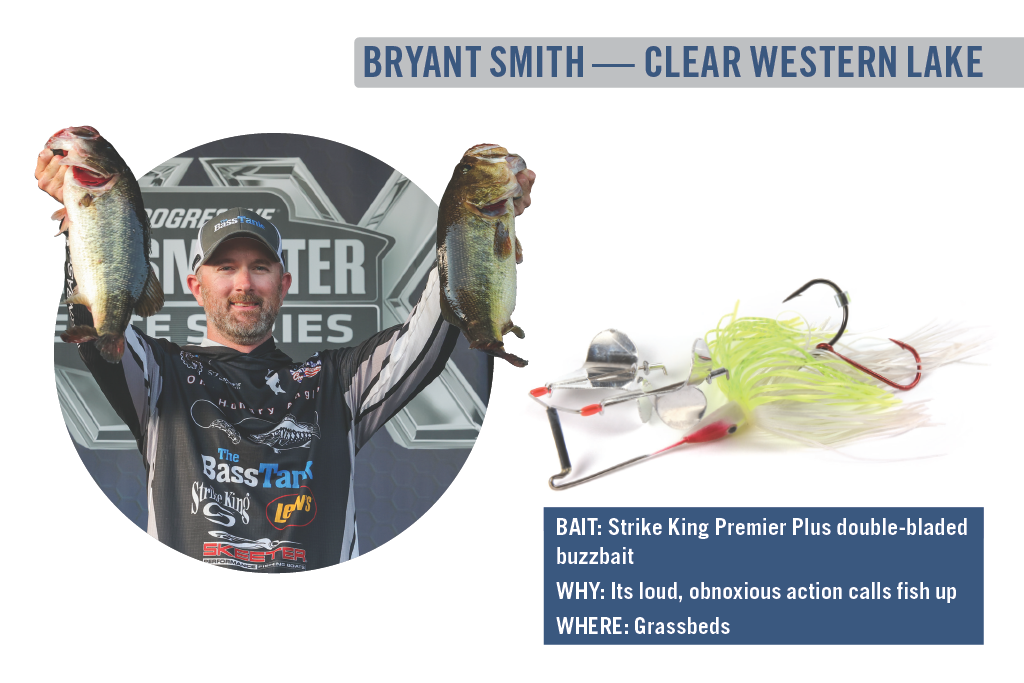
When he’s fishing around grass, Smith likes the bold look of a double buzzbait like the Strike King Premier Plus. This loud, obnoxious West Coast staple can draw big fish out of the grass or buzz right through the vegetation’s upper level.
“I think the biggest misconception in the clear water is that you have to downsize your line and go super-deep with really finessey presentations,” Smith adds. “That strategy catches a lot of fish, but you can go to the opposite end of the spectrum too. You can go bigger, louder and quicker, and you can catch some of the biggest fish in the lake that time of year.”
BAIT: Strike King Premier Plus double-bladed buzzbait
WHY: Its loud, obnoxious action calls fish up
WHERE: Grassbeds
Originally appeared in Bassmaster Magazine 2026.