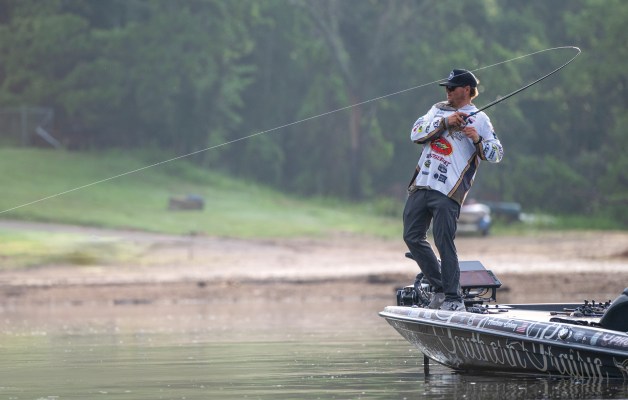
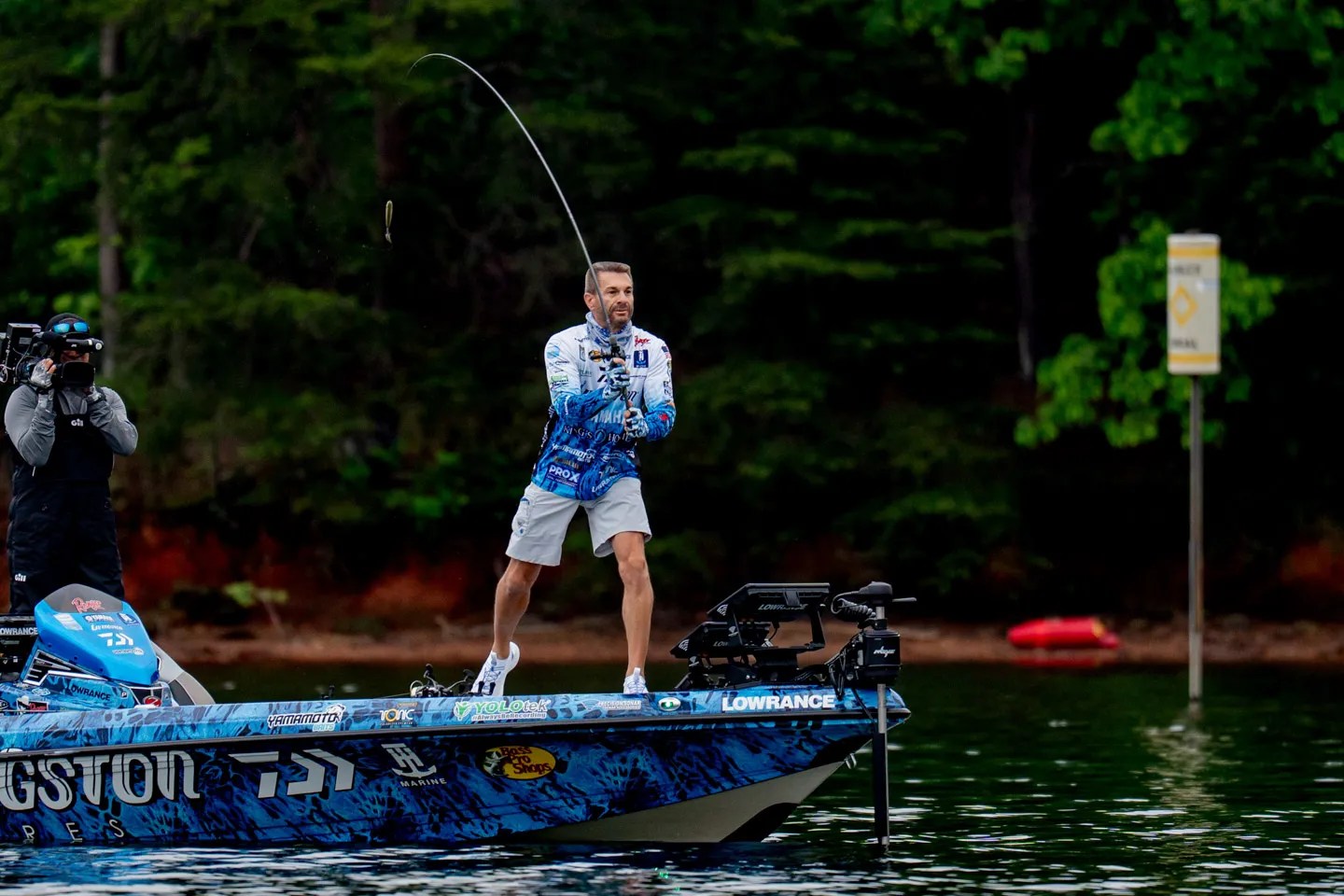
As far as a pre-practice advantage goes, Randy Howell’s is one for the history books.
When the 2014 Bassmaster Classic winner first competed on the Santee Cooper Lakes in B.A.S.S. competition — at the May 1994 South Carolina Invitational — well over a third of the current Progressive Bassmaster Elite Series field had yet to be born. By the time Elite rookie Fisher Anaya exited the womb, Howell had over 120 Bassmaster events on his permanent record.
Howell was there last October, sacrificing family time and other offseason fun to idle around the massive lakes. Searching for where the largemouth might be during the May event was not his goal.
“I’ve been a bunch of times over the years,” Howell said. “But I still try to go and scout every time I’m not familiar with a lake and what’s been going on over the past year or two. I hadn’t been to Santee in three or four years, so I went over after I helped at a high school event in Charlotte at Lake Norman.
“I’d heard that the grass was coming back and I wanted to see it while it was topped out, when it would be easier to find. A lot of the fish will have spawned by the time we’re there in May, so I needed to know where it was growing.”
A change in B.A.S.S. rules was another reason for his visit. Whereas the most recent past limitations on forward-facing sonar dealt only with the number of transducers allowed and total screen size, beginning in 2026 the technology will not be allowed in nearly half of the events. Those are Lake Guntersville, the Tennessee-Tombigbee Waterway, Santee Cooper and Lake Champlain.
That changes the way he’ll practice and the way many if not most anglers will fish during the tournament.
“With forward-facing sonar, you can see and locate the key spots really easily during the official practice,” he said. “Now it will take a little more time.”
That means we’ll likely see fewer pros floating out in mid-lake or center creek positions devoid of cover or structure, hunting individual giants in those four tournaments. Instead of spending hours panning their scopes back and forth and pinging a minnow, they’ll be trying to cover water or pierce the heaviest cover. That puts a premium on pre-practicing grass lakes.
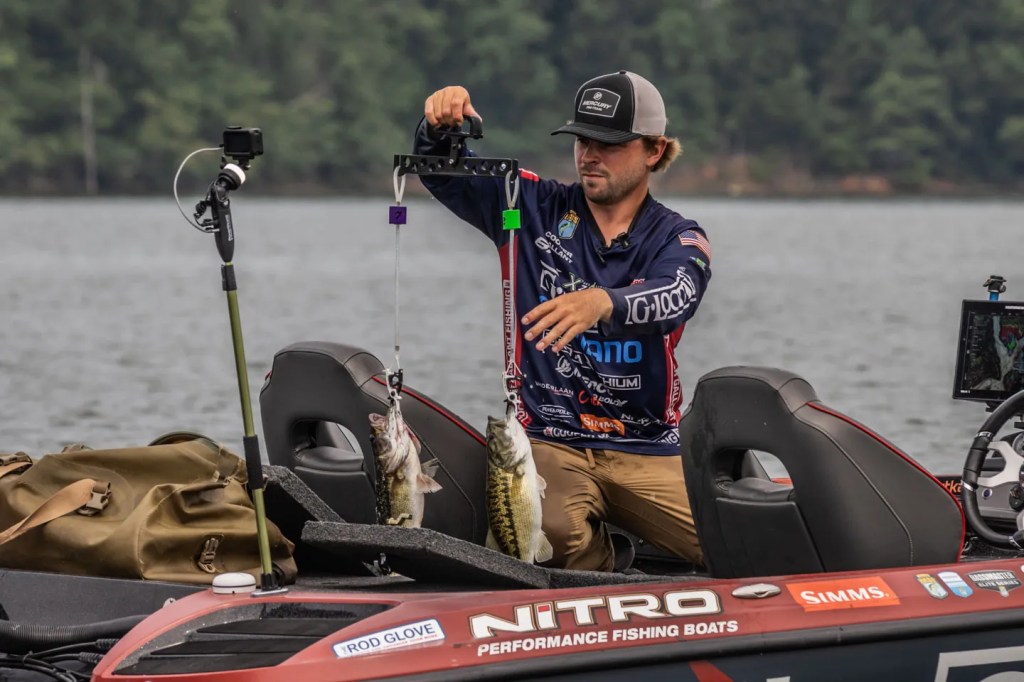
It’s one of the main reasons Canadian Elite Cooper Gallant spent a week and a half at Lake Guntersville, putting in four or five long days behind the wheel scouting for a tournament advantage.
“Obviously, a lot of fish will still be roaming out in the middle of nowhere,” Gallant explained. “Guys will still catch them with a minnow without looking at forward-facing sonar, but it won’t be in the middle of nowhere.
“I spent a lot of time looking for irregularities – different types of grass, holes in the grass, bald spots, any hard spots. I took my time in pre-practice because I don’t want to have to do that during the official practice. It was something I needed to do. I went up all the creeks, saw where grass was growing and where it was not.”
In contrast, forward-facing sonar will be allowed at the second event on Lake Martin. Gallant still pre-practiced there, but only for a day and a half.
“I just wanted to find as many juicy zones as I could,” he explained.
For some younger pros, the distinction between scoping and non-scoping events is blurred when it comes to pre-practice. Much of the public considers them to be one-dimensional “scopers,” in many cases unfairly. They’ll be combating that presumption all season long – and ultimately a small sample size of tournaments will tell a story – but in the meantime they’re on the water every day.
“When I was at Santee, several of them like Trey (McKinney) and JT (Thompkins) were there every day,” Howell said. “Then they were out there on Guntersville every day, all week.
“At this point, you need to pre-practice just to stay consistent and have a chance of doing well. Last year didn’t go the way I expected, so I’m trying not to take anything for granted.”
Howell won’t pre-practice the Arkansas River out of Muskogee, not because forward-facing sonar will be allowed or because it’s a shallow river, but rather because he can’t make it work before the waters go off limits. He planned to spend time on Martin and the Tennessee-Tombigbee. The former will allow forward-facing sonar and the latter will not.
The last time Howell visited the Tenn-Tom was for a 2004 Bassmaster Southern Open in which he finished 81st. For the record, that was over a year before Anaya was born, so for all meaningful purposes they’re both starting back at zero. Gallant was just about to turn 7years old.
“I like the mix,” Howell concluded. “It’s a fair mix and compromise. For the guys who are hardcore into using forward-facing sonar, they still get five, but to stay strong in the standings you must be able to fish a variety of different ways. That’s the fairest was to determine an angler of the year.”
Gallant agreed with an exception.
“Forward-facing sonar is a great tool and I like having it, but honestly I really don’t care,” he said. “I’m happy and blessed to be on the Elite Series. A lot of people think that all the young kids, all they can do is scope, but most can catch fish with or without.
“Tucker Smith proved a lot of people wrong by winning a non-scoping event on Guntersville last year. We all knew Tucker could catch them, and he won $500,000 without it.”
While he’s agnostic on whether tech should or should not be allowed, Gallant is excited to see some old-school tactics come back into play.
“It’ll be cool to see people chunking and winding a trap and a ChatterBait,” he said. “I hope I can keep those two lures in my hands the whole time.”