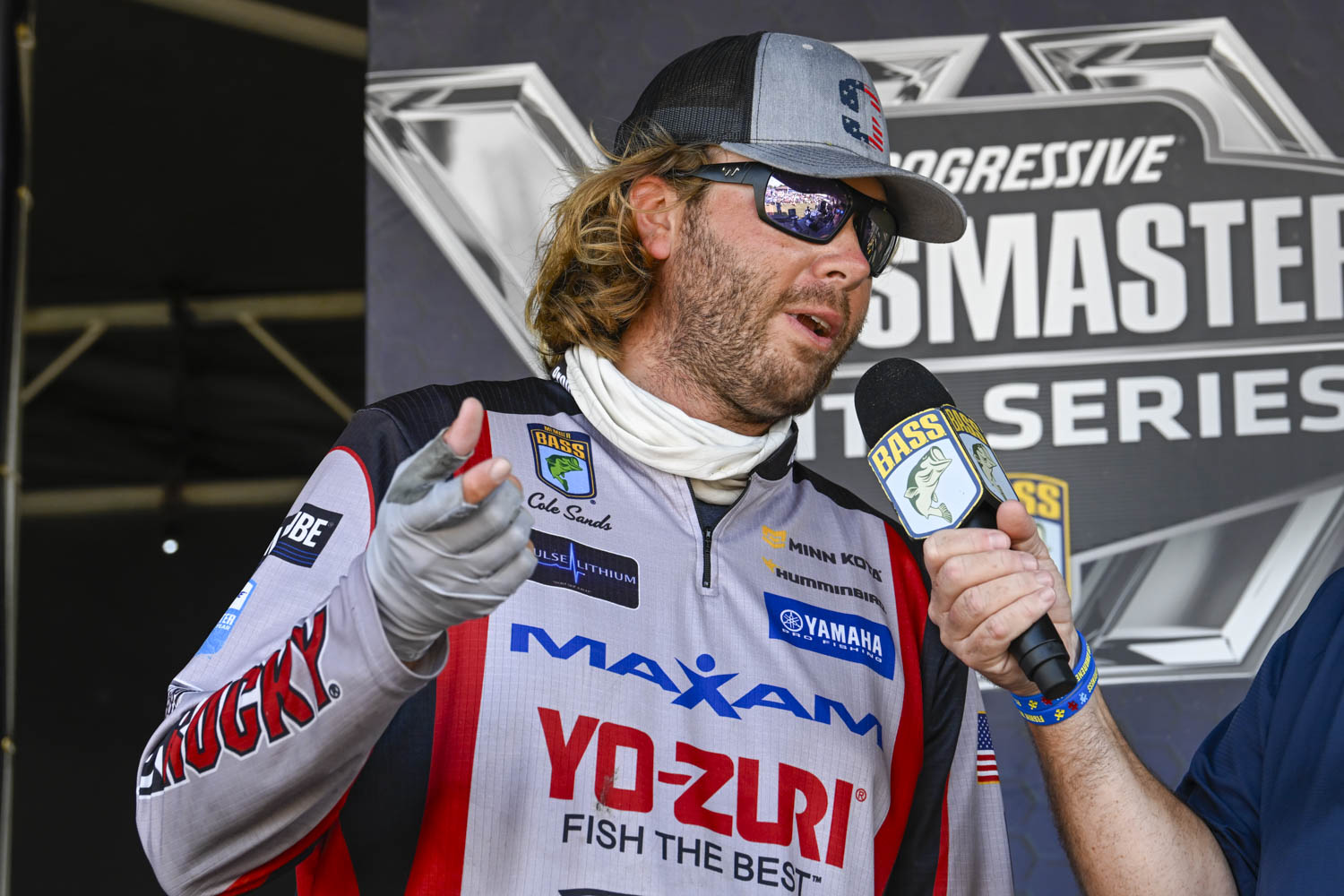
Event: 2025 Pro-Guide Batteries Bassmaster Elite at Mississippi River
What I faced: With this late-August event taking place shortly after a major meteorological event, Sands found himself struggling with the inevitable changing conditions. He went into the event optimistic about what his practice days had revealed. While he was encouraged by his findings, that’s actually where the trouble started.
Based in LaCrosse, Wisc., the season finale launched out of Pool 8, with tournament boundaries also including Pools 7 and 9. Sands spent all of his time in Pool 8, where he found significant post-deluge impacts whittling down the available waters into fishable areas largely defined by clarity.
Practice seemed to be challenging for most of the field, with conservative estimates for daily weights. Sands sized up his expectations and figured he’d have a good shot at meeting his year-end goal.
“I was right on the Classic line, and I really needed a top 40 to make the Classic,” he said. “Everybody was complaining that it was tough, so I figured if I catch 14 to 15 pounds, I’ll be good. But even if I had 11 or 12 pounds, I’d still be around 50th.
“That’s what I thought, just listening to everybody talk, but that was definitely not the case.”
At the tournament’s conclusion, local ace Pat Schlapper won with a four-day total of 66-5 — a little more than 16 1/2 pounds a day. It took about 13 1/2 to make 40th place.
What I did: During practice, Sands dialed in a promising area around Stoddard, Wisc., south of LaCrosse. Grass is always an important element on this fishery, but given the level of turbidity from recent rains, the water filtering vegetation proved essential.
“I’d had a pretty good practice and I probably had nine or 10 schools,” Sands recalled. “There was one area, kind of a community hole, where I had three or four holes in the grass that they were loaded in — and good ones, too.”
On Day 1, Sands made it to his area before anyone else, but after thoroughly fishing three different holes with nothing to show for it, he realized the deal was off.
“They were loaded in those holes (during practice), so it should have been like every cast,” he said. “I threw into the first hole and nothing. I’m like, ’That’s weird.’ I threw into the second one; no bites, so I was like, ‘That’s really strange.’
“Third one, same deal. I’m like, ‘Something’s changed.’”
A couple hours into the day with an empty livewell, Sands had step back and analyze how the scenario had shifted.
“We’d had a really cold night before the first day of the tournament, and I was like, ‘It has either pushed them under the grass mats nearby and they’re no longer in the holes, or they just left the area,’” Sands pondered. “I was like, ‘They probably just got under the grass.’”
Complicating the situation was the Plan B option that Sands’ practice had presented.
“In the back of my mind, I remembered I had found seven or eight other schools where I thought I could catch a bunch, but it was one of those deals where you don’t want to beat on them too hard in practice, so you really don’t know the potential of the rest of your stuff,” he said. “So, I said, ‘I’m gonna pick up my punch rod and punch my way out of here and see if I can get a couple bites with good, quality fish, and if I do, I’ll stay.’”
Turning from the drop shot and popper he had been throwing in the grass holes, Sands punched a creature bait and quickly caught a 2 1/4-pound bass that seemed to indicate the fish had simply relocated to thicker cover. A couple more bites in the same size range strengthened the premise, but the quality was not competitive.
“Those were not what you need; on the Mississippi River, you need 3- and 4-pounders,” Sands said. “My gut told me I needed to stay because the quality is there, but my head was saying, ‘You have seven or eight other places where you know they’re loaded.’
“I listened to my head instead of my gut. I ran around and fished those seven or eight other places and about half of those places were blown out from the rain, and they weren’t any good. The other places were loaded, but they were all 2- to 2 1/2-pound fish.”
Sands caught a first-round limit of 11-4 and placed 78th. On Day 2, he committed to his original area, punched and frogged the matted vegetation and sacked up 14-10 and improved to 55th. His two-day total of 25-14 was just over a pound off the cut for Semifinal Saturday.
“I should have listened to my gut and stayed in that one area and adjusted with the fish,” Sands said. “I caught, I don’t know how many 2 1/2- to 3-pounders and actually ended up having a pretty good second day.
“Had I listened to my gut and done that both days, I probably would be fishing the Classic, instead of being the first one out. But that’s tournament fishing. You have tournaments where you do make that decision to run other stuff and it works out, and then sometimes, you should have stayed where you were.”
What made the difference: As Sands explained, a big cold front had moved through the area two nights before the tournament. This system, which brought the rain, rattled the fish and caused their repositioning.
“I should have known that would happen, but when you have a time clock in the back of your head, you probably rush them more than you should,” Sands said. “I learned my lesson on Day 1. I got in too much of a hurry and lost confidence in my first area.
“But on Day 2, I stayed in that area and stuck it out and caught a lot of really nice fish. That’s what makes or breaks us in this sport — those decisions.”
What I learned: Sands makes his home in Calhoun, Tenn. — about an hour from Knoxville, which hosts the 2026 Bass Pro Shops Bassmaster Classic presented by Under Armour March 13-15 at the Tennessee River. That proximity made his final 2025 Elite finish particularly painful.
That experience solidified an inescapable truth: “Just because you found them doing one thing in practice, those fish usually don’t go very far. I kinda figured it out the first day, but I didn’t trust it enough to stick with it. The second day, I expounded on it and figured out the fish had only moved about 30 yards under the grass mats.
“I try not to second-guess a lot of things. I kinda think everything happens for a reason, but fishing the Classic in my backyard would have been nice. That one definitely stings.”