The weather’s warm and the winds are light; still the Big O has been pretty stingy. Variables are many, but during the Day 1 Halftime Show, Bassmaster legend and Lake Okeechobee icon Roland Martin noted that declining water levels have likely disrupted some of the spawning action, as relocating fish need time to acclimate and establish new bedding areas.
Getting bit is never assumed, but several anglers have mentioned employing tackle and tactical adjustments to help tilt the odds in their favor.
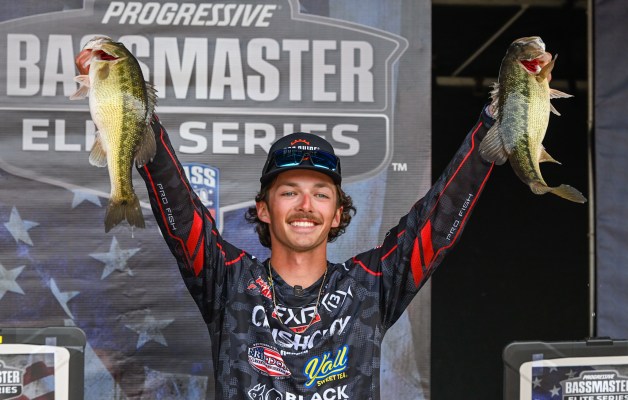
Pickup Line: Trey McKinney, the 2024 Dakota Lithium Rookie of the Year, electrified the Bass Live coverage with a hot hand that delivered a 20-pound bag by late morning. While we saw McKinney catch fish on a variety of baits, including a jerkbait and a glidebait, one of his most productive tools was a 6th Sense Bamboosa stick worm Neko-rigged with a 1/32-ounce nail weight.
Fishing a finesse rig on a lake where any cast could tempt a big bite, McKinney said his line choice enabled him to make the right presentations, while remaining ready to wrangle whatever bit.
“I like light line for that Neko rig because it helps the bait fall more naturally, and it helps me fish it with more of a natural presentation,” McKinney said. “I like 10-pound Seaguar Tatsu fluorocarbon, so if I hook a big one, it’s strong enough for me to horse them out.
“That’s the thing, you want to go just finessey enough so you don’t scare them, but you don’t want to risk breaking one off.”
McKinney also noted his line’s composition plays a big role in his game.
“Tatsu is a really limp line, it’s not coily or stiff, so you get good casting distance and it comes through the cover well,” McKinney said. “When I’m shaking that worm, I have to make sure I’m keeping it on the spot. Tatsu allows me to shake it without pulling it away.”
“If you hook one, it’s not going to twist up in a ball (from the pressure). Less line twist, fewer wind knots, I’m in.”
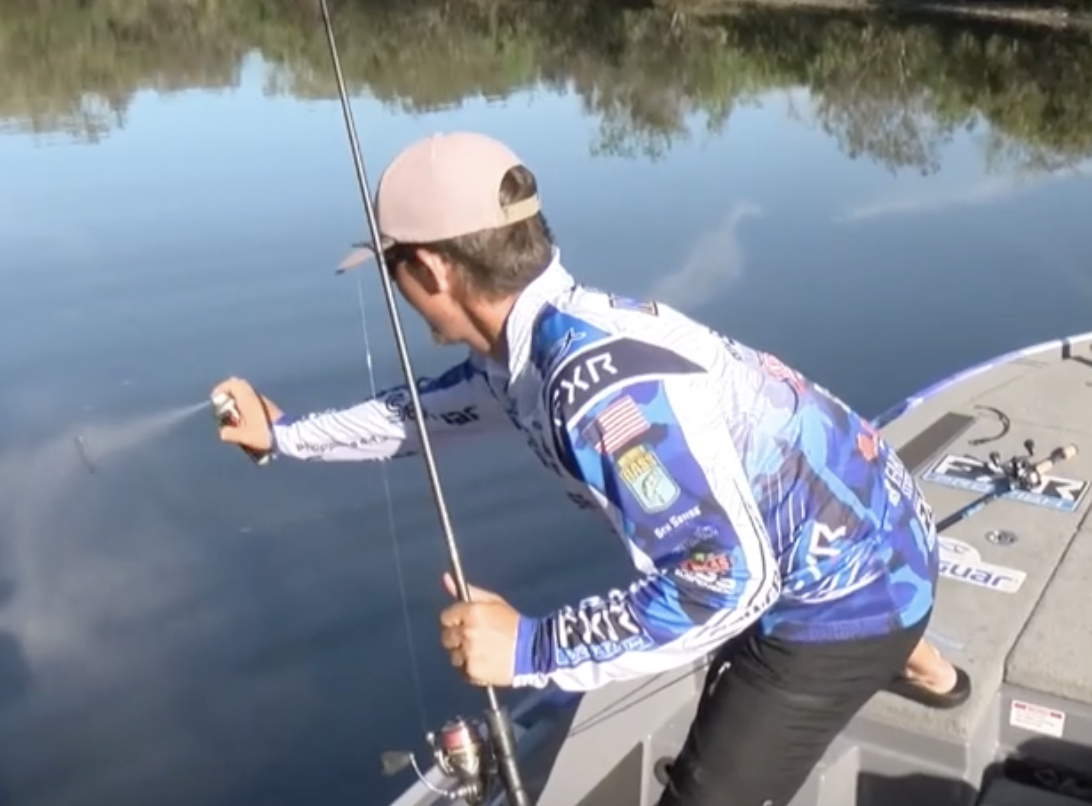
Makes Scents: About two hours into the Day-1 competition, McKinney spotted an indecisive fish considering his bait on his forward facing sonar. When the fish refused to commit, McKinney reeled up, covered his worm with garlic spray and quickly closed the sale on a 3-pounder.
Make Some Noise
Paul Mueller put his bladed jigs to work on Day 1 and tied Cooper Gallant for seventh place with 19-5. He said he tried several different bait configurations with various size, color and blade styles.
“I started out using light colors in the morning and then dark colors later in the day,” Mueller said. “I caught both of my good fish on a Chatterbait; one fish came in the morning on a light shad color and the other one was more of a dark golden shiner color — gold and black — when the sun was up.
“It was just experimentation because the bass were eating weird. I also experimented with blade sizes and the different noises and vibration that the blades make. Do you want to fish it slower with a bigger blade or a faster with a smaller blade; there are tweaks that you can make.”
Mueller said he found his greatest consistency with a bladed jig configuration that was louder due to the blade’s contact with the head.
Heavy Thoughts
Also employing a bladed jig, Steve Kennedy’s dressing his with a hefty Strike King Rage Lobster. The idea is to create a large profile that appeals to bigger fish.
The only problem is that Kennedy also likes to employ a dead-stick technique that creates a sudden moment of stimulus that a big bulky trailer can impede.
“When I’m swimming a jig or fishing a bladed jig, I like to kill it so it falls; but it’s not just the fall — I want it to fall straight down (at a 90-degree angle),” Kennedy said. “When it falls straight down, that triggers the bites.”
Abruptly stopping a traditional 3/8- or 1/2-ounce bladed jig fitted with a smaller, less water-resistant trailer will create that fast fall, but Kennedy knows the 4.5-inch Rage Lobster creates too much water resistance for a standard size jig head.
To achieve the desired drop rate, he’s packing 3/4- and 1-ounce bladed jig heads. When he pauses his retrieve, that extra weight yanks even a hefty trailer straight down for the abrupt display that spurs big fish to act.
The Kitchen Sink
Brandon Palaniuk took third place on Day 1 after sharing a small spot in a spillway canal off the Kissimmee River with a small group of anglers, including Greg DiPalma and Will Davis Jr., who placed first and second, respectively. None of the top three caught a lot of fish, so their day required a significant amount of experimentation to see what triggered bites.
“It looked like we had thrown every single thing from the tackle shop at them,” Palaniuk said. “I don’t know that any of us were prepared for it, because we were all digging around in boats, offering baits to each other.
“I know that I was not prepared for how I was gonna try to catch them. I think I caught six fish on four different baits.”
Suffice to say, the creativity, diversity and diligence will continue through this derby’s conclusion.