
After a 12 year run, you’re retiring as B.A.S.S. Conservation Director at the end of the year. Why now?
That’s the question Chase [Anderson] asked me last summer. I told him when we were up at Lake St. Clair for the Elite Series, and his first question was why now? He asked if there was something they could fix so that I would stay, but the honest answer is no.
I’ve been the Conservation Director at B.A.S.S. for 12 years, and my wife and I are in the process of moving back to Texas — where we are both from — to build a retirement house. Anytime you’re building a house, it’s not something you want to do part-time. But the bigger reason is that I want to go fishing more.
When my buddy in Minnesota tells me the smallmouth are biting, I don’t want to have to look at a calendar and say, “Oh, I can’t go. I’ve got to go to a meeting or work at a tournament.” I want to get in the truck and go.
Also, while my wife and I are still in good health, we are getting older. We want to get back to Texas where the family is and spend time with grand nieces and grand nephews that are getting into little league baseball and dance recitals.
Do you have a short list of places you want to go fishing with your newfound time?
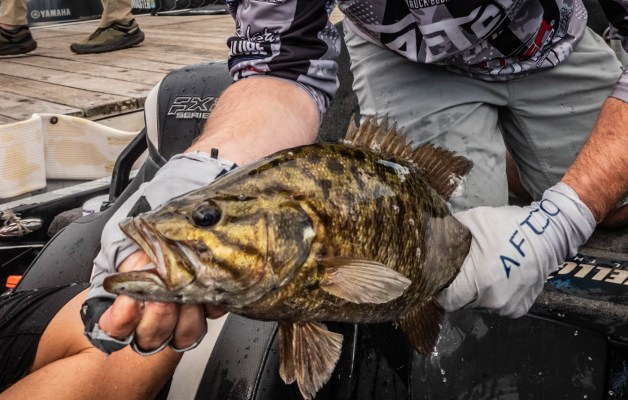
Over the last 15 or 20 years, I have become a real smallmouth addict. I definitely want to spend more time in New York, Michigan, Minnesota and Wisconsin. I want to explore more of the great smallmouth fisheries they have up there.
I would imagine because of your position, you probably have a fishing buddy in every state.
Well, not every state, but I do like the idea of having the freedom and the time to be able to do some things. I like having a bit more control over my schedule. Also, my wife has become an avid angler herself. She really likes to go places and has become really proficient. So, it’s good for us to be able to go and take a trip anytime we want to.
I love fishing for redfish in the marsh, so I want to spend more time down in Venice, La., poking around in the marsh with a spinnerbait and a jig.
Let’s talk about your job right now. As the Conservation Director for B.A.S.S. (for now), you’re one of the most prominent people behind the scenes in the organization. People see you at events; you’re also managing the conservation group on social media. But tell us what your mission is in your own words.
My job is really three-fold. The first one is representing B.A.S.S. on a number of different national boards, councils and committees that deal with fisheries policy — the political side of fishery management. Some of those are at the state level. Some are federal-level committees that B.A.S.S. has had a seat at for many years or decades.
In a broader sense, I represent not just bass anglers but freshwater recreational anglers as a whole.
The second component is working within the company with our tournament staff. I make sure that our fish handling and fish care processes are as good as they can be, so that we are returning as many fish alive and healthy to the waters they come from during our tournaments. That means working with our staff on tournaments from high school, college, B.A.S.S. Nation, Opens and Elite levels. I work with the staff running those tournaments to make sure they are following our best management practices that we initially wrote up more than 20 years ago, but have evolved over time.
Do you feel like there is more awareness now among anglers of how to keep fish healthy than there was 20 years ago?
It certainly has improved drastically since then. If you go back 30 or 40 years, we had fish fries after the tournament.
Social media has had a lot to do with spreading some of that information, but it’s a double-edged sword. There is also a lot of misinformation out there because everybody wants to have their own Facebook page or Instagram feed, and they think that the way they are doing things must be right. In some cases, they post things that are not within the best practices. So, it’s been a challenge over the years to try to educate anglers on what really is the best way to care for their fish.
Can you give us some examples of recent misinformation you’ve seen?
Well, there are things that go around about the use of chemicals in the livewell that really don’t have a lot of scientific study to prove them. There are anglers who use ice in their livewells to cool the water — which we actually recommend — but they are using too much. This creates a problem with fish mortality several days after they are released.
Delayed mortality is pretty much invisible in a lot of cases. But we know that under certain conditions, a percentage of those fish do die. And that is directly related to water temperatures.
Going back to the concept of catch and release, these fish are recyclable. They can be caught again and again if they survive going through the tournament process.
Can you give us some examples of success stories in your time as Conservation Director?
That goes into the third component of my job, which is working with B.A.S.S. Nation state conservation directors. Those people are volunteers. They’re bass anglers who feel a strong conviction to help protect the resource. And part of what I do is work with those directors to help them build positive relationships with state fish and game agencies, their local biologists and the fish chiefs within their states.
We try to build communications and teams where those groups can work together. To that end, we have partnered with AFTCO on grant programs since 2018. AFTCO supplies money, and we, in turn, provide that out to the B.A.S.S. Nation. It goes to either state chapters or clubs or sometimes high school fishing teams in the form of grants to do projects on the ground and in the water.
A lot of times, those projects enhance fish habitat or improve access to anglers and boaters, or they go to buy equipment for live release boats and things like that. So, that’s been a very positive program, and AFTCO has been a great partner with that. They’ve provided funding every year, and I can’t say enough about their conservation ethic. It’s built into their DNA, and they don’t just do it for publicity. It’s not a marketing thing. They do it because they believe in it.
Pull out your crystal ball and try to think about what issues bass conservationists will be dealing with 15 or 20 years for now. Do you have any predictions for what those issues might be?
There is obviously the issue of the growth of bass tournaments and the potential for negative impacts. This is an issue that needs a lot of study, and the cooperation of the bass fishing community in concert with their state agencies to better understand.
We have to make sure we are protecting those resources and maintaining them. There are times when we don’t want to harvest bass. But there are also times when we do the whole concept of selective harvest, and I think that’s something that needs to be promoted and emphasized a lot more.
I’m not just talking about biological impacts. There are social impacts like access issues, overcrowding and working with facilities around this country that were built in the 60s and 70s. A lot of boat ramps and parking facilities are woefully inadequate. Trucks and boats are bigger now. Parking is a problem. And when you have these large tournaments, you need enough boat ramps and parking.
That’s a double-edged sword, because you don’t want to overcrowd the waterway and diminish the experience for other anglers out there who are just pleasure boating or fishing for fun or own homes by the lake. We also don’t want to discourage people from getting into fishing.
License sales peaked during COVID, and they’ve been declining again. I think a lot of states are struggling because of that. They want to make sure people keep fishing and we get more new people into fishing. The gateway for that is obviously the hook and bobber, but at some point those youngsters graduate and some of them come into the competitive side of things in the high school fishing world.
We have to use that as a potential gateway to recruiting anglers to replace all of the baby boomers that are starting to age out.
Looking back, what do you hope your legacy is as Conservation Director?
Well, when I think about my total career, I think about a lot of fish care issues. Going back to my time in Oklahoma, I worked with B.A.S.S. on the Keeping Bass Alive booklet. And our goal this year is to get that translated into a video format that is more easily consumed by the younger generations.
Another issue I want to be remember for is connecting state fish and wildlife agencies with their respective B.A.S.S. Nation chapters, and building relationships between the bass anglers and the administrators and biologists in the state agencies. I think we’ve made a lot of really positive stories in that regard over the past several years.
When you think about bass anglers as one of the many stakeholders state agencies have to cater to, the bass anglers tend to be on the more vocal side. They also tend to be some of the more avid anglers and some of the best supporters of this state agencies when it comes to protecting water quality, habitat and the quality of fishing.
As we get into tougher economic times, a lot of the states are struggling budget-wise. If they have really good relationships with bass anglers, there is a potential there for anglers to provide a lot of volunteer labor and support for their programs.
That even translates to the political side of things. When you have a good relationship and you know what the state agency is going to their legislature for — say, a license fee increase or some sort of funding initiative — then you have a pool of support among the angling community that can help lobby. Anytime you can build a positive relationship like that, it’s a two-way street.
Is there anything else you want to say to the readers?
It’s been a fun ride. There have been highs and lows, and I don’t have any regrets. I think, for the most part, everything has flowed together pretty well.
I have made a lot of good friends, seen a lot of places and hopefully made some contributions that have some kind of lasting impact. I think about my connections to the B.A.S.S. Nation, the state chapters and our state conservation directors. Those are the guys and gals who will help carry on the legacy of me and my predecessors as conservation directors. They are the ones putting things to work at the local level that can really make a difference.
I think there are quite a few guys and gals who have really done a great job and will continue to do so after I retire.
Short strikes
Sky Diving or Scuba Diving: Scuba Diving. I’m not about to jump out of a perfectly good airplane.
Smallmouth or Largemouth: Smallmouth. I don’t even have to think about that.
Buzzbait or Spinnerbait: Spinnerbait. You can fish it like a buzzbait if you need to, but it gives you versatility all day.
Charcoal or Propane: That’s a tough one. If i’m short on time to make my wife dinner, I go with propane. But charcoal is preferred from a taste standpoint.
SEC or Big 12 Gameday: SEC, ’cause that’s where A&M is playing.
Lake Biwa or Lake El Salto: El Salto. The opportunity to catch a single giant fish doesn’t attract me that much. I’m not a trophy hunter. El Salto has more numbers to keep me busy all day.
Yellowstone or Yosemite: Probably Yellowstone. I am not a big trout guy but there are some fishing opportunities there.
Bill Dance or Roland Martin: Bill Dance. I grew up watching Bill. My fishing buddy and I taught ourselves to fish by watching his show. We’d go out to the pond and practice after every episode.
Big Game Saltwater Fishing or African Safari: I think I’d go for the safari thing, as long as I can bring a camera. I could see more wildlife that way.
Swim With An Alligator or a Bear: Probably an alligator. I mean from everything that I have heard about them, they’re not that threatening.
Fish a Tournament in a Pontoon Boat or Peddle Boat: I’d take the little peddle boat. It’s more maneuverable to get into backwaters.
Electric Outboard or Electric Pickup: I think I’d rather have an electric pickup.
ICAST or Classic Expo: Classic Expo. Partly because I don’t get to go. Every other year I don’t get to go because we have meetings.
Ice Fishing or Spear Fishing: Spear fishing because I hate the cold.