
Like father, like son.
The Rineys of Jonesboro, Ark., will long remember they caught two of the first three fish entered in the state’s new Legacy Lunker Program.
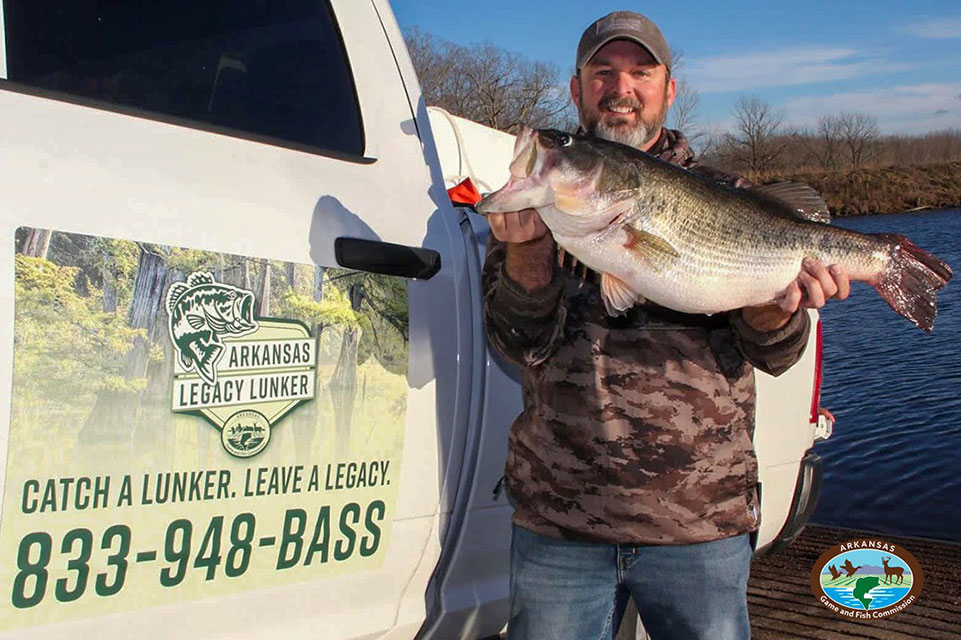
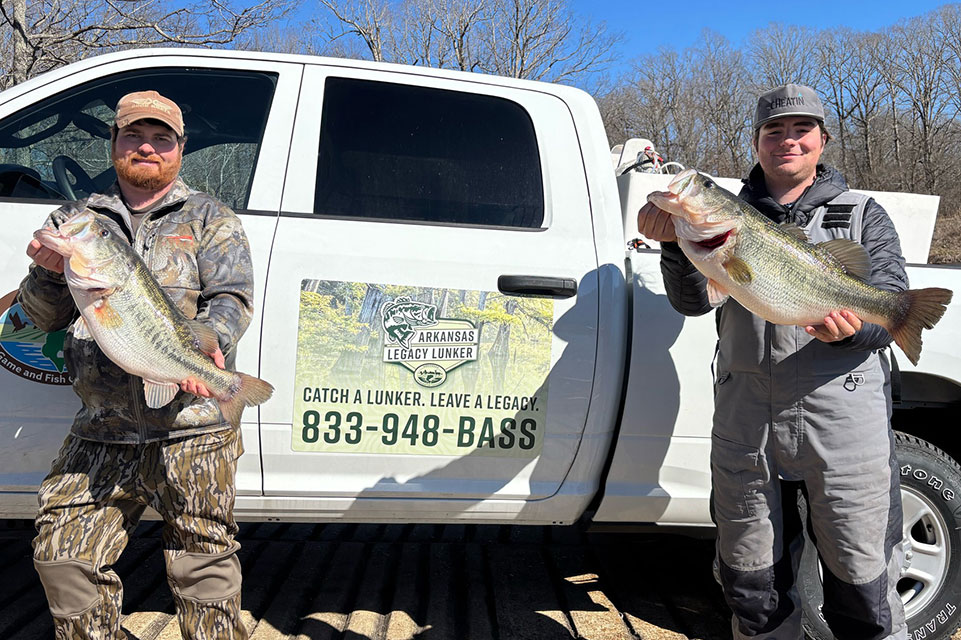
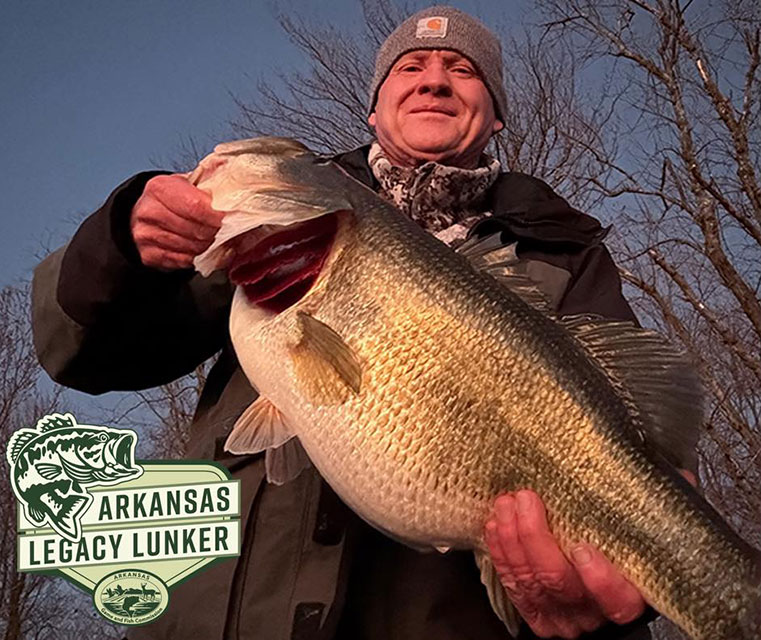
On Jan. 10, Kevin Riney, 45, caught a 12.04-pound largemouth from Lake Austell, about 30 miles west of Memphis. Two days later his son, Dylan Riney, 20, landed an 11.65 there, which came about 45 minutes after Kyle Lochridge brought a 10.16 beast into their boat.
“It’s pretty incredible to catch the very first one,” Kevin Riney said. “I told my son, 20 years, 40 years from now, we’ll be able to look back and say we had the first fish ever. To have a father and son in the program together, that’s pretty amazing.”
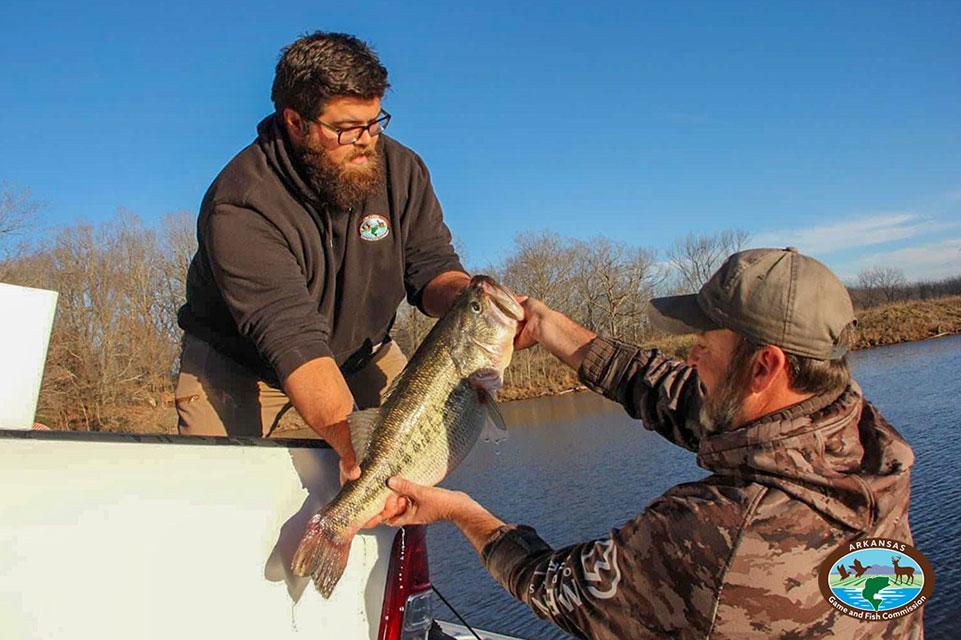
After a shakedown run in 2025, the Arkansas Game and Fish Commission began its program in earnest this year. Anglers bringing in a 10-pound plus bass between Jan. 1 and March 31 are asked to immediately call the Legacy Lunker hotline. Program coordinator Will Lancett will drive his mobile tank to pick up the fish then deliver it to biologists at the Joe Hogan State Fish Hatchery in Lonoke.
After spawning in the new state-of-the-art indoor facility, the fish and their offspring are returned to their home lake. Anglers receive a replica of their trophy fish by Harper’s Pure Country Taxidermy and are entered into a drawing for a 21-foot Xpress bass boat with a 250-horsepower Yamaha, retailing for about $75,000.
Trey Reid, the assistant chief of communications at AGFC, said the state conferred with and modeled its breeding protocol after Texas’ famed ShareLunker program. For the male component, Arkansas is using Titan Maxx bass from Georgia’s Red Hills Fishery, genetically tested for trophy-class growth.
“There is a ton of excitement, not just because of the potential of producing more big bass, but from a public relations standpoint, this is going to create excitement for bass fishing in Arkansas,” Reid said. “Every time one over 10 is caught and an angler donates, we’re going to publicize it. Hopefully, we’ll change the narrative that there are some decent bass in Arkansas, believe it or not.
“We’re not Florida. We’re not Texas, and we probably aren’t going to be because of our geographic latitude. But we are doing things that improve habitat, lake innovations, that will ultimately lead to some bigger bass, and this program is also going to lead to more of them.”
The Arkansas largemouth record is a 16-4 caught in 1976 from Mallard Lake near the Missouri bootheel. It was surpassed in 2012 by an ounce, but that catch wasn’t recognized because the angler did not possess a current fishing license. That bass was caught in Lake Dunn in Village Creek State Park, minutes away from Lake Austell.
Jeremy Risley, AGFC Black Bass Program coordinator, said he wasn’t surprised a lunker came from the 85-acre lake along Crowley’s Ridge, but three coming in such rapid succession was extraordinary.
“The lake is pretty small and only allows electric motors, but the AGFC has stocked Florida bass there and managed it as a trophy fishery for years, so it has the potential,” he said.
Big bass were anticipated from other lakes across The Natural State. In December, Lance Freeman landed a 14-pounder from De Gray Lake, missing the window to enter the program by several weeks. Last March, Griffin Ralph, a Bassmaster High School All-American, had one of five double-digit fish that made their way to the Lonoke hatchery in its soft opening. He caught a 13.43-pounder during a Youth B.A.S.S. Nation event on Millwood Lake, the state’s most renowned big bass fishery.
Millwood, in the southwest corner of the state, did pop just days after Austell. Jeff Pate, 59, of Texarkana, Texas, caught Legacy Lunker No. 4, an 11.10-pounder on a spinnerbait in 2 feet of water on Jan. 16.
“The bass bit right around 5 p.m., just as it was starting to get dark,” said Pate, who’s fished Millwood since he was 15.
The Rineys, both tournament anglers, knew Austell held some monsters. They kept it on the down-low and started scheming once the Lunker program was announced.
“We couldn’t wait till January got here,” Kevin Riney said. “We kind of laid off the lake all fall and left it alone to try to hopefully make those fish a little easier to catch. Come January we started hitting her pretty hard.”
Kevin Riney was having a good morning fishing alone, catching an 8-pounder, two 6-pounders and a 5. Around noon, he saw two big gals together on LiveScope about 8 feet down and cast his custom glidebait.
“I finally got her up and she barely fit in the net,” he said. “My scale said a hair over 12 and I just put her in the box and called Game and Fish.”
Lancett arrived two hours later and placed the bass in his tank for the ride to Lonoke. Just two days later he would make the same trip. On Monday, Lochridge landed his 10 on a minnow, and Dylan Riney called Lancett.
“I was like, Riney? That name’s familiar,” said Lancett, who quickly learned it was his partner who had the double-digit bass. “I told Dylan before I hung up, ‘Well, you got two hours to catch another one before I’m there.’”
Talk about pressure. Dylan called his father after Lochridge’s catch.
“My son is competitive. He said, ‘I’ve got to do everything I can to catch another one before (Lancett) gets here,’” Kevin Riney said. “And lo and behold about 45 minutes later, he called me back and said, ‘Dad, I did it!’
“So I was super excited. I still don’t know if it’s all sunk in yet that he and I have two of the first fish ever for this program.”
Lancett said the Austell bass are doing well at the hatchery, where temperature and light are being controlled for a mid-April spawn. While a whirlwind week, Lancett, also a tournament angler which spawned his interest in biology, said he’s enjoying his new role after working on fishery habitat.
“I helped manage the Lake Conway dam renovation,” he said. “So I went from everybody’s least favorite game and fish employee — the guy who drained Lake Conway — to the one that they maybe like now.”
After learning the stocking history of Lake Austell, Lancett wasn’t too stunned trophy fish came from the lake, but three lunkers in three days is remarkable.
“I definitely didn’t expect that, but these guys fished there a lot,” he said. “I think it’s one of those secret lakes that no one talks about. It’s going to get a lot of pressure now, and I bet fishing will get a little tougher.”
Kevin Riney said he’s asked how often he plans on making the 45-minute drive down from Jonesboro to Austell. He realizes the big catches will certainly draw attention to the little lake and Arkansas, but he knows that was the plan.
“You may have guys come from Missouri or other bordering states and say, ‘Hey, we want to get on this and try to catch big fish, not have to drive all way to Texas,’” he said. “When I was a kid growing up, that’s all you ever heard about, them big fish coming from (Texas’ Lake) Fork.
“So I don’t know. It isn’t a very big place. There’s going to be lots of boat pressure. I just hope everybody takes care of the fishery.”
The AGFC will certainly give Lake Austell, as well as other fisheries, its best, big shot.
Visit www.legacylunker.com for more information on the program, and call 833-948-2277 to enter a 10-pound-plus bass.