A statue of Babe Ruth stares longingly from the Baltimore street corner just outside the gates of Camden Yards, the smell of crab mac, chili dogs and barbecue wafting over the home field of the Baltimore Orioles. Across from the frozen, bronzed eyes of the Great Bambino, a collection of hotels welcomes baseball fans and business travelers to downtown Baltimore year-round. Aside from pricey lava cakes at the hotel bar, the Hilton Baltimore Inner Harbor is unexceptional among this lot. The hotel is a 20-story sterile box near a saltwater harbor that feels about as far away from a cypress swamp as a bass angler could get.
But in February 2025, the future of sportfishing was being written by some of the most influential minds in the industry beneath the Hilton’s fluorescent lighting. Inside the hotel’s ballroom, while the Orioles were still warming up in the Florida Grapefruit League down South, the Baltimore air buzzed with the low hum of conversation and the rustle of uniforms stitched with names from every corner of America. Patches from Alabama, Maine, Alaska, Virginia, Hawaii and Texas clung to button-up shirts and fleece vests as more than a hundred employees from state fish and wildlife agencies around the nation mingled in the ballroom.
The crowd was diverse — the kind of audience where as many people probably drive home in an F-150 as a Subaru. Stetson hats and man buns shared common ground in the crowd. Most wore name tags denoting management or executive roles in marketing and conservation. Nearly everyone in the room was tasked with growing the number of anglers fishing in the United States — a surprisingly delicate dance whose steps are not easy to master.
Despite the blossoming ranks of youth bass fishing organizations across the country, sportfishing as a whole is not in exceptional shape. Participation numbers have grown from 46 million to 57.9 million anglers in the past decade, but millions of anglers opt out of the sport each year. In 2024, 5.1 million new anglers hit the water in the U.S., along with 11.8 million returning anglers who got back into the fold. But simultaneously, 16.6 million phased out.
Bass fishing organizations, including B.A.S.S., have committed to doing their share to stem the tide. But a lion’s share of the load falls on the behind-the-scenes national nonprofit that hosted those state agencies in a Baltimore ballroom: the Recreational Boating & Fishing Foundation (RBFF).
To everyday anglers, the workshop can be a bore. But to those who work at state agencies, it’s an invaluable tool. Cards are doled out. Meals are shared. State agencies gain the opportunity to learn about effective angler recruitment strategies taking place hundreds of miles apart. And they benefit from a platform to showcase their conservation efforts to peers at no cost to themselves.
Thanks in part to the workshop, the Wisconsin Department of Natural Resources used insights to build a new social media strategy. The Utah Division of Wildlife Resources used knowledge gained at the workshop to create outreach programs for Hispanic anglers, one of the fastest-growing segments of anglers in the United States. And the Nevada Department of Wildlife borrowed strategies to increase fishing license renewals.
Every bass angler is a part of an ecosystem that includes those agencies. That ecosystem also includes saltwater enthusiasts, fly anglers and weekend warriors walking the banks with live bait and a cane pole. Fisheries, tackle and viewpoints vary. But every angler is connected by a common thread — their wallet.
Since 1950, when the Dingell-Johnson Sport Fish Restoration Act was rallied through Congress by the sportfishing industry, a piece of every dollar spent on fishing tackle has gone back toward fishing. The act has since been expanded to include excise taxes on motorboat and small outdoor engine fuel and electric motors, plus import duties on some products. The money goes into the Sport Fish Restoration and Boating Trust Fund, which is administered by the U.S. Fish & Wildlife Service (USFWS), and is then allocated to various programs and agencies, with the largest share going to states for restoration programs.
In 2025, the total amount of federal funding directed to state agencies amounted to $416,382,754. That money is distributed based on a state’s landmass and number of licensed anglers. Texas and Alaska received more than $20 million each. Alabama and New Mexico received about $7 million. Rhode Island and Vermont received about $4 million, and so on.
According to B.A.S.S. Conservation Director Gene Gilliland, those dollars fund management and research. They support hatcheries, build docks, install ramps, support fish habitat and educate anglers. And, since 1998, 2% of those dollars has also been dedicated to growing the sport of fishing.
From grunge era to growth
By the time Nirvana ruled the airwaves and young anglers started to smell like teen spirit, four decades of financial support from Congress had positioned fisheries for success. But outside of Ray Scott’s lightning-hot Bassmaster universe, the marketing arm of fishing was lagging behind fisheries and facilities.
“The ’90s were not great for the fishing industry,” says American Sportfishing Association (ASA) President Glenn Hughes. “The states were not doing a very good job of keeping people in the sport. So, the industry said collectively that we had to move some of the money toward promoting fishing.”
Bolstered by the ASA, which is the industry’s trade association, and fishing tackle manufacturers, a new congressional act dubbed the Sportfishing and Boating Safety Act allocated 2% of the Sport Fish Restoration and Boating Trust Fund toward organized, national promotion — an effort called the National Outreach and Communications Program (NOCP).
The Recreational Boating & Fishing Foundation was birthed out of that movement through a cooperative agreement with USFWS to implement the NOCP. And despite some early jitters, the nonprofit hummed along largely unnoticed, steadily picking up new anglers, as the sportfishing industry focused on more glamorous issues like legal tackle bans and vessel speed regulations.
While the focus of avid anglers was on pressing issues like these, RBFF’s focus was on making newcomers feel like fishing had a place for them.
RBFF founded its State Marketing Workshop and established a women-focused industry event at ICAST, the sportfish industry trade show. It used scientific market studies to understand why people quit fishing and how to engage new anglers. It distributed the results of that research to state agencies for free to help sustain the lifeblood of sportfishing. And it worked together with the ASA and National Marine Manufacturers Association (NMMA) to increase participation across the board. According to data published by RBFF, the total number of Americans participating in angling and the percentage of the population participating both reached the highest levels on record in 2024.
Additionally, RBFF partnered with the USFWS to build a network of more than 30 fishing education trailers (“First Catch Centers”) from South Carolina to California that worked in conjunction with state agencies to stage fishing seminars for youths, families and people in metropolitan areas. They hosted nonendemic press trips, bringing publicity to the sport in national magazines and websites beyond the avid fishing bubble. They showed other outdoors lovers — such as campers, hikers, kayakers and birders — the joys of sportfishing.
Thanks to RBFF research, we know that just one in five anglers fished alone in 2024. We know that out of 57.9 million anglers in the U.S., 43 million went fishing in freshwater in 2024. We know that 21.3 million anglers were women that year, including 39% of first-time anglers. We know that the number of Black anglers in 2024, 5.5 million, was a record high since tracking began in 2007. And we also know that Hispanic anglers accounted for 6.6 million additional anglers.
We know that 82% of anglers are based in popular Bassmaster hot spots of the South, Northeast and Midwest. We also know that around 85% of current fishing participants were introduced to fishing before the age of 12.
Based on years of research like this, RBFF created award-winning advertising campaigns using video, print and corporate partnerships to target future generations of anglers and parents. Among them is the campaign for which RBFF is probably best known: Take Me Fishing. The initiative includes a website with resources for helping people everywhere get started in — and better enjoy — fishing.
To reach future anglers outside of the traditional world of fishing, RBFF collaborated with partners like Disney and the National Women’s Soccer League to increase angling awareness among mothers and daughters, as well as fathers and sons. RBFF created Vamos a Pescar, a highly regarded recruitment and retention program for Hispanic anglers that includes an education fund, special events and more.
“Few were doing what RBFF did on a national scale,” said Rachel Piacenza, RBFF’s senior director of consumer marketing, public relations and communications. “That is making real space for newcomers while motivating the entire industry to evolve, be more welcoming and stay relevant. We weren’t afraid to take bold, thoughtful media risks to ensure fishing felt accessible and inviting to all.”
For whom the bell tolls
Almost as soon as the doors closed on the 2025 workshop in Baltimore, alarm bells began going off at RBFF. Fresh off a successful workshop and the announcement of a Marine Marketers of America Neptune Award for Best Paid Advertising for RBFF’s “Second Catch” campaign, which inspired young women to embrace fishing and boating, disconcerting news arrived.
In March, the organization was subjected to a U.S. Department of the Interior (which oversees the USFWS) audit of all marketing and communications. Though RBFF was not provided with a reason for the audit, the move followed a pair of executive orders (EO 14151, EO 14168) from the White House focused on gender and diversity. Days later, a national cable news outlet published a story about Iowa Sen. Joni Ernst accusing the organization of waste, fraud and abuse of taxpayer funds. The story criticized RBFF’s $1.99 million advertising partnership with Disney. It also critiqued the salaries of RBFF executives and the cost of the annual State Marketing Workshop.
The piece quoted Ernst telling “special interests” to “go fish.”
On April 1, RBFF’s federal funding was effectively frozen as funds were not released for the new fiscal year. RBFF was forced to trim its team of 16 in half.
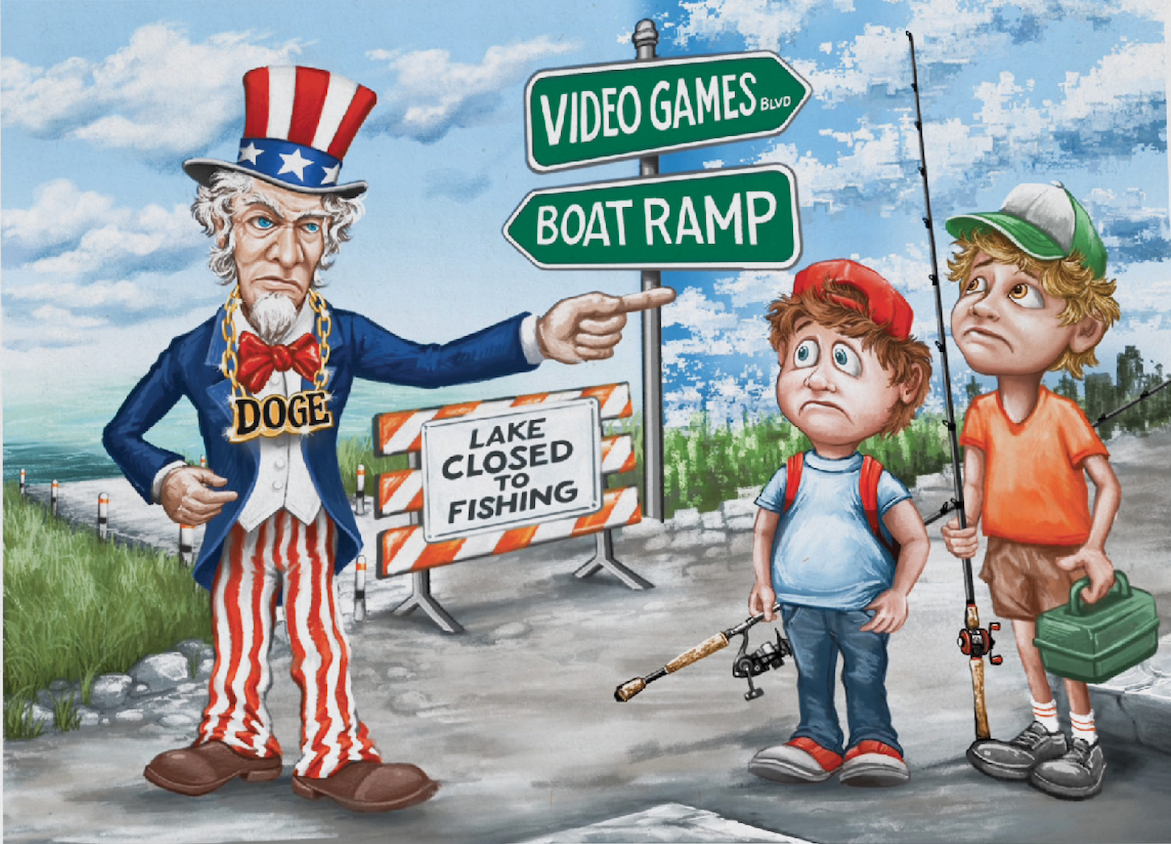
Then on June 10, two days after National Fishing and Boating Week ended, RBFF received notice from the Department of the Interior that its work “no longer effectuates the priorities of the United States Fish & Wildlife Service.” Its grant funding for 2025 was canceled, along with funding for 2026 and 2027. The move terminated RBFF’s cooperative agreement to implement the National Outreach and Communications Program.
By August, the writing was on the wall. Despite overtures of support from sportfishing industry representatives on Capitol Hill, the decision from the Department of Government Efficiency (DOGE) was final. And it severed a vital artery leading directly to the heart of American fisheries.
On August 15, former RBFF Senior Director of Industry Engagement JD Strong filled two roller bags with his personal belongings and walked out of the nonprofit’s Alexandria, Va., office, bound for home. A year and a half earlier, the former Oklahoma Department of Wildlife Conservation director had come out of retirement to join RBFF, such was the allure of its cause.
“There was a time when all of this money was going out the door to multiple entities and we were getting a downward spiral in participation,” Strong laments. “Are we headed back in that direction now?”
Within days of canceling RBFF’s funding, the Department of the Interior placed a notice of funding available. According to industry sources, more than 200 separate groups applied to utilize a slice of the $26 million pie for 2026 and 2027. Furthermore, RBFF’s 2025 funding of around $12 million remains unused. It’s unclear where that money went.
“I thought there was no better way of using funds than through RBFF,” adds Hughes. “For 27 years, no other group has had the infrastructure, the wherewithal, the intelligence and the relationships to pull a national program off.”
The Department of the Interior says around 15 applicants will receive between $100,000 and $5 million in funding through 2027.
In a statement released by RBFF last summer, it reported that fishing license sales among states reporting to a national dashboard were down 8% between April 1, when RBFF funding was frozen, and mid-July. Previously, the organization cited similar numbers in an article that ran on OutdoorLife.com, reporting that the decline represented a potential loss of more than $590 million in angler spending and 5,600 jobs. Hughes says that while multiple reasons may have contributed to that data, the ASA has never seen a drop in sales that steep that quickly.
A skeleton crew of RBFF holdovers operating on limited nonfederal funds will attempt to reclaim some of its footing, though most of the staff has now moved on.
Last year, ASA shared it was applying for a piece of former RBFF funding. In part, it hoped to honor the nation’s 250th anniversary while also funneling resources to recruit and retain anglers directly to retailers. Legally, the funding is legislatively mandated to support a National Outreach and Communications Program.
“It’s critical to have an organized national marketing campaign,” adds Hughes. “When things are piecemeal, we won’t have a consistent message or ways for groups to come together to make sure these programs complement each other. It’s one thing to have an event. It’s another to have a national campaign where you’re trying to move millions of people to make a decision about fishing.”
Editor’s note: The information in this article is up to date as of early November 2025. BT RBFF’s 2025 State Marketing Workshop served to educate wildlife agency professionals about how to connect with and recruit anglers to the sport.
Originally appeared in B.A.S.S. Times 2026.