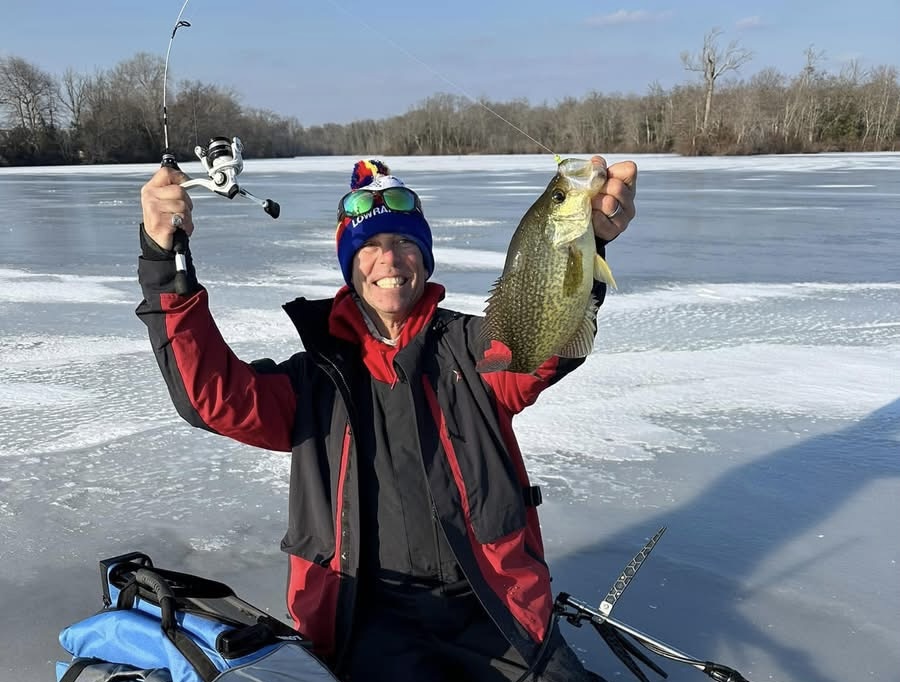

A solid layer of ice has formed on my home lake, which is something that doesn’t happen very often. I took advantage of it recently and went ice fishing for perch, bluegill and crappie.
I never thought ice fishing could teach me anything about catching bass, but I learned a lot of things that I believe will translate to bass fishing.
I trekked onto the ice with a Lowrance ActiveTarget Explorer Series Pack on my back. The waterproof bag and frame hold a 9-inch display Lowrance graph, a pole with a transducer attached and a lithium battery.
After you cut a hole in the ice and drop the transducer through it, you can take advantage of down or forward-facing sonar just like you do in a bass boat.
I could never sit still inside a shanty and fish through one or two holes. I call what I do “power fishing on ice.”
I used a mapping app on my cellphone to follow a bottom contour at a depth I wanted to fish under the ice. I dragged my boot to mark the contour and any breaklines and depth changes I came across.
As always when I’m ice fishing, I went overboard with my manual ice auger and bored 10 to 30 holes along the contour I marked. My forearms took a beating, but it was worth it.
Then I dropped the Explorer’s transducer through each hole and looked for brush and schools of fish. Once I found a hole that had fish under it, I broke out my ice fishing tackle and got after them.
Just as with bass fishing, finding them and catching them are two different things. Even though I was after panfish, I still had to figure out what they liked and how to coax them into biting.
I cycled through different baits, just as I do when I’m bass fishing. I started with tiny metal spoons and blade baits without any response. Then I tried traditional ice jigs with no takers.
Finally, I tried Berkley’s Switch, a lure I’ve used bass fishing. It’s basically a jighead minnow, but the head is encapsulated by the soft plastic body. I use the 1/4- and 3/8-ounce sizes for bass fishing. I went with the little 1/16-ounce size in this instance.
When I dropped the Switch though the hole, I noticed that it always maintained a lifelike horizontal stance. That’s because the line eye sits back farther from the nose than with other jighead baits.
I also noticed that I was getting an immediate response from the fish. The Switch was just hanging there motionless, but fish were coming closer to get a better look at. I was amazed that the horizonal posture made such a difference.
I had gotten their attention but still wasn’t getting any takers. I began gently shaking the little Abu ice fishing rod to make its soft tip jiggle, which made the slender tail of the Switch flicker. That caused the fish around the bait to get more active.
But they still wouldn’t eat. So, just as with bass fishing, I kept experimenting.
While jiggling the rod, I tried slowly raising it. When I did that, a fish that had been looking at my bait followed it up and nabbed it. That proved to be the final ingredient.
When you think about it, whenever a shad, shiner, herring or some other baitfish is threatened, it tries to escape upward toward the surface. That slow rise was final piece of the puzzle that made those fish commit.
It took me a couple of hours to dial all this in. When I did, I started catching them.
I also learned that if I let the bait fall below a panfish, I would never catch it. Some of the fish ran off as if they were spooked when that happened.
I plan to fish the bigger sizes of the Switch in open water for bass just as I did while ice fishing for panfish. I believe what I learned ice fishing is going to pay off for me before the Bassmaster Elite Series season is over this year.