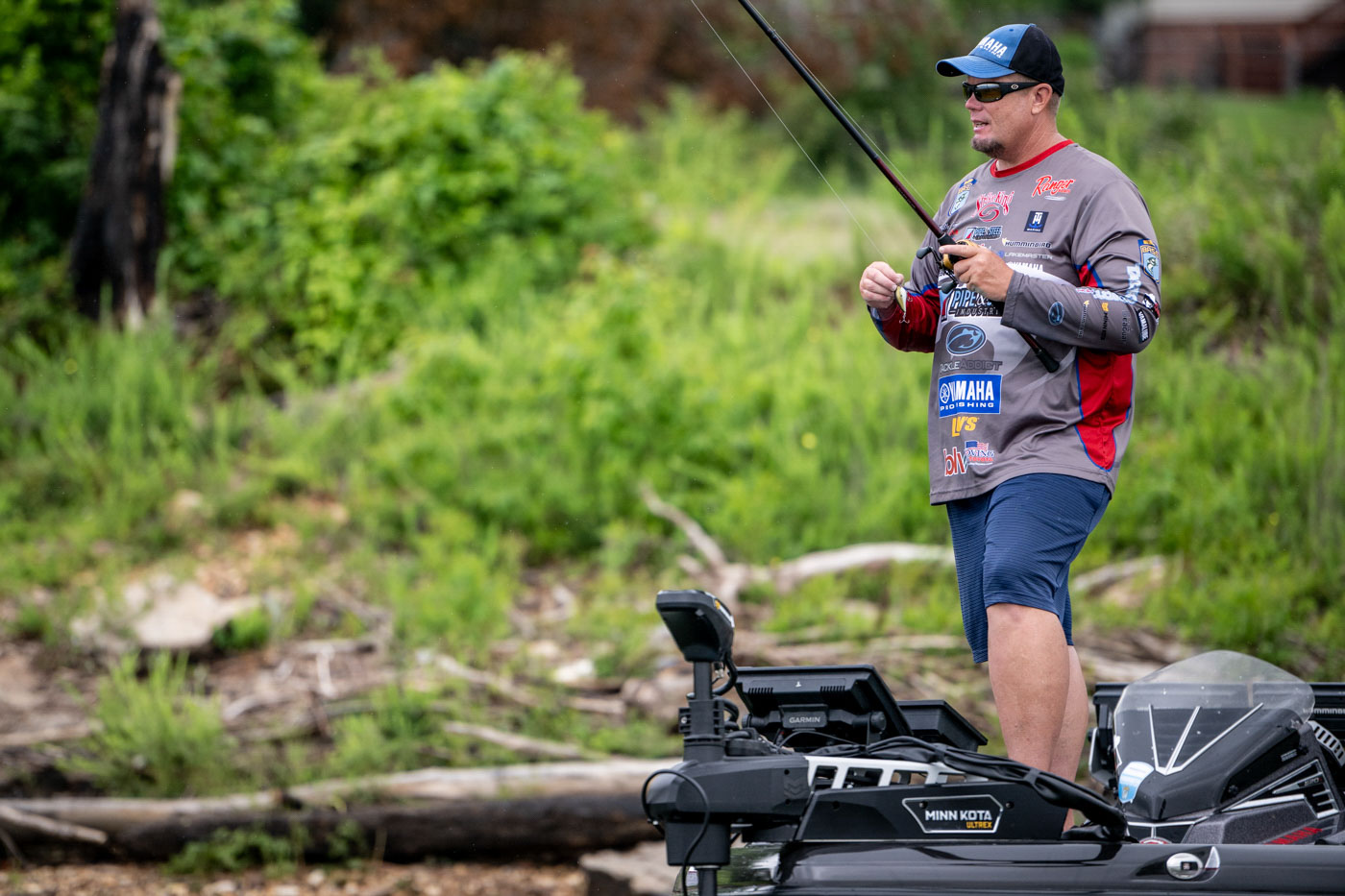
Early in my career, if I got on a flipping or pitching bite this time of year, I chose from two lures: A green pumpkin jig or a black and blue jig.
Those lures worked well and they still do, but over time I’ve added a few choices to the arsenal. Over the next few months, I’ll use them all, varying my choices with the conditions and the cover. I’ll still have my 3/8- or 1/2-ounce Strike King flipping jig on the deck, but it’s not always the ideal choice.
The Tennessee-Tombigbee tournament is a good example of how the right choice produces more fish. In my primary area, the bass were relating to laydowns, but they weren’t suspended out in the tips of them. Instead, they were spawning or chasing a shad spawn along the bank, so I had to put my lure as close to the shoreline as possible.
The strike window was small. They wouldn’t bite if I missed that target, so I wanted to be able to slip that lure in there without it getting caught on the branches. The best choice was a black and blue Strike King Rage Bug. It is compact and doesn’t have long appendages, so it wouldn’t get caught on the way in.
In my second area there were fewer laydowns and flatter banks, so I was making longer pitches to isolated reed clumps. I probably could’ve kept on fishing the Rage Bug, but I ended up switching to a Strike King Game Haw, which has a little more action and longer tails. The fish weren’t always where I thought they’d be, so it was important to have that drawing power as I fished the bait out.
Another choice I frequently employ is a big worm, like the Strike King Zeus. I don’t usually use it during the spawn because it’s too long and the fish can move it off the bed without getting hooked. It’s also not something that’ll easily slip into tight places, but around docks and isolated laydowns, it’s a great old school way to get big bites.
And of course, the jig never went out of style. I actually prefer to fish it whenever I can because not only does it attract quality fish, but it has fewer moving parts (sinker, etc.). Just tie it on, add a trailer and get to work. Of course, none of this is 100%. They’re just guidelines to get you started.
I carry quite a few colors in all of these baits, but if you’re just getting started, consider two basic options: black and blue and either green pumpkin or blue craw. Those will cover the vast majority of situations. One other sneaky pattern that comes into play this year is an all-white lure. When bass are keyed in on a shad spawn, a white jig or Rage Bug is often the best choice of all.
Be careful not to overpower your lures with hooks that are too big. A lot of people look at the heavy cover where fish reside and assume that they’ll need a huge hook to extract them, but the last thing you want to do is make a perfect cast to the sweet spot and get hung up. I used a 3/0 Owner Jungle Flipping Hook for the Game Hawg and the Rage Bug and typically go up to a 4/0 with the big worm.
I also use fluorocarbon in many situations where other anglers use braid. Of course, there are times when braid is a must, but you’ll be surprised at how many more bites you get with 25-pound test Seaguar AbrazX than you do with braid around pressured fish or in clearer water.
In tight tournaments, having the right bait on the right hook on the right line can make all of the difference.