How much do you remember about being 12 years old? About all I can recall is that I was one of the short kids on my seventh-grade basketball team, I hadn’t quite discovered hair gel yet and I think I was still trying to beat the Rainbow Road time trial record on the Mario Kart game at our local movie rental store.
I certainly wasn’t guiding for salmon in the Pacific Northwest. Heck, I could barely cast back then. There’s no way I would’ve been able to keep up with 12-year-old Jaxon Young.
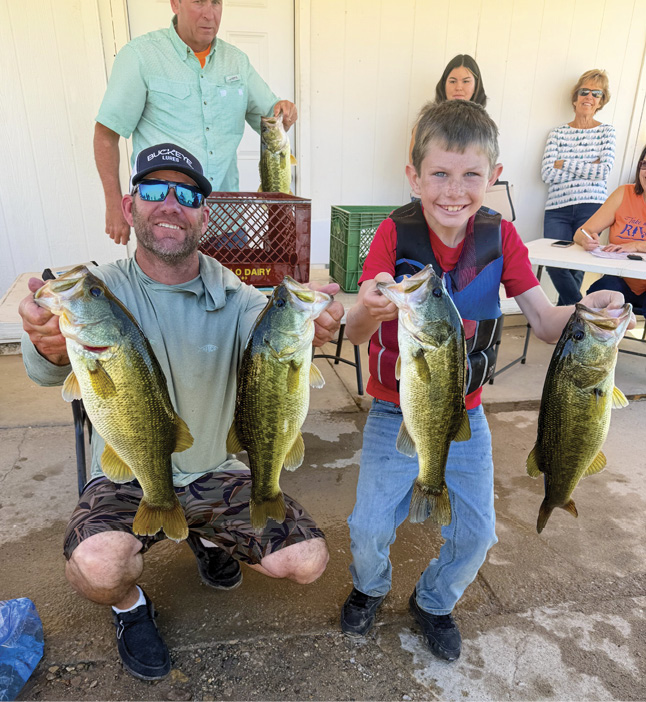
I first learned of Jaxon from his father, Nick Young, a source in the story “Frogs With Kick” on page 44. Nick is a full-time fishing guide who splits his time between the Colorado River reservoirs of Arizona and the salmon fishery near Gold Beach, Ore. For the Youngs, fishing is the family business.
“Jaxon works with me,” says Nick. “He’s a licensed guide in Oregon.”
I had no idea it was possible to get a guide’s license without being old enough for a driver’s license, but it’s not even new. Jaxon has been licensed since he was 9 years old. He’s been tournament fishing with Nick since he was 4 and could already skip with a baitcaster at a time when most kids his age were figuring out how to ride a bike without training wheels. He’s apparently quite the hit with clients, too.
“He goes out with me about four or five days a week,” Nick says. “He gets up at 3:30 in the morning. The minute my clients are getting out of their car, he walks up to them and says, ‘Good morning, my name is Jaxon. I’ll be your deckhand for the day.’
“It’s impressive,” Nick continues. “Of course, dads always brag on their kids and they’re proud of their kids, but it’s beyond me being proud of him. He’s known all over. He’s famous on the Rogue River. I’m like chopped liver.”
Spending your childhood on the water is a unique way to grow up, which is according to plan for Nick and his wife, Elise. Along with Jaxon, the family includes 10-year-old daughter Hazel and 2 1/2-year-old son Lake.
The kids are homeschooled, partly because they spend half the year in Arizona and half the year in Oregon, but also because the Youngs wanted their kids’ education to include lessons beyond typical grade-school subjects. They’re also teaching real-world adult lessons about accountability, hard work and finances. They’ve gone as far as setting up youth investment accounts for each kid. Nick says Jaxon is pumping about 80% of the money he earns on the water into the markets.
“He’s already planning for the future at his age, and he understands it as well,” Nick says. “It’s a great lifestyle for the children. They’re always doing something fun.”
This unique lifestyle affords the family plenty of time for other outdoor pursuits too, from simple nature trips to hike or catch salamanders to turkey and blacktail hunting. Nick’s attitude is that, even if the kids choose not to hunt and fish when they get older, they’ll at least understand that food doesn’t just appear at the grocery store.
“The outdoors are definitely the root of our life,” he adds. “I do feel like it’s important to introduce them to that and raise them like that. I think a lot of our society is losing touch with that.”
I can’t argue with him. In today’s world, debates happening around the dinner table are more likely to be about screentime than about what time the kids have to come in and wash up in the evening, Oregon is threatening to put hunting and fishing bans on the ballot, and AI-powered everything is transforming the classroom and workplace.
So, as nontraditional as the Youngs’ approach may seem, their story is a good reminder that the outdoors remains one of the greatest classrooms of them all, a place that invites curiosity and exploration, and where life is anything but “artificial.”
And at the very least, there are worse places to learn life’s most important lessons than a boat deck.
Just ask Jaxon.