
The summer-to-fall transition can be an imprecise period, with weather patterns determining exact timing. Bass will be shifting from their warm-season patterns to new areas based on changes in temperature, photoperiod and baitfish availability. Four Progressive Bassmaster Elite Series pros discuss their tactics for bagging the beasts during this often-
challenging period.
Jay Przekurat — Northern Lake
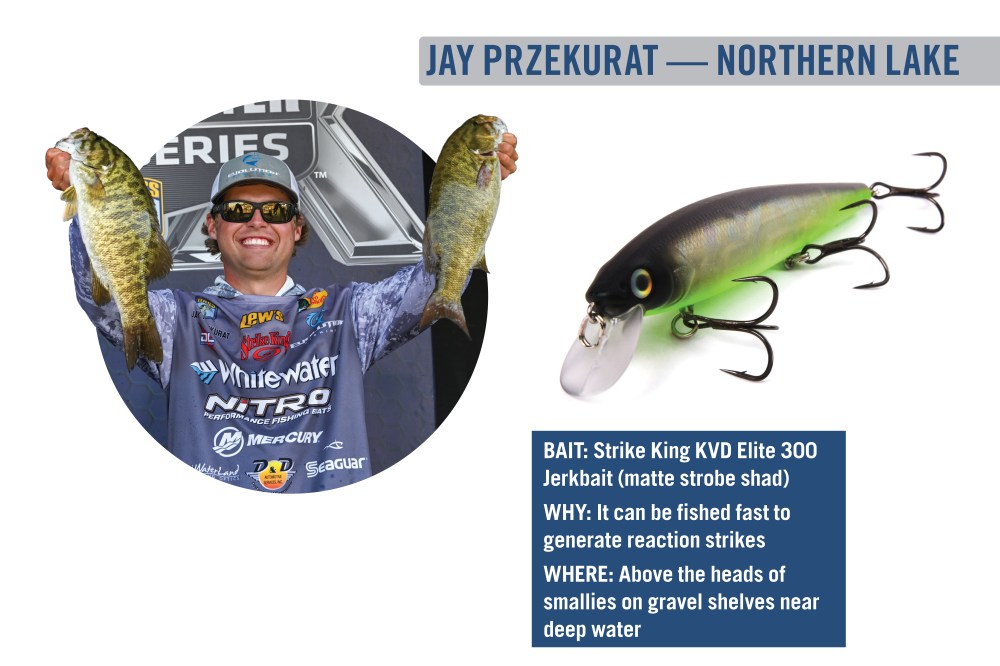
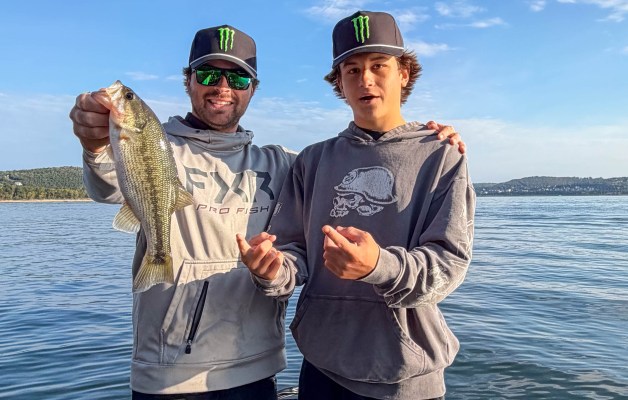
Fall is one of the absolute best times of year to catch a true trophy smallmouth bass, and for Wisconsin pro Jay Przekurat, stealth and strategic location define the search for magnum smallies during this season of transition.
Essentially, he looks for areas that he considers to be less obvious to most anglers but with the key features those behemoth bronzebacks favor.
“I’m looking for areas closest to the deepest water that butt up to places that hold some type of habitat,” Przekurat says. “So, we’re talking about channel-swing places that have a good gravel patch on them. It could be something with a shelf, almost like an underwater current break.”
Przekurat says that he’s not terribly picky on the exact habitat features, as long as it’s near a significant depth change.
“That deep water could be 20 feet, or it could be 80 feet,” Przekurat says, “as long as that fish can escape that shelf that he’s sitting on in that 8- to 10-foot range whenever he feels something he doesn’t like. A lot of the places you’re going to be targeting that time of the year are going to be wind-driven.
“I’m fishing windward shelves, little edges and places that a fish can sit but not have to work too hard to sit there when the wind is piling into it. The more wind, the better.”
If any of this sounds familiar, Przekurat targeted just such a scenario when he won at the St. Lawrence River during his Elite Series rookie season in 2022. He spent all four days fishing an unassuming spot on the north bank of Black River Bay in Lake Ontario.
“I like the small, isolated places that are maybe 10 yards long and have a little edge to them,” Przekurat adds. “It just makes your target a little easier when you know where the fish are going to be sitting.”
For fun fishing, Przekurat likes an umbrella rig, but in tournaments he’s likely to lean on a Strike King 3 3/4- or 4 3/4-inch Rage Swimmer on a 1/4- to 1/2-ounce jighead or a Strike King KVD Elite 300 Jerkbait. One of his favorite jerkbait colors is matte strobe shad, which has a chartreuse belly.
“That time of year, there’s a lot of fish feeding up in the water column, so I like to keep a moving bait in my hand as much as I can,” he says. “You can also throw a 1/2- to 3/4-ounce finesse football jig with a Strike King Rage Menace.
“I’d use the football jig after I’ve gone through the area with my reaction baits and I want to slow down and drag on the bottom. Sometimes, if you don’t get your biggest bite on those reaction baits, you can get a big bite dragging.”
Before going to his bottom-contact presentation, Przekurat will give his fish ample opportunity to attack his reaction baits. The keys there are keeping his baits above the fish and mimicking a real baitfish’s authentic fleeing action.
In this case, a smallmouth’s naturally aggressive demeanor plays in his favor.
“Speeding up is the best way to trigger the biggest fish in the school to bite,” Przekurat adds. “You kind of have to match the fish’s reaction, but as a general rule of thumb, you want to keep that bait moving and keep it away from them.”
Tucker Smith — Highland Reservoir
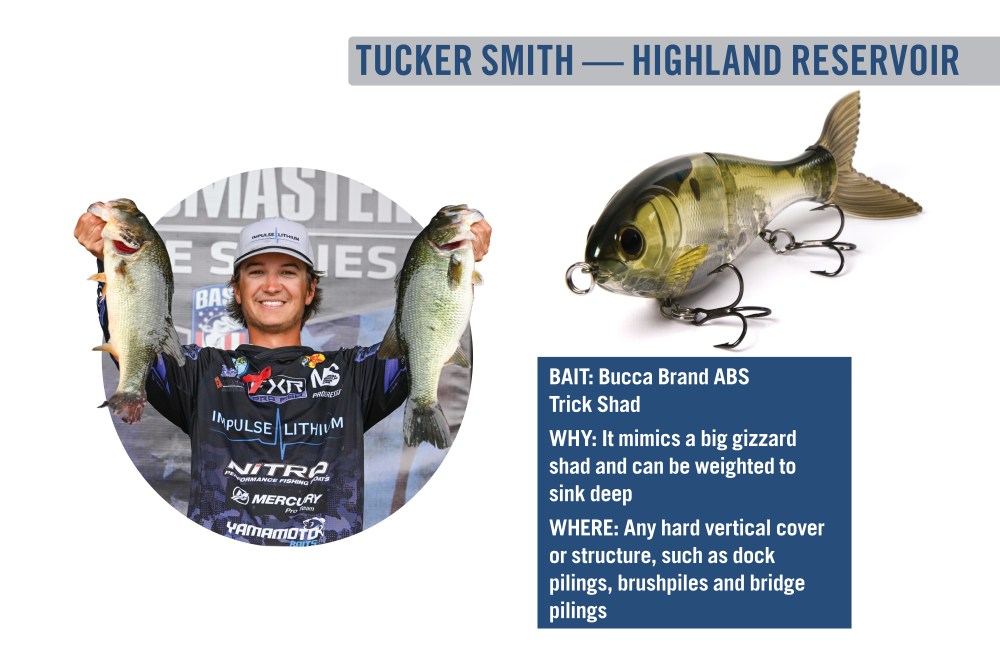
During the summer-to-fall transition, Tucker Smith begins the search for giants by targeting creek mouths.
“It seems like on a lot of reservoirs, the mouths of the creeks hold a lot of big fish because it’s a good funneling area for those fish to move back from summer to fall,” Smith says. “A lot of those fish are moving from the main-river channel to the creeks, so fishing the mouths of creeks is a good way to pinpoint them and meet them halfway.”
Smith knows that as soon as the fish detect fall’s early cooling, their dietary focus is on baitfish, especially big schools of shad. Finding the day-makers often comes down to targeting the right habitat.
“The biggest fish in the lake relate to hard structure, whether that be a stump, a brushpile or a rockpile,” he says. “It seems like vertical structure makes the fish most comfortable, because they can move up and down in the water column without having to change location.
“The really big fish are kind of lazy. They live by themselves most of the time, so you’re not looking for a group of fish; you’re looking for isolated hard structure. I’ve caught most of my biggest fish on isolated brushpiles that are up on a flat with hard bottom.”
Along with those off-the-wall, standalone targets, Smith is sure to check bridges near those creek mouths, as each piling presents a vertical target. His go-to offering is a 3/16-ounce Picasso jighead with a minnow body matching local forage size and color.
“It’s easy to target a big fish in any part of the water column with this bait and work it slowly,” he says. “The 3/16 gives me good depth versatility without sinking too fast. I also like a Picasso flipping jig with a big craw trailer, like a 4-inch Yamamoto Yama Craw.”
When he needs a reaction bait, Smith considers a Bill Lewis Scope Stik to be one of the best options for tempting big bass on forward-facing sonar.
“I also like a glidebait like the Bucca Brand ABS Trick Shad this time of year because it mimics gizzard shad. A glidebait attracts big fish, and it’s good around vertical structure.”
In some cases, smaller threadfin shad may out-number gizzards in certain highland reservoirs, and when that’s the case, Smith dials down the presentation size. However, when big fish are eating big forage, he makes sure his glidebait reaches the strike zone.
“You want to make sure it sinks deep enough, so I’ll add SuspenStrips or I’ll wrap lead wire around the hook shanks,” Smith says. “You want to get as close to the structure as possible without hanging up. Those big fish like to pin bait against that structure.”
Kyle Welcher — Southern Grass Lake
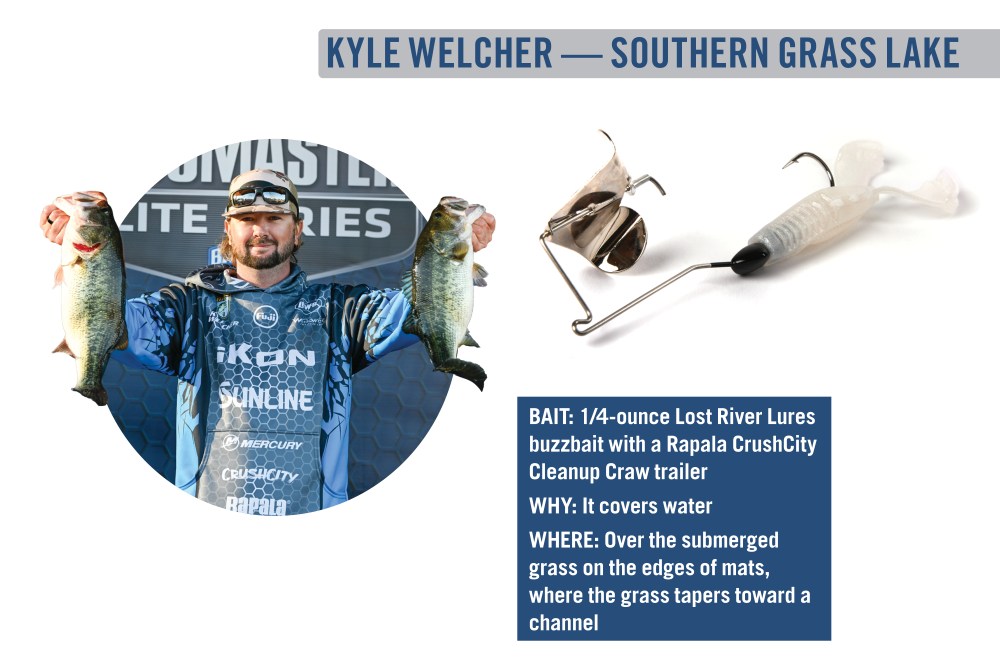
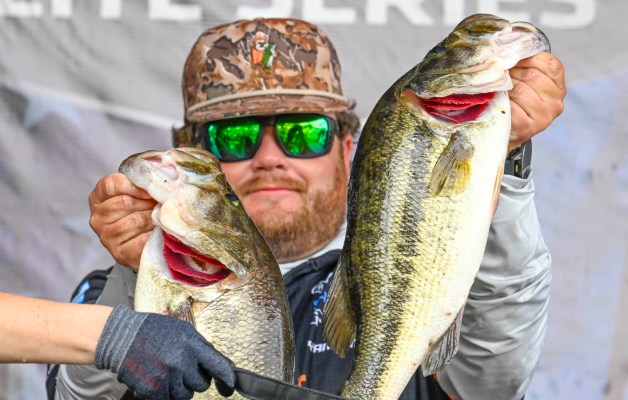
In early fall, Kyle Welcher bases his search on the premise that big fish want to remain hidden near nature’s food-delivery service, so he seeks out the deepest, thickest grass that’s closest to current.
“That time of year, the thickest grass typically has holes inside it,” Welcher says. “If it’s matted over and it’s super-thick, typically those holes underneath are where you can find a school. The grass has to be laid over, and typically it’s covered with ‘cheese.’”
On a reservoir, he expects to find the bigger fish near the riverine portion. When he can find dense mats in these areas, he’s in business.
“In my opinion, whenever it gets hot and the days get long, fish naturally swim upriver, and then when the days get shorter and it starts getting colder in fall, the fish start swimming downcurrent,” Welcher says. “That time of year, the mouth of the river or upriver a little bit seems to be the best section of every lake with a river section.
“On Lake Guntersville, the B.B. Comer Bridge area always plays for giants, because that’s where the lake narrows up,” he offers as an example.
Once around a good mat, Welcher starts to dial in key features. What may appear to be a solid wall of submerged aquatic vegetation holds the equivalent of a luxury cabana for summer-weary fish.
“Whenever you first start fishing on a grass lake, think ‘sweet spots,’” Welcher says. “You have the outside edge, the inside edge; you have clumps; you have points, and then on the outside where it starts to taper into the river channel. That’s where the buzzbait bite is really good.”
Topwater offers the best shot at catching a big bass in this scenario, so Welcher puts his faith in a frog and a 1/4-ounce Lost River Lures buzzbait with a Rapala CrushCity Cleanup Craw trailer.
For traversing the cheesy tops of matted grass, he likes a traditional walking frog, while a popping frog allows him to create maximum disturbance around isolated clumps of grass or openings within a large mat.
Welcher stresses the importance of giving any dense grassbed positioned near current a fair chance to shine. He’s seen the super-shallow stuff yield giants just as easily as a deeper area, so he’ll stay on the trolling motor until he determines a preference.
Once he gets a few bites, Welcher can pick up his speed and cover expansive mats by hitting similar key areas. Sometimes, they’re in a foot of water on an inside grassline. Other times, they’re in front of the mat where it tapers down to the channel.
“There’s a lot of things you have to check, depending on the water level, what they’re feeding on, the current flow,” he adds. “It’s a process of elimination, so pay attention to all the variables, because it changes every day.”
Taku Ito — Dock Lake
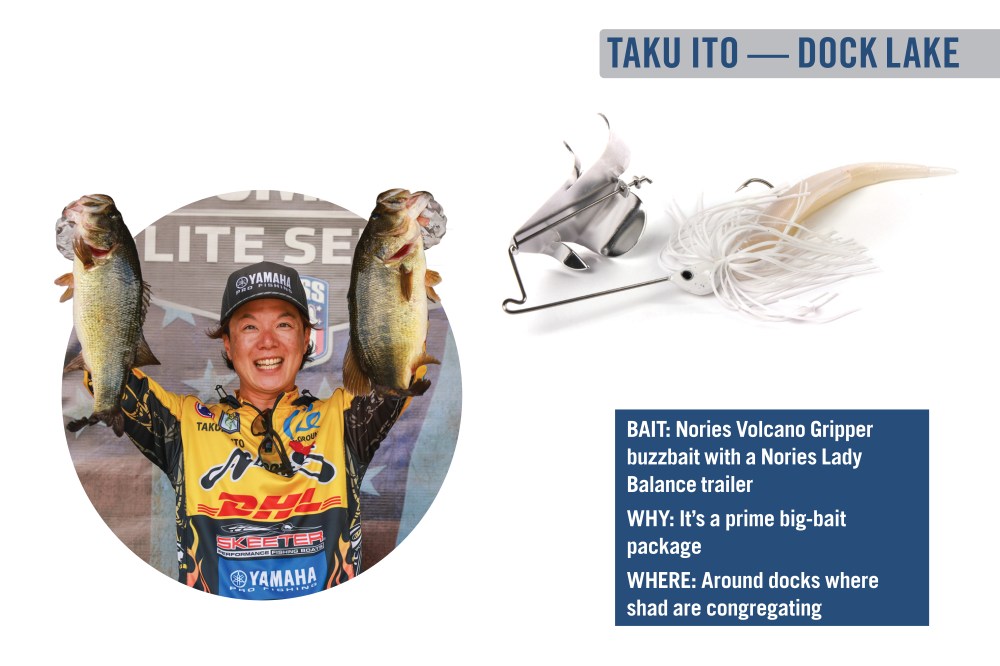
While he admits that his Japanese home waters offered him minimal dock fishing experience, Taku Ito is a quick study. He didn’t need long after coming to the U.S. to figure out the common-sense principles requisite to tempting a late-season giant around docks.
On many lakes, shad and bass are in transition this time of year, and docks give them cover and structure to hide or ambush prey as they move from one point to another. Ito says he’s not terribly particular on size or design when choosing a dock to fish, but given his druthers, he’d pick a floating dock positioned along the natural migration route of shad.
“Both shallow and deep areas have the potential to hold big fish, but I feel that shallow is better in the fall,” says Ito, who just wrapped up his seventh season on the Elite Series. “The most important thing is bait, so in the fall, I focus solely on finding baitfish.”
Once he finds his preferred scenario, typically in the front half of a creek arm, Ito takes a no-nonsense approach. He’s not interested in competing with nature’s buffet by matching the hatch. Rather, he’s all about showing those big fish a big-bite opportunity. In this case, a 1/2-ounce Nories Volcano Gripper buzzbait with a Nories Lady Balance trailer is the perfect option.
Depending on the dock’s setup, Ito targets the zones where he can make a smooth, consistent retrieve. Even with a bait predicated on commotion, he’s keenly aware of anything that might negatively impact a highly perceptive giant.
“I feel that big bass are really sensitive to the tension in my line, so I try to keep reeling steadily and avoid creating any slack or tightness in the line,” Ito adds.
Finally, daily timing matters, too, as water temperatures will begin to fluctuate as days get shorter and nighttime air temperatures fall.
“I feel that the morning is better in early fall, because I think it’s still like summer [with high water temperatures],” Ito explains. “But later fall is different. It’s not like summer, so I feel like noon is the better time [once the water has had time to warm].”
Originally appeared in Bassmaster Magazine 2026.