Forward facing sonar is not the only tool for catching bass, but let’s be honest, the term “game-changing” is no understatement. That’s particularly true on Lake Champlain, a smallmouth-dominant fishery where the vast majority of bronzebacks roam deep, open waters in perpetual pursuit of nomadic baitfish schools.
Champlain also holds plenty of big largemouth, as evidenced by Carl Jocumsen, who led Day 1 with an all-largemouth limit of 23 pounds, 2 ounces.
Nevertheless, the majority of the field weighed all smallmouth, or mixed bags. In recent years, jighead minnows and dropshots have done much of the smallmouth work on Champlain, but anglers that targeted the brown ones — as well as some in the largemouth camp — broke from the standard presentations and reached into the tackle selections of yesteryear.
Specifically, hard baits.
Why It Matters
On Sept. 4, 2025, B.A.S.S. held a coin flip to select which 2026 Elite events would allow forward facing sonar and which would not. The SPRO Bassmaster Elite at Lake Champlain does not allow this live sonar technology.
With forward facing sonar, we’d be watching a very different tournament. Without it, we’re watching an undeniably diverse and entertaining event.
Prior to tournament week, conversations regarding the no-forward facing sonar format buzzed with two main questions:
1. Will largemouth play a bigger role on this smallmouth-heavy lake?
Day 1 already answered that one. Even if largemouth catches dwindle henceforth, the impact has already been made.
2. How will anglers adapt without the visual advantage that forward facing sonar offers?
That, too, was answered on Day 1 with many good fish caught by anglers casting and winding. A few examples:
Elite rookie Nick Trim, the 2025 Mercury B.A.S.S. Nation Championship winner, caught several of his fish on a Yo-Zuri Pro Series Jerkbait.
Cole Sands fared well by winding a Yo-Zuri 1.5 MR squarebill through grass and rock habitat to mimic yellow perch and crawfish.
John Crews caught about a dozen smallmouth, including a 3-pounder that made his final limit on a medium running SPRO Outsider crankbait.
Tristan McCormick caught a limit of smallmouth on a Strike King Sexy topwater and what he termed an old-school crankbait with a tight wiggle.
For clarity, Day 1 brought reports of flipping, punching, dragging and dropshotting plastics. Second-place Drew Cook weighed in four smallies and took the day’s Big Bass honors with a 5-pound, 13-ounce largemouth that ate a wacky-rigged SPRO Wacky Snack.
That’s to be expected, as such tactics work with or without live sonar. Still, the case for hard baits is solid.
Gotta Find ‘Em
On Day 1, John Garrett spent much of his day in the Rouse’s Point area, where he worked across a large grass flat peppered with scattered rock. Focusing on variances of high and low spots, he alternated between a shallow diving crankbait and a deep diving crankbait.
“I’m just covering water and trying to get a reaction bite and then when I do, I’m slowing down and picking it apart with a bladed jig,” Garrett said.
Drew Cook, who targeted most of his smallmouth with a SPRO Little John MD, noted the thrill of the hunt: “Anytime you’re catching smallmouth winding something in it’s a good time.”
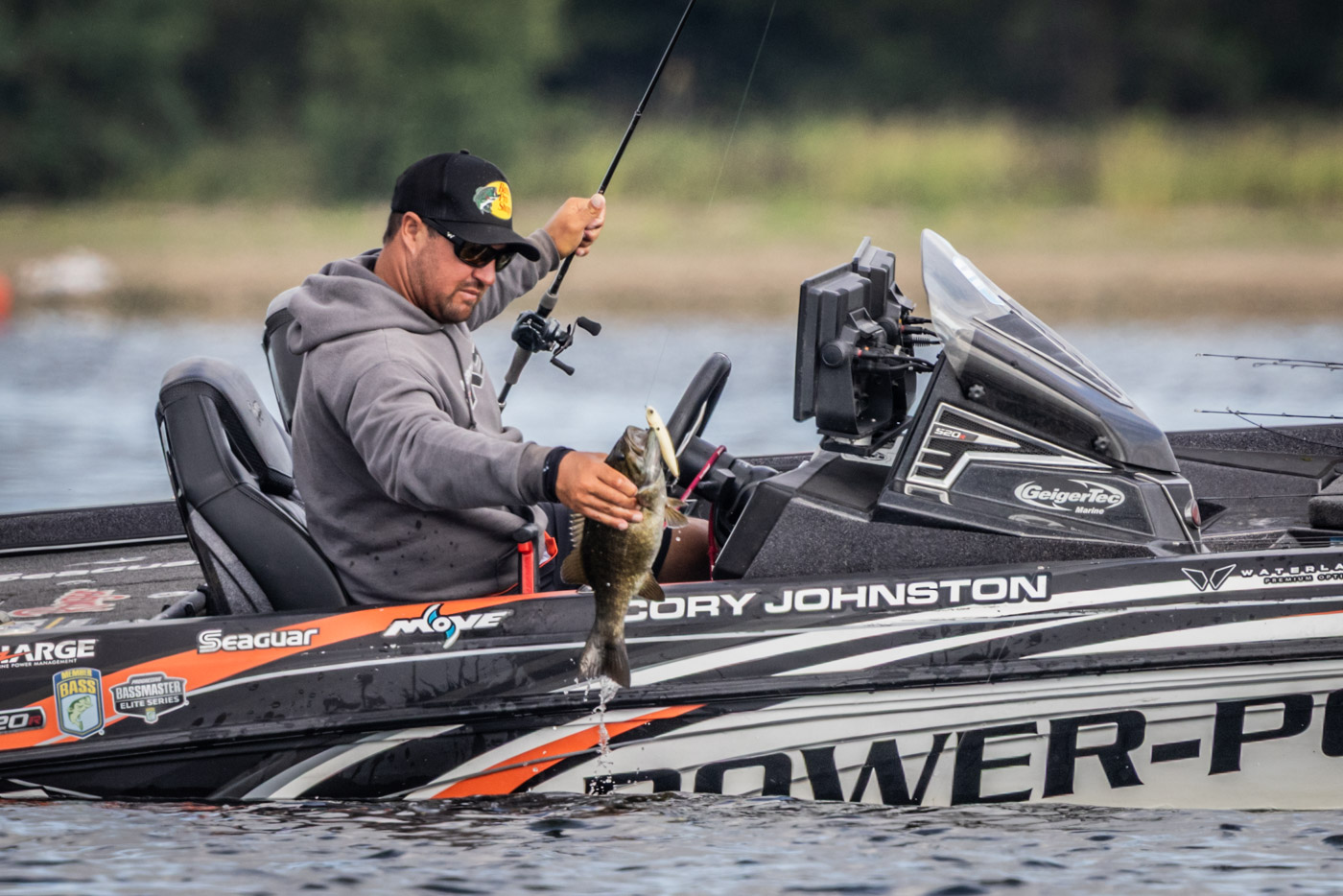
Cory Johnston, sixth on Day 1, did a lot of his early work with a popper. Notably, Johnston started the second round throwing a topwater over a shallow flat with a fish-friendly mix of rock, grass and sandy patches.
Crews made a good point by noting that crankbaits can reveal fish that often hide from live sonar.
“You can’t see them, but the fish come up off the bottom and eat the crankbait,” he said. “If I (was able to use) forward facing sonar, I probably wouldn’t even see these fish, because they’re in spotty grass or in the rocks.”
Day Saver
While no one would fairly describe hard baits as a Plan B decision, Lee Livesay demonstrated the salvaging potential of a timely adjustment.
“I practiced flipping milfoil and I was catching some big ones, 4- to 6-pound largemouth,” he said. “I had an early boat number and got to run all my spots. It was super calm, which is what you want for flipping milfoil and never caught a bass doing that.
“I pulled out a 6th Sense Dogma walking topwater in one of the areas where I was catching some flipping (in practice), pulled up to a little rocky point and caught a 5-11 and one almost 4,” Livesay said.
Livesay would later relocate and finish out his limit on smallmouth, but knocking off those two hefty largemouth on a hard bait saved his day.
Play Their Game
McCormick said he came to Champlain expecting hard baits to play a big role in his game plan. Of course, the absence of forward facing sonar influenced that mindset, but the invasive alewife (first documented in the early 2000’s and now fully established) also entered the thought process.
“Champlain has changed a lot over the years; these fish used to be really bottom-oriented, but now with the alewives in here, they’re feeding up,” McCormick said. “A topwater is a really good player this time of year, just because you can call them up from so far away.”
Reporting a late-day kicker, McCormick said: “I was due in at 4 o’clock and I pulled up to a place I’d been saving around 3:40. I fired the old Sexy Dog out there and my biggest of the day came up and exploded on it. It jumped me from 16 even up to 17-15.”
Day 1 was mostly calm and sunny, but the forecast calls for increasing wind as the tournament progresses. That’ll limit the topwater presentations, but windy conditions tend to favor subsurface reaction baits, so we might hear even more reports of hard bait success.