

There are, indeed, places in bass fishing where you can make a wrong turn and still catch a few fish. The St. Lawrence River isn’t necessarily one of them. When the Bassmaster Elite Series heads to New York for its upcoming event, anglers will have an almost overwhelming number of decisions to make. Do they stay in the river? Do they run toward Lake Ontario? Do they fish shallow? Do they hunt offshore? Do they commit to one area or spend the first few days covering water and let the fish tell them where they belong?
Team Toyota pro Matt Arey has spent enough time around this fishery to know how easy it is to make the wrong decision. If he were competing in this particular event, he already knows where he’d spend his time.
“I’ve made a lot of mistakes on this fishery in the past but if I were fishing this event I would spend every second I have on Lake Ontario.”
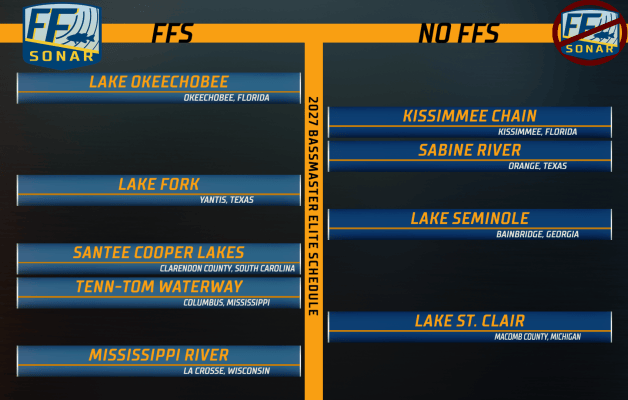
That’s a bold statement on a fishery as diverse as the St. Lawrence but it also speaks to the unique opportunity presented by this year’s event. Forward-facing sonar will be allowed and that will fundamentally change how anglers approach the vast expanses of water available to them. The St. Lawrence has become one of the premier smallmouth destinations in the country, and it doesn’t take long to understand why. Giant smallmouth inhabit everything from shallow rock and current-swept islands to offshore shoals and deep-water structure. The river connects to Lake Ontario, creating an enormous network of habitat that can keep bass moving throughout the year.
For Elite Series anglers, that creates a problem that sounds like a good one to have: There are almost too many fish. The challenge is finding the right ones. Arey sees the St. Lawrence as a body of water that rewards anglers who understand how it’s different pieces fit together.
“It’s a very diverse body of water because you have the mouth of the river dumping into lakes, there are a lot of shallow islands that will be in play, and the technology is so advanced now. It will be one to watch, for sure.”
That diversity is one of the reasons the St. Lawrence has become a fixture on the professional tournament trail. An angler can find himself fishing what feels like a traditional river tournament in one area, then make a long run and suddenly be dealing with conditions befitting of a Great Lakes event. Current, wind, depth and water clarity can all change dramatically from one location to another. The smallmouth don’t exactly make the decision any easier.
They can live on shallow rock one day and suspend over deeper water the next. They can position tightly to current seams or roam across massive offshore flats. Heck, they can be grouped up in enormous schools or scattered across seemingly endless stretches of structure. That is where forward-facing sonar enters the equation.
On a fishery like the St. Lawrence, its influence could be particularly significant because anglers aren’t simply using it to locate structure. They can use it to identify individual bass, watch how those fish react to a lure and make repeated adjustments to their presentation in real time. That’s especially valuable on Lake Ontario, where an angler can spend hours looking at enormous expanses of relatively featureless water before finding the right combination of depth, rock and bass. With FFS allowed, the offshore game could become a tournament within the tournament.
The best anglers may spend hours idling and scanning before ever making a cast. Once they locate a productive area, they can use their electronics to determine whether individual fish are present and, perhaps more importantly, whether those fish are catchable. That doesn’t mean the river should be overlooked. Quite the opposite, actually. The St. Lawrence has an enormous population of quality shallow-water smallmouth, and those fish can provide an entirely different path to victory.
“There are giant smallmouth that live shallow in that river but they get a bunch of pressure. I think if someone can find a little spot to themselves, it will pay big dividends.”
Elite Series anglers aren’t showing up to the St. Lawrence hoping to stumble onto a six-pound smallmouth living behind an overlooked island. They’ve seen enough tournament results to know what the fishery can produce. The most obvious shallow-water areas will likely receive plenty of attention. The St. Lawrence is big, though.
Maybe it’s a small island that doesn’t look particularly special or a stretch of current that is difficult to access. Perhaps a handful of rocks sitting slightly deeper than the surrounding structure. Those places can become tournament gold, according to Arey.
That’s what makes the St. Lawrence River such an intriguing way to close an Elite Series season. There isn’t one obvious pattern, to be honest. Not even an obvious section of the fishery, some would argue. There certainly isn’t one obvious way to catch them according to the Team Toyota pro.
The St. Lawrence will offer deep water and shallow water, current and still water, isolated fish and schools, famous spots and overlooked stretches. It will offer all of the modern tools of professional bass fishing while still rewarding the angler who understands the fundamentals of finding good water and keeping the boat in the right place. Arey is sure of this.
Somewhere in that enormous maze of river, islands and Great Lakes water, there will almost certainly be a little piece of overlooked real estate that changes the entire tournament. Arey believes finding it could pay big dividends. That’s the beauty of the St. Lawrence. You can have all the technology in the world but at the end of the day, you still have to find the bass.