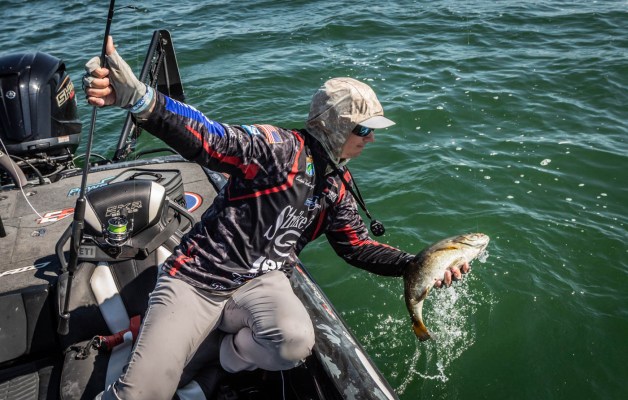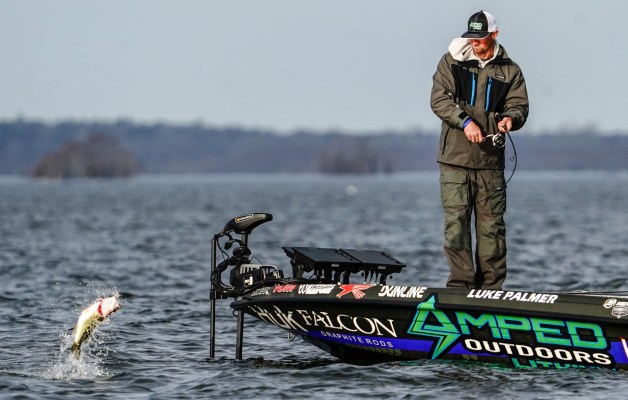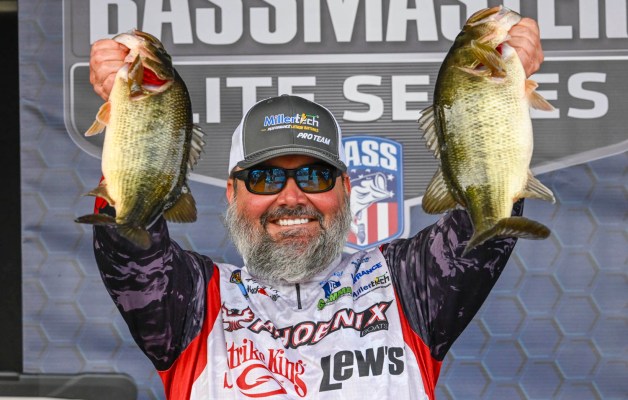
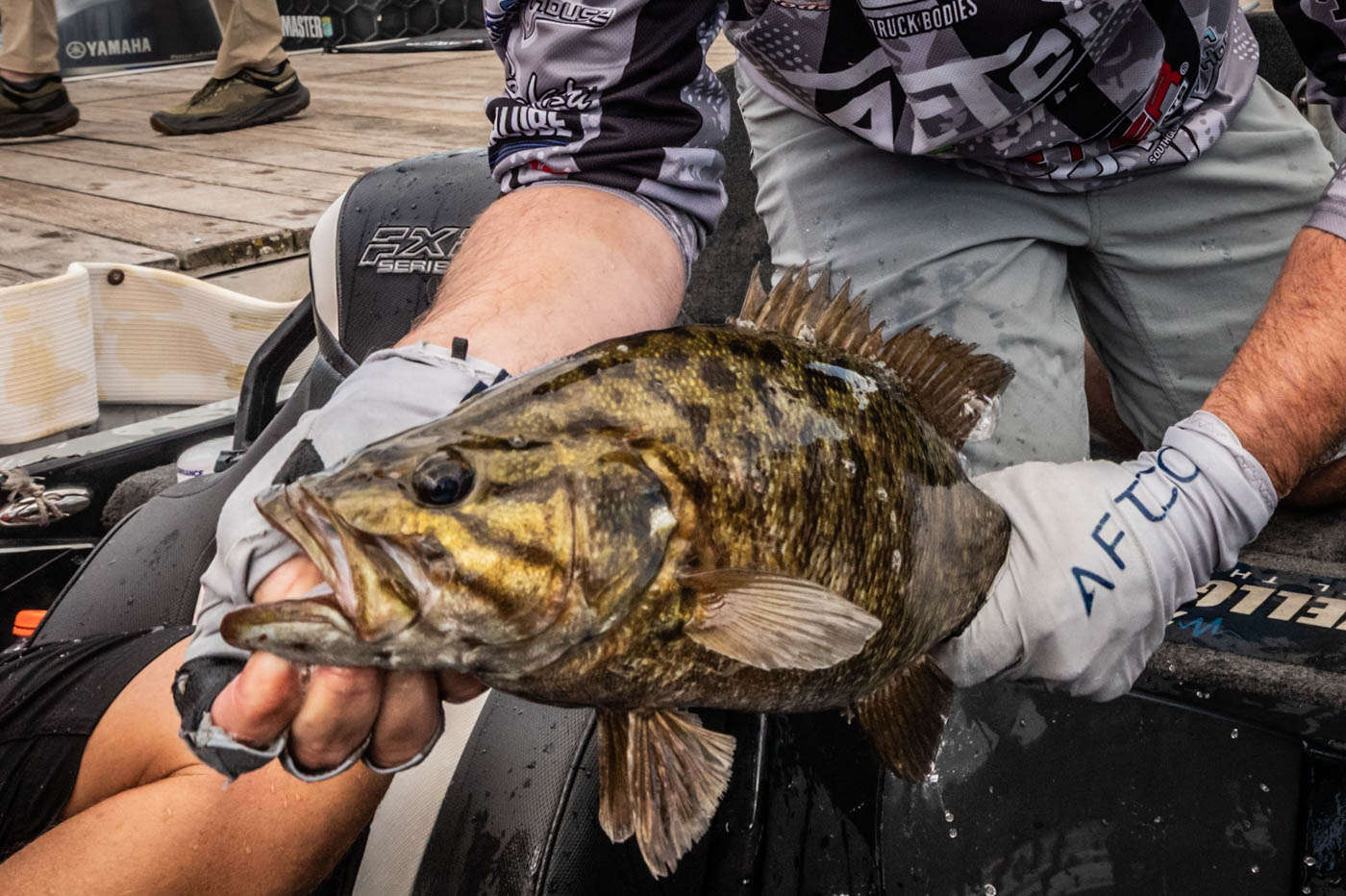
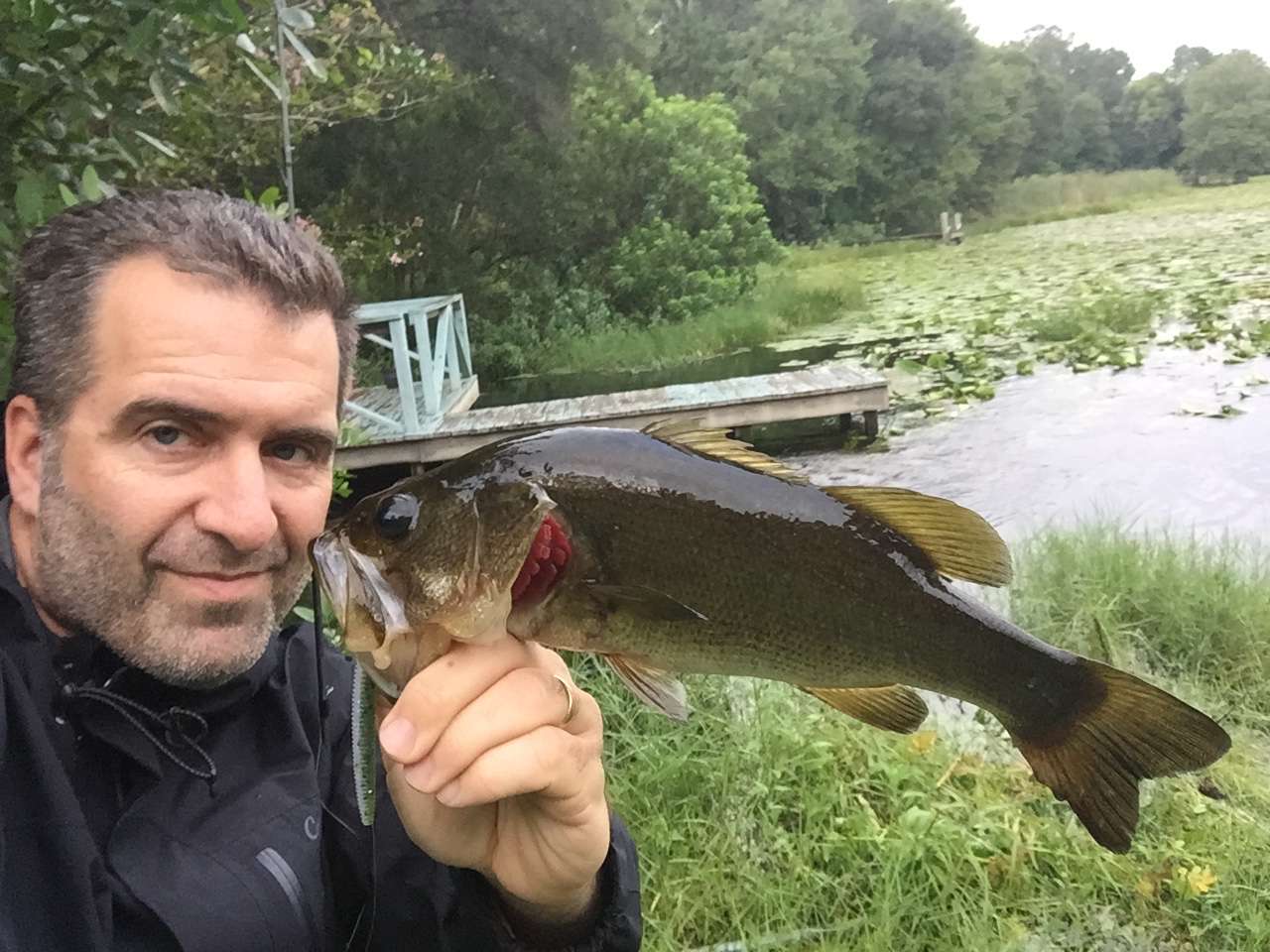
The smallmouth bass caught during the SPRO Bassmaster Elite at Lake Champlain have been handled with utmost care, held in large-capacity, well-aerated tanks during weigh-ins and, ultimately, returned to the lake.
Live release, which helps perpetuate the fisheries B.A.S.S. visits, is the overarching objective, but before they go, some of this tournament’s smallmouth bass will play a key role in helping biologists gather data that will help frame an important population picture.
Stationed at the Yamaha/AFTCO/PiranhO2 Live Release Boat, fisheries technicians from the University of Vermont’s Rubenstein Lab collected caudal (tail) fin clips from several of the event’s larger fish. As technician Morgan Cohen explained, these clips will provide genetic details that will be entered into a database for analysis.
The Scope
Thais Bernos, a professor in the Rubenstein Lab who oversees this program, shared a graphic that described the objective as: “We study bass genetics in Lake Champlain to better understand how live-release practices can promote the resilience and sustainability of bass populations.”
The program began this year and runs through 2028. The graduate student who will be analyzing the data collected this year starts in January.
“We will sample at least five other tournaments this summer,” Bernos said. “Earlier this year, we began collecting fin clips from smallmouth bass from the five basins of Lake Champlain ourselves during an electrofishing survey of fish communities conducted by my lab.
“Many of the fish we caught using this approach were younger, smaller fish. We are now working with bass tournament anglers to collect clips from trophy-sized fish.”
The Purpose
Champlain is a large lake, stretching 120 miles long and 12 miles wide, with five distinct basins. This gives smallmouth bass plenty of room to roam, but biologists believe that the fish generally remain in a particular basin.
Fishing tournaments comprise an integral piece of Bernos’ study for a couple of reasons. First, most tournament formats determine competitive results based on weight, so anglers strive to catch the largest fish possible.
Also, live release tournaments return a day’s catches to waters close to the weigh-in site. This means some of those bass are significantly relocated.
“We’re trying to look at their genetics to try and determine if them getting moved all around Lake Champlain is impacting the population structure,” Cohen said. “One thing about Lake Champlain is that all the basins are very divided due to manmade barriers like causeways and natural barriers like islands.
“There’s not a whole lot of movement and flow between those basins, so when those fish are caught from, say, Missisquoi or the South Lake and then released in the Main Lake, they’re in completely different habitat. Those basins can be so different in their dynamics and their trophic levels.”
Bernos adds this: “The specific goals of this study are to, first and foremost, understand whether Lake Champlain harbors distinct breeding populations of smallmouth bass and how they are distributed across basins,” Bernos said. “A second objective is to understand whether tournaments have the potential to induce evolutionary shifts in the population.
“This may happen if, for example, fish from small breeding populations or those carrying genes enabling rapid growth are more likely to be caught and moved across the lake.”
Why It Matters
As B.A.S.S. Conservation Director Gene Gilliland notes, the vast majority of the Elite tournament’s fish were live released. From anglers’ handling on the water, to the carefully orchestrated weigh-in procedures, significant effort goes into prudent fish care.
Notably, licensed tournament anglers fishing Lake Champlain operate under the same regulations as recreational fishermen, who are allowed to seasonally harvest five smallmouth per day (10- and 12-inch minimum lengths for Vermont and New York, respectively). In tournaments or fun fishing, the majority of bass anglers release smallmouth, but any Elite tournament fish that does not survive, is given to Bernos’ team for additional study.
“They’re going to be able to take those fish back and age them,” Gilliland said. “Now, they know how long the fish is, how much it weighs and then they can figure out how old they are, so they can look at growth rates.
“Now, we can compare genetics and growth rates. Is there a correlation there? It’s not something that the Vermont Fish & Wildlife Department is going to take directly and change a regulation, but it’s the start of collecting bass data that they don’t have.”
Tournament anglers delight in seeing Lake Champlain on their event schedule because this magnificent lake offers some of the nation’s best fishing opportunities. It seems appropriate that their efforts are contributing to research aimed at perpetuating this treasured fishery’s appeal.