Once fall starts to roll around, many of the most serious bass anglers get excited about hunting. I’m in that camp – I can’t wait to sit in the deer stand in the coming months.
But I never completely put bass fishing on the back burner. I guide at Sam Rayburn Reservoir well into the colder months. It may surprise a lot of you to hear this, but I catch more big East Texas fish between October and December than at any other time of the year.
In September it’s still really hot here, so I consider mid-October to be the start of our autumn. Once those cooler nights start to roll around, there are lots of great ways to catch big largemouth. Topwaters like a Strike King Sexy Dawg are one. Crankbaits are clearly another.
But if I want to catch a true giant – or help my clients catch one – day in, day out, there may be no better option than a big worm.
That reality dates back to my guiding days on lakes Amistad and Falcon. In fact, it’s pretty much true anywhere I’ve fished in the South. If you want to catch giants, in different depths and different types of cover, it’s hard to go wrong with that worm. You don’t always get a ton of bites, but when you feel that pressure, there’s a pretty good chance it’ll be big.
You can do it with forward-facing sonar or without. I learned to do it without and still fish that way most of the time when I’m guiding. It’s simply not fair to the guy in the back to have his buddy dialed in on a fish for an extended period of time.
There will definitely be windows when they bite better. Early in the fall, when it’s still warm, I tend to get out pretty early. There’s often a period from 8 to 11 a.m. when they’re moving up and feeding heavily. By midday, when it gets hot, it often gets tougher. There will be another window in the evening. The good thing about the worm – unlike some of my other favorite techniques – is that it continues to produce even in the tough times.
While you may occasionally find schools of fish, a lot of times the best way to catch a personal best is by targeting lone wolves in isolated cover. My favorite of all time is big stumps. On the upper end of Rayburn, they could be in 4 feet of water, while in the midlake section I’ll often target 12 to 15 feet. Man-made brush and deep vegetation are also prime areas to drag your worm.
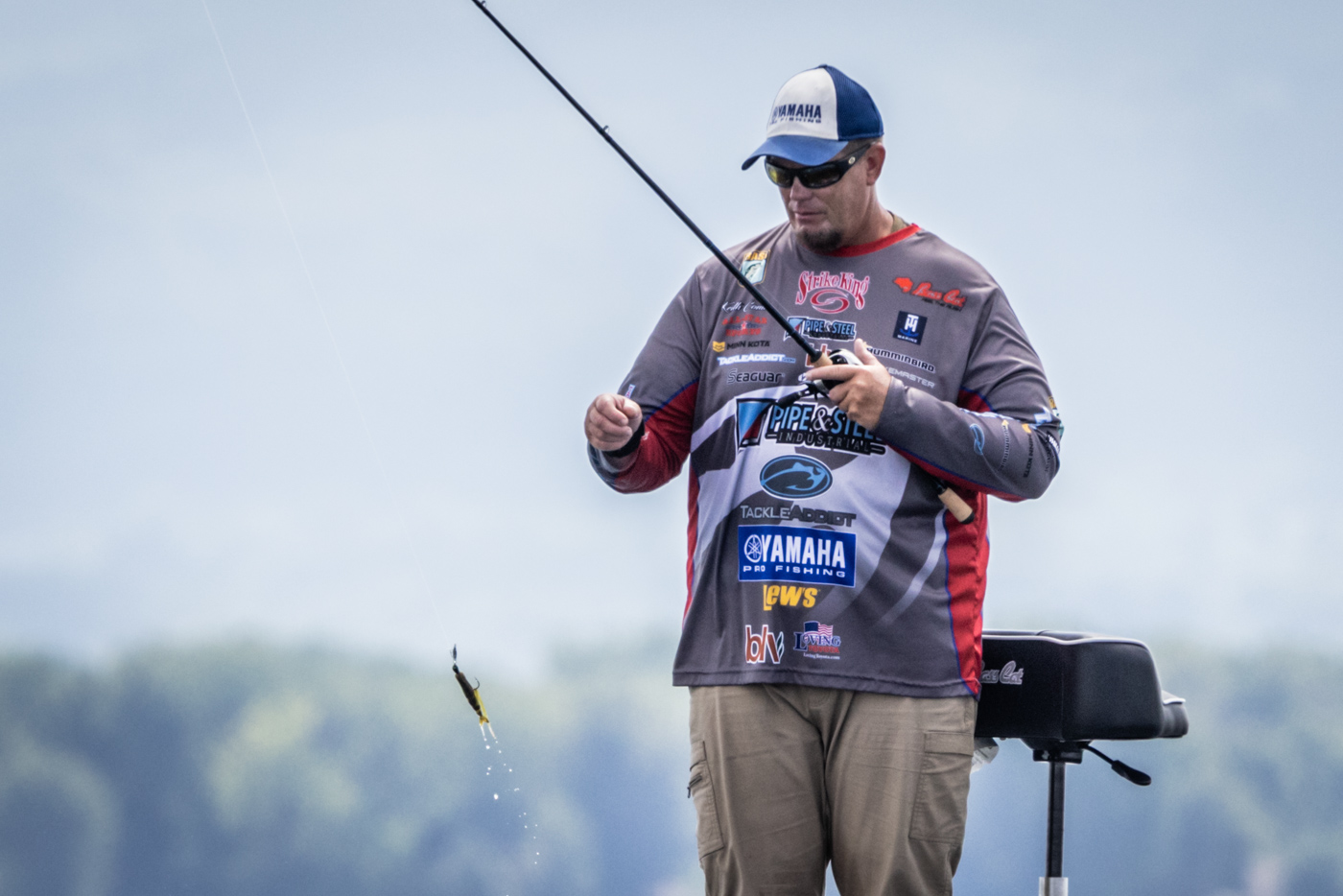
Over the years, I’ve gone back and forth on my favorite worms. For a while, I liked the Strike King straight tails the best. Lately I’ve leaned most heavily on their 12-inch Zeus with a big action tail. One way to tell which one the fish prefer is to have one guy use one style and the other use another. Oftentimes the bass will show a preference for one over the other for no apparent reason. It’s not necessarily science.
No matter where I’m fishing, season after season, I use three color patterns the most – Black and blue, Plum and Strike King’s Melon Bug. That last one in particular is a killer in East Texas. Sometimes someone will outfish you with something different, or you’ll go on a run with something off the wall. When that happens, I often stock up and end up with a pile of them the next year – while the old standards produce again and again.
If you’re new to fishing, remember that remaining in contact with the bottom or the cover is the most important aspect of fishing this way. Beyond that, there’s not really a way to fish the big worm wrong. And remember to use a 7-foot, 4-inch to 7-foot, 6-inch heavy-action rod. When they grab that worm and head sideways, they inevitably throw some slack or a bow in your line. If you don’t absolutely smoke them on the hook set there’s a good chance they’ll get off. You need to absolutely bring it.
The great thing about casting a big worm this time of year is you have a chance to catch the fish of a lifetime while you have the lake almost to yourself. It’s not complicated. Instead, it’s a back-to-basics way of enjoying great success — an old technique that never went out of style.