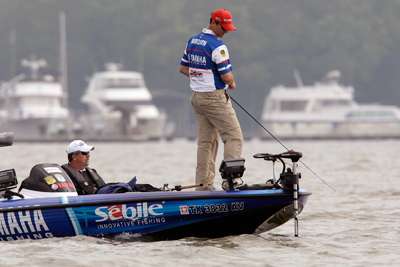

During his formative years, fishing on Sam Rayburn Lake, Todd Faircloth got plenty of lessons on how to deal with pressured waters. “There are tournaments on Rayburn every weekend from January to July and there are some jackpot tournaments during the week, too,” said Faircloth, who noted there could be a couple of thousand boats on the lake on a Saturday in the springtime. “It is a big lake, and you think you can get away from the pressure sometimes but there are known spots on the lake that replenish and produce every year. And everyone knows where those spots are.”
His experience at fishing pressured waters helped Faircloth make the Top 12 cut during the 2009 Southern Challenge at Lake Guntersville. “In that region of the country, Guntersville has become a famous lake, and it seems to have constant pressure on it, but it constantly produces, too,” he said. When dealing with pressured waters, try the following suggestions from Faircloth to improve your catch rate.
(1) Go offshore
Faircloth earned his 11th place finish at Guntersville by keying on offshore structure with a Sebile Flatt Shad and a Yamamoto Senko. Once he catches a fish offshore, Faircloth makes a quick mental note of the location of the bite. “It doesn’t bother me at all to fish behind somebody if I am fishing offshore. A lot of people will catch fish offshore, but they don’t pay attention to exactly where that fish came from or what it came off of,” he said. “When you get off the bank like that and catch a fish, that fish was there for a reason, and people need to understand that. Usually, when you catch one there are more with it.”
(2) Vary lures and sizes
“I normally just let the situation dictate what I use. You always hear that you should downsize and finesse on pressured situations, and a lot of times that is true, but a lot of times I will take a different approach to it. When people are finesse fishing and the fish get accustomed to seeing all that little bitty stuff, I will go big.” If others are throwing finesse worms, Faircloth will try a 6- or 7-inch Senko. He will also opt for a 3/4- or 1-ounce lipless crankbait when everyone else is throwing 1/4- or 1/2-ounce models. The Texas pro also avoids using noisy lures with rattles when on pressured waters.
(3) Pay attention to the competition
“If I am fishing an area with competitors and I see they are using a certain bait, I don’t want to go right behind them with the same bait or technique they are using. I will switch it up and give the fish something different to look at. A lot of times that has paid off for me.”
(4) Get into the thick of it
When sharing the bank with others and flipping to specific targets, Faircloth concentrates on the thickest part of the cover. “I am going to try to put my bait where the other guys aren’t putting it.”
(5) Slow down
Fishing too fast is the biggest mistake Faircloth sees weekend anglers make on pressured waters. “When you are fishing pressured fish, it is generally a slow bite and the faster you move the worse off you are.”
(6) Try different retrieve speeds and presentations
Faircloth does this on any body of water, but it becomes more critical to him when facing heavy fishing pressure.
(7) Stay put on productive spots
“A lot of times when you are dealing with a pressured body of water, odds are the next spot you are going to will have the same amount of pressure as the spot you just left. If you are in a big creek or on a big point or flat, a lot of times you are better off staying in that area and just going through it with a different bait or technique.”
(8) Employ stealth tactics
When fishing shallow water, Faircloth usually turns off his rear depthfinder, switches his trolling motor to low and runs it at a constant speed to minimize unnatural noises and movements. Editor’s Note: If you have a story idea you would like to vote on for an upcoming poll, send your idea to john@jnoutdoors.com.